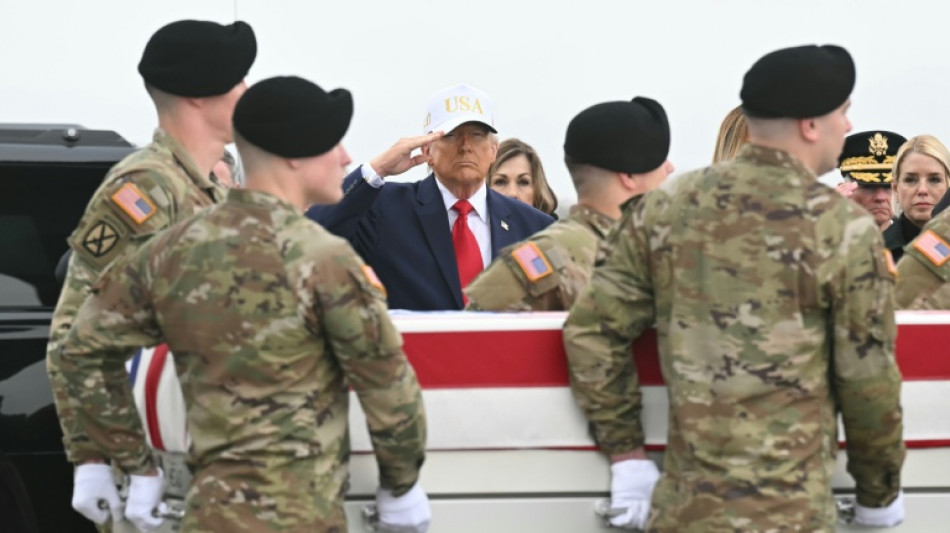
US, Israel see gap on Iran as Trump under pressure / Photo: © AFP
Ten days after attacking Iran together, the United States and Israel have seen a public divergence, with President Donald Trump facing political pressure and not sharing Israel's long-term goals.
The allies face a stark divide in how their publics view the war, with historically low support by Americans for an offensive enthusiastically backed by most Israelis.
With the price of oil spiking, a warning sign in US politics, Trump told CBS News on Monday that the war was "pretty much" over, despite his earlier vows with Prime Minister Benjamin Netanyahu to pursue weeks if not months of attacks.
US officials voiced unease after Tehran residents woke up Sunday to apocalyptic scenes of black smoke blocking out the sun and choking them, following Israeli attacks on fuel depots around the city of 10 million people.
Even Senator Lindsey Graham, a hawkish Republican ally of Trump who has urged war on Iran for years, called on Israel to "please be cautious about what targets you select."
"Our goal is to liberate the Iranian people in a fashion that does not cripple their chance to start a new and better life when this regime collapses," Graham wrote on X.
Michael Singh, managing director of the Washington Institute for Near East Policy, said that US and Israeli goals were mostly similar -- but not identical.
He said that Israel wants Iran, whose cleric-run government has championed Hamas, to be "permanently weakened" -- a strategy Israel has pursued across the region, notably in repeatedly bombing historic adversary Syria despite a change in government.
"The US may not have as much of an appetite for a long conflict, especially because we have priorities in other theaters that Israel obviously doesn't have, and we can pack up and go home whereas Israel can't," said Singh, who served as the top White House advisor on the Middle East under former president George W. Bush.
Both Netanyahu and Trump have spoken favorably of Iranians overthrowing the Islamic republic, which faces widespread opposition and ruthlessly suppressed protests in January, but neither has made it an explicit goal.
Trump -- who for years denounced US interventionism in the Middle East as wasteful and misguided -- has offered different explanations for attacking the country of 90 million people, mostly focusing on degrading its military.
But Secretary of State Marco Rubio raised eyebrows when he told reporters that the "imminent threat" faced by the United States -- a key legal threshold as Congress constitutionally has power to declare war -- was that Israel had already decided to attack Iran, which would have then retaliated against US forces.
- Growing partisan gap -
Israel retains strong support within Trump's Republican Party but the rival Democratic Party -- and a few prominent voices on the right -- have accused Trump of blindly following Israel into a regional war.
A Quinnipiac poll released Monday found that a narrow majority of Americans were against military action in Iran -- 53 percent, a striking level of opposition just days into a war -- and that 44 percent believed the United States was too supportive of Israel.
A recent Gallup poll found that for the first time more Americans sympathized with the Palestinians than the Israelis in their conflict, after Israel reduced Gaza to rubble in relentless bombardment following the October 7, 2023 attack by Hamas.
California Governor Gavin Newsom, considered a likely Democratic candidate for president in 2028, recently questioned US aid to Israel and agreed that its treatment of Palestinians showed it to be an "apartheid state" -- a charaterization strongly resented by Israelis and once unthinkable for a leading American political contender.
Aaron David Miller, a veteran US negotiator on the Middle East who is now a senior fellow at the Carnegie Endowment for International Peace, said Netanyahu has become even more dependent on Trump as Israel this year holds elections, in which the veteran prime minister will want to show he has the US president's support.
"When Donald Trump says stop, this is going to stop, no matter whether the Israelis feel it's mission accomplished or not, because the degree of leverage that Trump has over Netanyahu is unprecedented in the history of a presidents' relations with Israeli prime ministers," Miller said.
T.Hancock--TNT