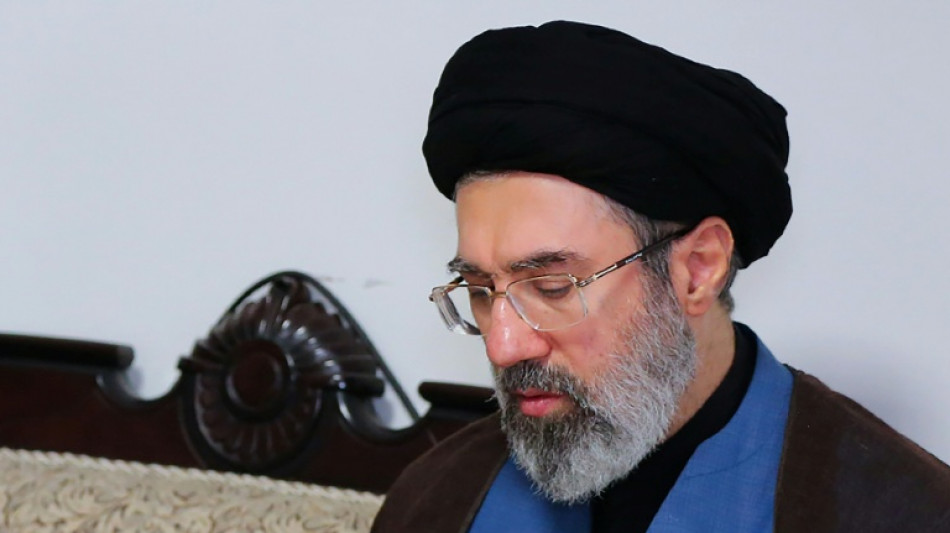
Khamenei's son takes charge as Iran war sends oil price soaring / Photo: © KHAMENEI.IR/AFP
Iran marked the appointment of Ayatollah Mojtaba Khamenei to replace his father as its new supreme leader with a barrage of missiles against Israel and the Gulf on Monday, as the war sent oil prices soaring.
As Iran entered its new era and the conflict its 10th day, world oil prices were already up by almost a third, Saudi Arabia intercepted drones targeting oil fields and Bahrain's state energy company warned after a missile strike that it may be unable to fulfil export contracts.
The United Arab Emirates and Kuwait also reported attacks, and Asian economies reacted quickly. The Japanese and South Korean stock markets closed down by more than five percent, Filipino motorists queued to fill their tanks and Vietnam prepared to scrap tariffs on fuel imports.
Iranian state media said the Assembly of Experts, Tehran's top clerical body, did not hesitate in choosing a new leader despite "the brutal aggression of the criminal America and the evil Zionist regime", then showed a missile ready for launch bearing the slogan "At your command, Sayyid Mojtaba".
Following strikes on Bahrain's sprawling Al Ma'ameer oil facility that ignited a fire and material damage, the country's state-owned energy company Bapco joined its counterparts in Qatar and Kuwait in declaring "force majeure" -- a warning that events beyond its control may lead it to miss export targets.
The war came weeks after Iranian authorities under Ayatollah Ali Khamenei crushed nationwide protests against the government, killing thousands according to rights groups.
The younger Khamenei, appointed to replace the cleric who led Iran for nearly four decades and who was killed in the first wave of US-Israeli strikes, is considered a fellow hardliner who will pursue his father's rejection of dissent.
US President Donald Trump had previously dismissed Mojtaba Khamenei as a "lightweight", and insisted again Sunday on ABC News before the announcement that: "If he doesn't get approval from us he's not going to last long."
- Oil price spikes -
As Iran retaliated against its oil-rich Gulf Arab neighbours, the benchmark price for a barrel of crude soared beyond $100 for the first time since Russia's invasion of Ukraine four years ago.
Trump dismissed the price spike, a politically sensitive issue in the United States, as a "small price to pay" for removing the alleged threat of Iran's nuclear programme.
In a sign that the United States does not expect a quick end to the war, the State Department ordered non-emergency staff to leave Saudi Arabia, days after a drone hit the US embassy.
As questions swirl over the length of the war, Trump told the Times of Israel that any decision on when to end hostilities will be a joint one with Israel's Prime Minister Benjamin Netanyahu.
"I think it's mutual... a little bit. We've been talking. I'll make a decision at the right time, but everything's going to be taken into account," Trump said.
Few expect major changes in Iran's stance under the younger Khamenei, a trained cleric close to Iran's powerful Islamic Revolutionary Guard Corps.
The Guards quickly pledged support for the new leader, who comes into the role with far less experience than his father, saying they were "ready for complete obedience and self-sacrifice in carrying out the divine commands".
Iran's allies and proxies also rushed to express support, with the powerful Badr organisation in Iraq saying the new leadership represents "blessed continuity of the path of the Islamic revolution".
- 'Fierce clashes' -
The multi-front war also intensified in Lebanon. Iran-backed militants Hezbollah said they were engaging Israeli forces who landed in eastern Lebanon on 15 helicopters across the Syrian border.
Hezbollah said combat was ongoing after its fighters "engaged the helicopters and the infiltrating force with appropriate weapons".
Lebanon's state-run National News Agency earlier reported "fierce clashes" around the town of Nabi Sheet, where an Israeli operation over the weekend killed 41 people.
Lebanon's health minister said Israeli strikes have killed at least 394 people since the start of the war, including 83 children and 42 women.
In Bahrain, the health ministry reported 32 people wounded overnight by an Iranian drone attack on the island of Sitra.
The wounded include a 17-year-old girl who suffered severe head and eye injuries, and a two-month-old baby, according to the ministry.
Saudi Arabia said Sunday that two people were killed and 12 wounded as a projectile landed in Al-Kharj province.
Iran's health ministry said Sunday that at least 1,200 civilians had been killed and around 10,000 wounded -- figures AFP could not independently verify.
In Israel, Iranian missile attacks have killed 10 people, according to authorities. Two soldiers were killed in Lebanon, the military said.
burs/hmn/dc/ser
F.Hughes--TNT