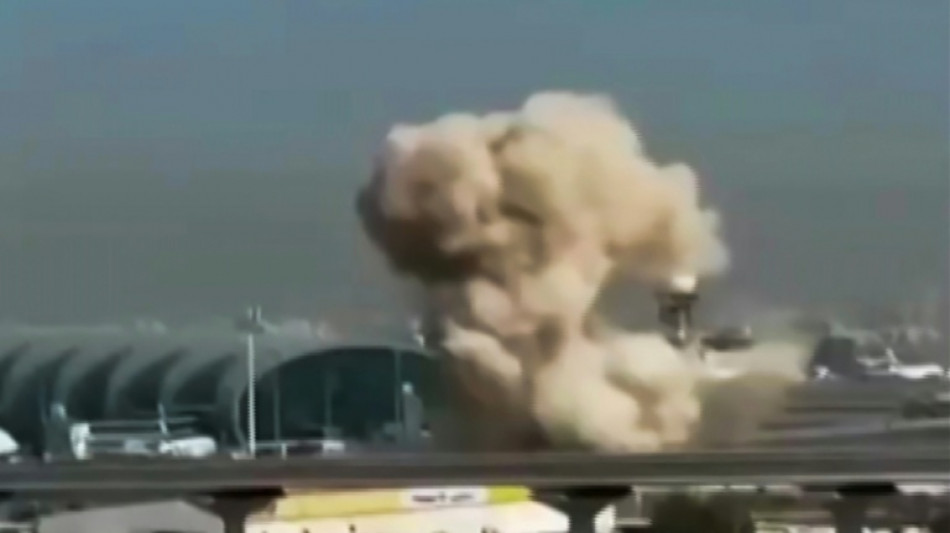
New attacks in Gulf as Iran vows for more / Photo: © UGC/AFP
Gulf nations on Saturday reported new missile and drone attacks, while Iran vowed to press on with strikes against neighbouring countries as the war entered its second week.
Loud explosions were heard in Dubai, the Qatari capital Doha and Bahrain's Manama, with attacks reported in the UAE, Saudi Arabia, Qatar and Kuwait, where the national oil company announced a "precautionary" cut to production.
The attacks came despite Iran's president earlier apologising to Gulf countries for earlier strikes. He had said they would no longer be targeted unless strikes were launched from their territory first.
Hours later, Iran said it would continue conducting strikes on sites in Gulf countries which were "at the disposal of the enemy".
UAE President Mohammed bin Zayed Al Nahyan said in a rare televised address that the Emirates were in "a period of war" and "will emerge stronger" from it.
Dubai authorities said Saturday evening one person had been killed by debris from an "aerial interception", adding they were a Pakistani national.
- Dubai airport closed, reopens -
Earlier in the day, Dubai closed its main airport -- the world's busiest for international traffic -- after authorities said an unidentified object was intercepted nearby.
A witness told AFP of a loud explosion in the area followed by a cloud of smoke, while footage authenticated by AFP recorded the sound of a drone followed by a loud explosion and plumes of smoke close to an airport concourse.
The government said there had been "a minor incident resulting from the fall of debris after an interception", without directly mentioning the airport. It said there were no injuries.
The Flightradar24 tracking website earlier showed planes circling above the airport in an apparent holding pattern.
In a statement since deleted from X, Emirates, the largest airline in the Middle East, had announced it was suspending all flights to and from Dubai until further notice, but later said it had resumed operations.
The UAE, a US ally and home to American military installations, has been the most heavily targeted nation in the Gulf during the war.
Earlier in the day, the Ministry of Defence said that of the 16 ballistic missiles fired at the country on Saturday, all but one had been intercepted, with that missile falling into the sea.
Of the 121 drones detected, 119 were brought down, while two fell within Emirati territory.
The barrage brings the number of ballistic missiles detected by the UAE since the start of the war last Saturday to 221, the defence ministry said, with the number of drones surpassing 1,300.
Flights from Dubai's main airport had partially resumed on Monday despite daily drone attacks targeting sites in the UAE.
Last Saturday, four employees were injured and an airport terminal damaged as the war broke out following US-Israeli strikes on Iran.
Iranian attacks have also hit Abu Dhabi airport, the upmarket Palm Jumeirah development and the Burj Al Arab luxury hotel over the past week, while drone debris caused a fire at the US consulate in Dubai on Tuesday.
- Base in Saudi Arabia targeted -
Elsewhere in the Gulf on Saturday, Qatar's defence ministry said its military had intercepted two missile attacks targeting the country.
Kuwait said Saturday night it had intercepted seven drones since dawn, with the attacks resulting "only in material damage from falling debris".
And Bahrain said it has intercepted and 92 missiles and 151 drones since the start of the "brutal Iranian aggression".
AFP journalists heard an explosion Saturday night in Manama, Bahrain's capital, as authorities said one person was injured after rocket shrapnel fell in a public street.
In Saudi Arabia, the defence ministry said it had destroyed three ballistic missiles heading towards Prince Sultan Air Base, which hosts American troops, as well as 17 drones over the Shaybah oil field in the southeast.
Kuwait also reported intercepting a drone, while the country's national oil company announced a "precautionary" cut to its production of crude due to Iranian attacks and threats to the Strait of Hormuz, a key transit point for Gulf hydrocarbons.
Further north, Jordan accused Iran of directly targeting sites in the kingdom, saying Tehran had fired 119 missiles and drones in the past week.
"These missiles and drones were targeting vital installations inside Jordan and were not passing through our territories," said military spokesman Brigadier General Mustafa Hayari.
A.M.James--TNT