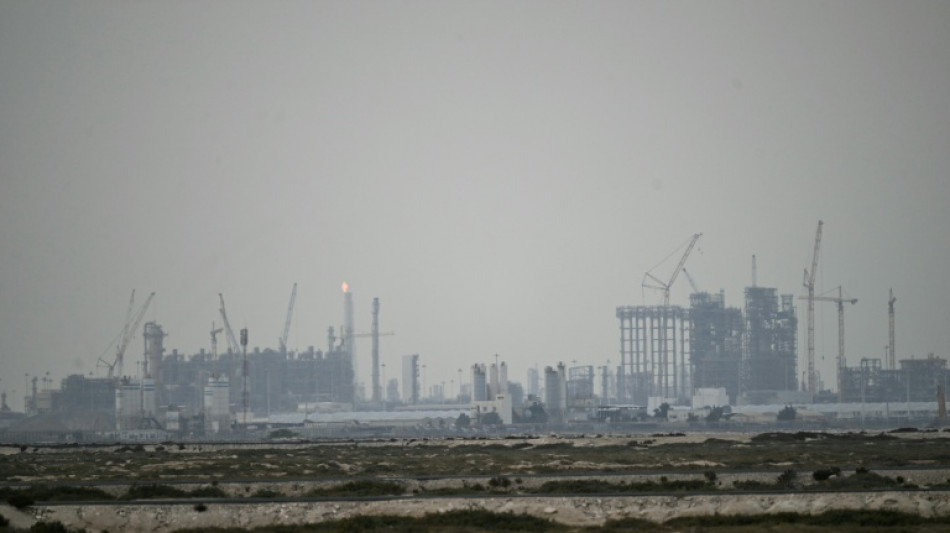
Mideast war rekindles European fears over soaring gas prices / Photo: © AFP
With shipping through the Strait of Hormuz nearly choked off due to the Middle East war, natural gas prices have spiked and Europe is worried that it will suffer a crisis like in 2022.
Europe is heavily dependent upon natural gas imports, and the Russian invasion of Ukraine led to a disruption of supplies via pipeline.
This led to a surge in the European natural gas reference price, Dutch TTF, which spent most of 2022 over 100 euros per megawatt hour.
The outbreak of the war, which has seen major liquified natural gas producer Qatar halt production due to a lack of transport ships, has seen Dutch TTF double in price to over 60 euros, before pulling back on Wednesday.
With prices returning to levels not seen since the start of 2023, European businesses are already reacting.
- Immediate effects -
"In certain industrial sectors, particularly chemicals," the conflict "is already leading to a slowdown in production," with companies preferring to reduce output rather than buy energy when prices are too high, a spokesperson for Uniden, the French trade association for energy‑intensive industries such chemicals, steel, and paper, told AFP.
Smaller firms face a "cash flow shock", said Marc Sanchez, head of the SDI trade association of small and medium-sized businesses in France.
In Germany, companies that do not have long-term energy contracts are "directly impacted by price fluctuations," said Wolfgang Niedermark of the BDI, the country’s main industrial federation.
For now, "there are no security of supply issues but prices and the aftermath remain a strong concern," said a source at the European Commission.
- Different situation from 2022 -
In 2022 Europe suffered economic disruption as severe as the 1973 oil shock.
That was primarily due to is heavy reliance on Russian natural gas delivered by pipeline, which was disrupted due to the conflict, including the destruction of a key conduit under the Baltic Sea.
At the time Europe had very limited infrastructure to import liquefied natural gas (LNG). But it has since developed sufficient facilities to offload the fuel from ships and inject it into distribution networks.
Europe was thus able to diversify its suppliers.
In 2025, the United States was the top LNG supplier, followed by Russia, while Qatar ranked third with eight percent of European LNG imports.
The European Commission source noted that a smaller share of EU gas imports now travel through the Strait of Hormuz, and gas demand has also dropped.
But the current crisis could drive up the cost of filling Europe's gas storage facilities for next winter.
Moreover, European gas storage facilities were only 30 percent full at the end of February, compared with 62 percent at the end of February 2024.
- Risk of a long conflict -
"The key question is how long the blockage lasts" of the Strait of Hormuz, said Laurent David, general manager of the trade association which unites most LNG importers.
LNG exports from Qatar and the United Arab Emirates, almost all of which pass through the key waterway, account for a fifth of global supplies.
Even if 90 percent of those supplies go to Asia, the longer the Strait of Hormuz remains blocked the fiercer competition will be for remaining supplies, causing a bidding war between Asian and European countries.
Before new gas liquefication facilities go online in 2027 there "are no alternatives" to replace supplies that transit the Strait of Hormuz, said David.
Meanwhile, Western Europe's largest gas producer, Norway, can't boost output.
"We're already producing at maximum capacity," Equinor spokesman Ola Morten Aanestad told AFP.
- The question of Russian gas -
The potential supply crisis comes at a difficult moment for the European Union, which intends to stop importing Russian LNG from the autumn of 2027 to deny Moscow another source of funding for its military campaign in Ukraine.
While the Commission says it intends to respect that calendar, the energy minister of Norway, which is not a member of the EU, believes a delay will become topical.
"They are very clear that they want to free themselves from Russian oil and gas," Terje Aasland was quoted as saying by Bloomberg.
"But with the situation we are in now geopolitically, it is clear that that debate -- I believe -- will emerge again," he added.
nal-adc-cda-kas/uh/rl/pdw
N.Taylor--TNT