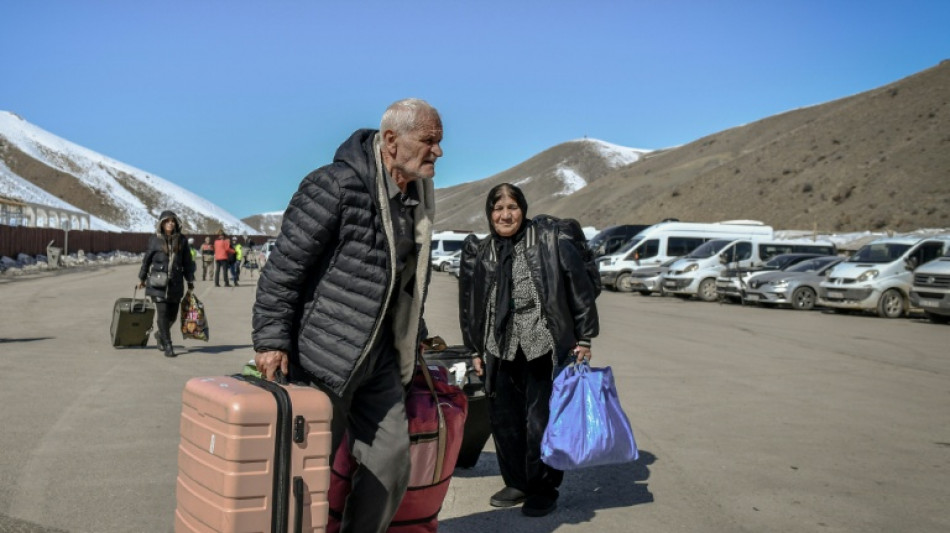
Iran war exiles describe terror of daily strikes / Photo: © AFP
Terrified travellers fleeing war in Iran for the safety of neighbouring countries have described the extent of US and Israeli air strikes around the country, which have pummelled many regional cities as well as the capital Tehran.
AFP spoke to Iranians as well as foreign students and traders at border crossings in Pakistan and Turkey, and was able to interview others trying to flee by phone or text messages despite widespread communication problems.
Taken together, their testimonies offer insight into the scale of the air campaign over the last five days that the US military claimed Wednesday was bigger than the so-called "shock and awe" campaign against Saddam Hussein's Iraq in 2003.
On the Turkish side of the Kapikoy-Razi border crossing, groups of travellers with large suitcases and children clutching teddy bears were trickling through the security checkpoint to seek shelter.
A woman from Tabriz, an economic hub in northwest Iran, reported a barrage of strikes around the city that had pushed her to leave her home and family.
"We sleep in fear and wake up with stress, so the situation is pretty awful," Sanaz, who gave only her first name, told AFP.
"After what we've been through all these years, we are hoping that maybe in two or three months' time, we will see major change in our country, politically, economically."
Around 2,000 kilometres away (1,250 miles) in the far east of the country, Pakistanis are flooding back to their country through the Taftan border crossing, sharing stories about a war none of them expected to be caught up in.
Basheer Ahmed, a 42-year-old trader, was returning from Bandar Abbas, a strategic naval city in southern Iran that lies just across from the Strait of Hormuz, a chokepoint of global shipping that Iran has effectively closed.
"The situation was very bad. There were five to 10 explosions during the day. We could not even tell where the bombs were coming from," he told AFP.
"The situation was extremely tense, and people were trying to leave the area by any means possible."
Fellow traveller Mushtaq Ahmed, 41, said he had passed through the central cities of Qom and Mashad in the east where he had witnessed pro-regime demonstrations.
"People were chanting and expressing their grief. It felt like a public holiday -- shops and offices were closed," he said.
- Fear and hope -
In the north of Iran, others are also trying to flee to Armenia, one of seven countries bordering Iran.
Shahid Rashid, an Indian student at a medical university in the western Iranian city of Urmia, told AFP by text message that he had seen "around eight strikes" 200 metres away from his hostel on Tuesday.
His university is providing free meals to those trapped in their lodgings because all local shops are closed.
With nothing to do other than wait for the Indian consulate to organise visas for Armenia -- as they did during a 12-day war between Iran and Israel last June -- he is hoping for a quick reaction.
"All I can say is we are depressed here because of the current situation -- and that situation is deteriorating," he added.
Israel and the United States launched military action against Iran last Saturday, killing supreme leader Ayatollah Ali Khamenei in one of the first missile salvoes.
The two countries have given different objectives for the war, from regime change to destroying Iran's nuclear and long-range missile programmes, as well as its navy.
According to the Iranian Red Crescent, the US and Israeli attacks have killed 787 people in Iran, a toll that could not be independently confirmed by AFP.
For her, the blasts were a source of fear, as well as hope.
"Even if you knew that you could get hit yourself, you were happy that they (the regime) would get what they deserve and that they won't be getting any sleep," she said.
burs-adp/jj
S.Collins--TNT