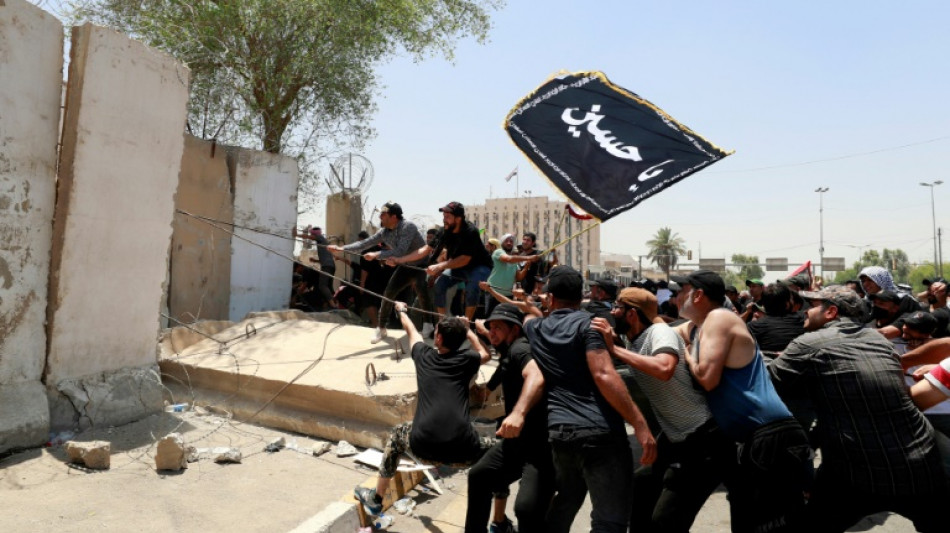
Pro-Sadr protesters occupy Iraq parliament again / Photo: © AFP
Supporters of powerful Iraqi cleric Moqtada Sadr penetrated Baghdad's heavily fortified "Green Zone" and occupied parliament on Saturday in a deepening political crisis.
It is the second time in days that Sadr supporters have forced their way in to the legislative chamber, months after elections that failed to lead to formation of a government.
Demonstrators waved Iraqi flags and pictures of the cleric inside the legislature, an AFP photographer said.
They entered after thousands of protesters had massed at the end of a bridge leading to the Green Zone before dozens tore down concrete barriers protecting it and ran inside, the photographer reported.
Security forces had fired tear gas near an entrance to the district, home to foreign embassies and other government buildings as well as parliament.
Some protesters on the bridge were injured and carried off by their fellow demonstrators.
"All the people are with you Sayyed Moqtada," the protesters chanted, using his title as a descendant of the Prophet Mohammed.
Sadr's bloc emerged from elections in October as the biggest parliamentary faction, but was still far short of a majority and, 10 months on, deadlock persists over the establishment of a new government.
Supporters of the populist Shiite cleric oppose the recently announced candidacy of Mohammed al-Sudani, a former minister and ex-provincial governor, who is the pro-Iran Coordination Framework's pick for premier.
The protests are the latest challenge for oil-rich Iraq, which remains mired in a political and a socio-economic crisis despite elevated global crude prices.
Saturday's demonstration comes three days after crowds of Sadr supporters breached the Green Zone despite volleys of tear gas fire from the police.
They occupied the parliament building, singing, dancing and taking selfies before leaving two hours later but only after Sadr told them to leave.
- 'Revolution' -
On Saturday, security forces shut off roads in the capital leading to the Green Zone with massive blocks of concrete.
"We are here for a revolution," said protester Haydar al-Lami.
"We don't want the corrupt; we don't want those who have been in power to return... since 2003, they have only brought us harm."
By convention, the post of prime minister goes to a leader from Iraq's Shiite majority.
Sadr, a former militia leader, had initially supported the idea of a majority government.
That would have sent his Shiite adversaries from the pro-Iran Coordination Framework into opposition.
The Coordination Framework draws lawmakers from former prime minister Nuri al-Maliki's party and the pro-Iran Fatah Alliance, the political arm of the Shiite-led former paramilitary group Hashed al-Shaabi.
But last month Sadr's 73 lawmakers quit in a move seen as seeking to pressure his rivals to fast-track the establishment of a government.
Sixty-four new lawmakers were sworn in later in June, making the pro-Iran bloc the largest in parliament.
That triggered the fury of Sadr's supporters, who according to a security source also ransacked the Baghdad office of Maliki's Daawa party on Friday night, as well as that of the Hikma movement of Ammar al-Hakim which is a part of the Coordination Framework.
"We would have liked them to wait until the government was formed to evaluate its performance, to give it a chance and to challenge it if it is not," Hakim said in a recent interview with BBC Arabic.
"The Sadrist movement has a problem with the idea that the Coordination Framework will form a government," he said.
"If it doesn't turn out to be Sudani and a second or third candidate is nominated, they would still object," he said.
C.Bell--TNT