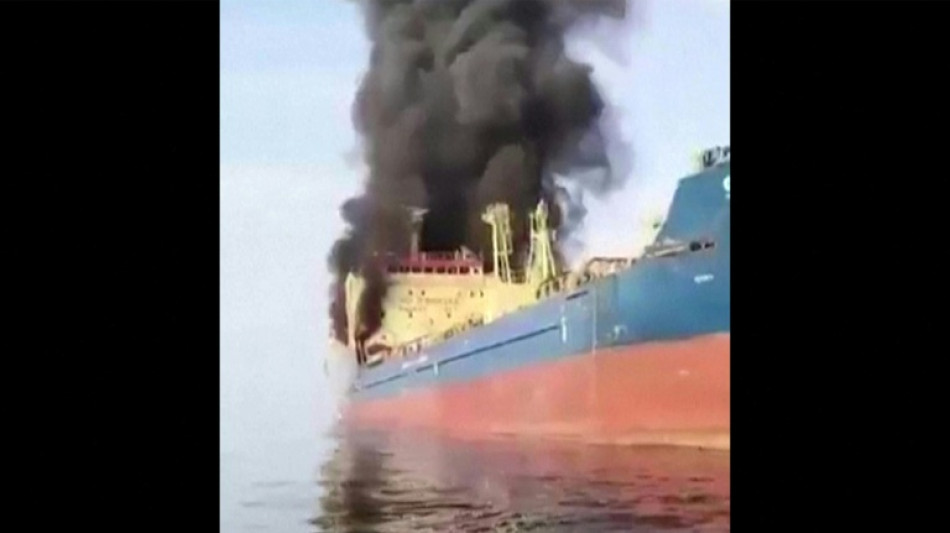
Will US oil companies be the big winners from the Iran war? / Photo: © UGC/AFP
Energy prices have surged dramatically since the United States and Israel launched their attack on Iran Saturday, and that will almost certainly translate into bigger profits.
But the question remains whether the new war in the Middle East also leads to increased oilfield investment.
- What does the Middle East war mean for US oil industry profits? -
Geopolitical crises lift oil industry profits if a supply disruption causes commodity prices to spike. That's what happened after Russia invaded Ukraine.
In the third quarter of 2022, ExxonMobil and Chevron reported more than $30 billion in profits between the two companies. The results were boosted by a surge in crude and natural gas prices.
Brent oil futures briefly surged above $85 a barrel Tuesday, while European natural gas prices reached their highest level in 2023.
These increases show the market's response to the effective shutdown of the Strait of Hormuz, a waterway accounting for some 20 percent of global crude supplies. The jump in the natural gas market is due to QatarEnergy's suspension of liquefied natural gas (LNG) production.
"Certainly, the producers get a benefit when prices go up like this," said Again Capital's John Kilduff. "This will definitely help their bottom lines."
The question is whether commodity prices will stay high.
- Will US companies invest to produce more oil and natural gas? -
Energy industry analysts don't expect companies to drill more wells or increase capital budgets unless they conclude the outages will be lengthy. Investments in projects that don't come online for months or years requires confidence prices will stay high.
"What US companies would need to see would be a sustained higher price," said Dan Pickering of Pickering Energy partners in Houston, who thinks oil prices could reach $100 a barrel if the Strait of Hormuz stays empty for a meaningful duration.
But such a lengthy outage is far from a sure thing.
President Donald Trump -- closely attuned to the political implications of gasoline prices ahead of mid-term elections -- said Tuesday that the US navy would escort oil tankers through the Strait of Hormuz if needed, and ordered Washington to provide insurance for shipping.
The announcement prompted a modest pullback in oil prices, which finished below session highs.
Oil prices could retreat further if the United States, China and other countries tap emergency stockpiles, said Ken Medlock, a fellow at the Baker Institute for Public Policy at Rice University in Houston.
Futures markets currently show oil prices retreating gradually in the second half of 2026, implying "the market is seeing it as a short-term" disruption, Medlock said.
- How much could US energy supply grow and where would investments go? -
While the US energy industry is poised to benefit from Middle East oil and gas outages, the United States "cannot simply 'flip a switch' to replace large, sudden Middle Eastern outages," said Brian Kessens, portfolio manager at Tortoise Capital.
Some elements of the petroleum industry have already benefited from the upheaval. Kessens said refined products dislocated by the Hormuz outage has boosted profit margins for Gulf Coast refiners.
Other short-term winners include LNG exporters who have capacity not committed in contracts.
Despite this, "meaningful incremental supply typically requires months to years," Kessens said.
Among the potential upstream oil and gas candidates, analysts said the most likely pick for incremental additional investment would be shale properties such as the Permian Basin in the US, where oil companies are already active and which have a shorter payback compared with other prospects.
"The focus would be on short-cycle, quick results activity. US shale, maybe a little bit of Venezuela," Pickering said. "Then it would move to longer-term projects like exploration and offshore."
G.Morris--TNT