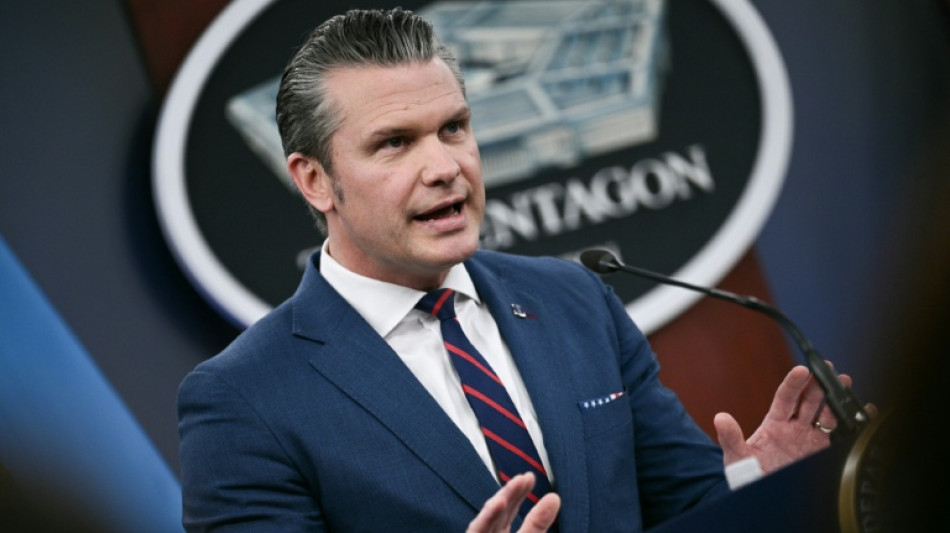
Can Anthropic survive taking on Trump's Pentagon? / Photo: © AFP
In an unprecedented dispute between the US government and a private business, Defense Secretary Pete Hegseth has declared AI company Anthropic a supply chain risk -- a measure usually reserved for companies from adversary nations, like China's Huawei.
The Pentagon is furious that Anthropic is insisting on certain conditions for the use of its technology -- no mass surveillance or fully autonomous weapons systems -- even as the military has been using the company's models for classified operations for more than two years.
Some believe the decision could destroy one of America's most high-profile companies in a unilateral act of corporate destruction.
- Will Anthropic survive this? -
The battle is bigger than the actual financial contract, which amounted to $200 million.
The existential threat is the supply chain designation, which means any company that works with the US military would have to prove it has no dealings with Anthropic.
Dean Ball, who helped craft the Trump administration's own AI policy, called the decision "corporate murder," warning that the message sent to every investor in America was unambiguous: do business on our terms, or we will end your business.
Anthropic has vowed to challenge the supply chain risk designation in court, calling it a "dangerous precedent for any American company that negotiates with the government."
Legal experts say the company has strong grounds, but the court process could take months or longer -- a serious vulnerability for a company that had hoped to go public this year and, given the fragile economics of the AI industry, must maintain investor confidence to survive.
Still, "Anthropic will suffer a setback when it loses the government as a client, but it will survive and continue to grow," Erik Gordon, a business professor at the University of Michigan, told AFP.
The company for now "has one of the best products," he said.
- Is this a win for OpenAI? -
Just hours after the US government banned Anthropic, rival OpenAI announced it had reached a deal for the Pentagon to use its AI models in classified systems.
OpenAI CEO Sam Altman said the agreement contains the same two limitations Anthropic had been insisting on.
But OpenAI appeared to enshrine these differently: while Anthropic tried to have the limits spelled out explicitly in the contract, OpenAI agreed that the Pentagon could use its technology for "any lawful purpose" -- a formulation Anthropic had refused.
OpenAI also says its technology will be cloud-only, preventing models from being embedded directly into weapons hardware, and that an engineer will be deployed to oversee classified use.
Critics are calling on OpenAI employees to quit or put pressure on their leadership to support its archrival Anthropic.
"OpenAI caved and framed it as not caving, and screwed Anthropic while framing it as helping them," said Miles Brundage, OpenAI's former head of policy research, on X.
- Silicon Valley's reaction -
The Trump administration's assault on Anthropic sent shockwaves across Silicon Valley, hardening political battle lines that have now divided the tech world.
Anthropic's most prominent antagonist is venture capitalist David Sacks, the White House's chief AI policymaker, who has long argued that the company's safety-first approach will slow innovation and cede ground to China.
He is closely aligned with Emil Michael, the Pentagon's de facto chief technology officer and a veteran of Uber during its most aggressive phase, when the company was known for its scorched-earth approach to entering new markets.
Coming out in support of Anthropic, hundreds of engineers at Google, Amazon, Microsoft and OpenAI signed petitions and open letters urging their leaders to refuse Pentagon demands for unrestricted AI use.
At the executive level the picture was more divided. No major tech company has publicly defended Anthropic, though several executives at competing firms, speaking anonymously in the media, expressed concern that the ban sets a dangerous precedent.
Elon Musk, by contrast, posted that "Anthropic hates Western Civilization," aligning publicly with the administration.
T.Bailey--TNT