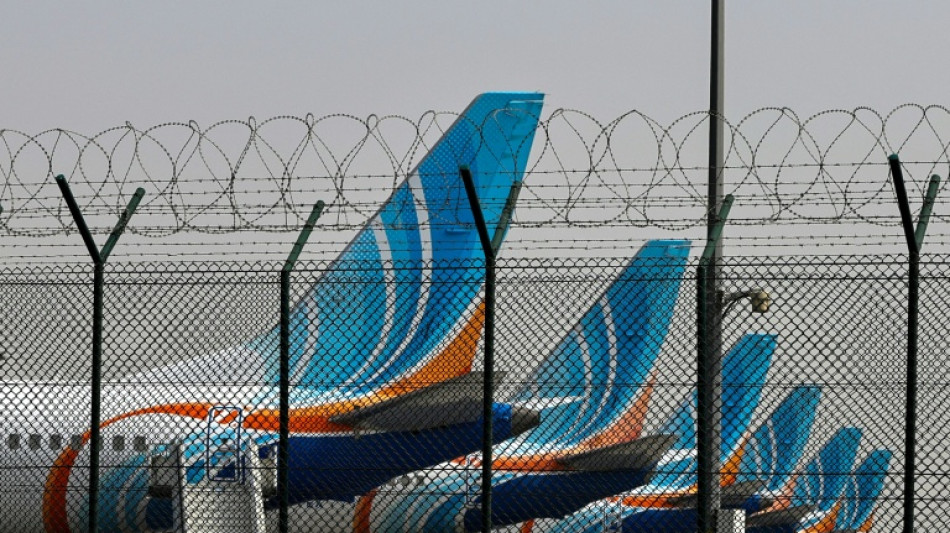
Iran war spells danger for global airlines / Photo: © AFP
Air routes closed, airports damaged and hundreds of thousands of passengers stranded: the new war in the Middle East has again highlighted the global aviation sector's vulnerability to geopolitical upheaval.
Much of the region's airspace has been shut after the US and Israeli attack on Iran and its retaliatory strikes in the region -- further disrupting a global air-traffic scene already complicated by Russia's war in Ukraine.
Dubai International Airport, Kuwait's main airport and a British military airbase in Cyprus were hit during Iran's response.
Iran, Iraq, Israel, Syria, Kuwait, Qatar and the United Arab Emirates all announced at least partial closures of their skies.
The International Air Transport Association (IATA) on Monday called on all sides to refrain from targeting civilian aircraft and airports.
For commercial airlines, the conflict raised memories of disasters such as that of Malaysia Airlines flight MH17, destroyed by a missile over Ukraine in 2014 with 298 people killed, or the Ukrainian Boeing accidentally shot down by Iran in 2020, killing 176.
"It is critical that states respect their obligation to keep civilians and civil aviation free from harm," said the head of IATA, Willie Walsh, head of the International Air Transport Association.
"We all hope for an early peaceful resolution to the current hostilities."
– Thousands of flights cancelled –
Dubai's airports announced they would resume limited flights on Monday evening but Air France said it was extending its suspension of flights to that and three other airports until March 5.
According to the aeronautical data provider Cirium, at least 1,560 inbound flights to the Middle East out of 3,779 were cancelled on Monday.
On Sunday, 2,000 cancellations were recorded out of 4,000 flights -- representing about 900,000 aircraft seats.
Beyond Iran, no civil aircraft were flying on Monday afternoon over the Emirates, Qatar, Kuwait or Iraq, according to the online mapping tool of the website Flightradar24.
The major air corridor over the Euphrates Valley in Iraq was empty.
Aircraft connecting Europe to Asia were flying either via the Gulf of Suez and then through central Saudi Arabia and Oman, or much further north through the narrow Armenia–Azerbaijan corridor.
These two countries, lying between Iran and the Russian Caucasus, have become essential to aviation since Russia's invasion of Ukraine in 2022.
Moscow barred Western and Japanese airlines from its airspace in retaliation for similar measures targeting its own carriers.
No-fly "red zones" have multiplied in recent years -- notably linked to the war in Gaza and clashes between Israel and Lebanon's Hezbollah, but also in Africa, Afghanistan and Pakistan.
"We have never been in such a difficult situation," Thierry Oriol, a senior representative of French airline pilots' union SNPL, told AFP.
"Even during the Cold War, everyone flew all over the place. There weren't all these no-fly zones."
- EasyJet cancellations -
The fallout from the conflict extended beyond the Gulf, with a British military airbase in Cyprus hit on Monday by an Iranian drone.
UK low-cost airline EasyJet later said it was cancelling three flights to Britain scheduled from the Mediterranean island, while Paphos Airport in the west was evacuated.
IATA says Middle Eastern airlines accounted for 9.5 percent of global air traffic last year.
Via hubs such as of Dubai and Doha, Gulf-based carriers such as Emirates, Etihad and Qatar Airways with their long‑haul fleets connect Europe and the Americas with Asia and Oceania.
With annual revenues exceeding a trillion dollar among its 360 airline members, IATA had forecast records in traffic and profits this year, with 5.2 billion passengers.
It warned on Monday that the war unleashed uncertainty over air traffic levels and -- crucially -- fuel costs.
S.Arnold--TNT