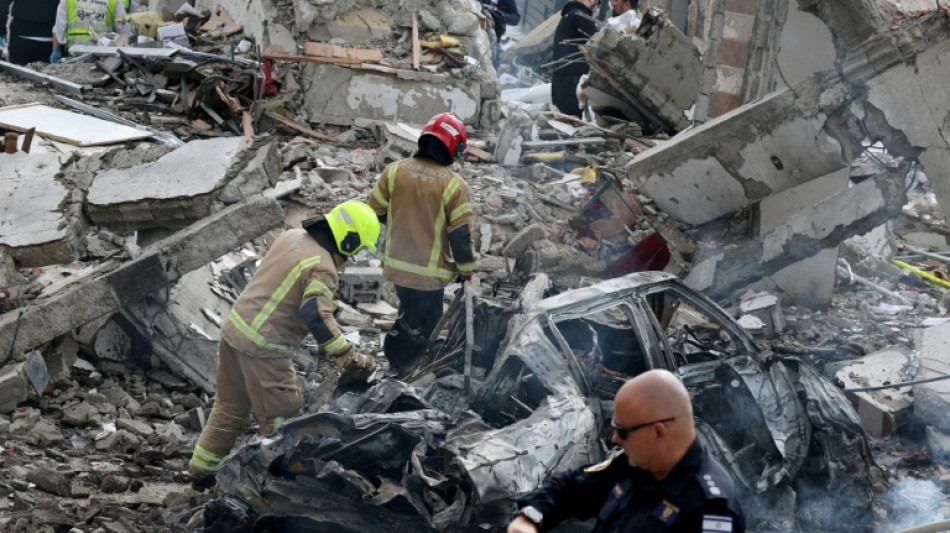
'A terrible day,' says Israel community shaken by deadly Iranian strike / Photo: © AFP
Ilana Malka doesn't know if her three great-nephews are alive after an Iranian missile struck a shelter in her city of Beit Shemesh, in central Israel, leaving a crater in the ground and a void in the community.
The building that housed the shelter was blown to bits by the hit, sending chunks of concrete large enough to destroy cars 50 metres (yards) away.
The missile hit the public protection centre while its door was still open to allow people in, Malka and other residents said, killing at least 9, injuring 46, and leaving 11 missing, according to the police.
"I heard about my three children, my brother's grandchildren, that they were there, and they didn't find them yet", 65-year-old Malka said, visibly shaken.
Her own house, about 100 metres from the shelter, lost most of its windows and bits of ceiling, while her garden was littered with oranges blown off a tree by the blast.
But she considers herself lucky, she said, as she would usually head to the public shelter when air raid sirens ring.
Tired from the previous day of war, she decided to head down to her own basement shelter, known as a mamal in Hebrew, which is not up to official standard norms and whose door was blown off by the blast around midday on Sunday.
"God helped me. Maybe he loves us. For sure, he loves us", she told AFP.
- 'Everyone knows everyone' -
Like Malka, most residents of the neighbourhood knew someone inside the public shelter.
"Beit Shemesh is a small town, so everyone knows everyone", Moshe Levy, a 52-year-old contractor, told AFP.
His sister moved their 88-year-old mother from the apartment he finished renovating last week just two hours before the strike.
Though not so close to the impact site, it sustained considerable damage including windows blasted out of their frames and holes in the roof.
"Here its just material damage, money can fix it all. There, money can't fix life", he said, sparing a thought for the members of his community who lost relatives.
The roof of his mother's building — like many others in the neighbourhood -- bore clues to the blast's centre: clay tiles broken or lifted on the side facing the shelter.
Closer to the site where the bombed building once stood, the streets were progressively more and more covered with debris of all sorts from the disintegrated shelter, chunks of clay tiles, wood from furniture, bits of cement and glass from windows.
Israel's sophisticated air defence systems have shot down many missiles fired from Iran, but Saturday's strike served as a stark reminder that interceptors do not provide guaranteed protection.
The war, which started on Saturday, intensified on Sunday as Tehran retaliated for the killing of its supreme leader, Ayatollah Ali Khamenei, with missile barrages against Israel, Gulf countries and US military assets across the region.
Ricki Ben David, a 56-year-old nurse, first feared for her grandchildren, who live below her.
"I wasn't panicked about myself. I wasn't afraid for myself as much as I was worried about my family members", she said.
"I know these people", she said of the strike victims, "people we know, neighbours, like family. It's simply a terrible day", Ben David said.
"We live together, we pray together in the synagogue, we see each other on holidays, we help one another", she added.
At the impact site, a fresh evergreen scent wafted through the air from cypress trees whose branches were blown off in the strike.
As night began to fall, search and rescue teams lit large floodlights to continue their search for the missing, while police and military officers dispersed the hundreds of onlookers for fear of another strike.
W.Baxter--TNT