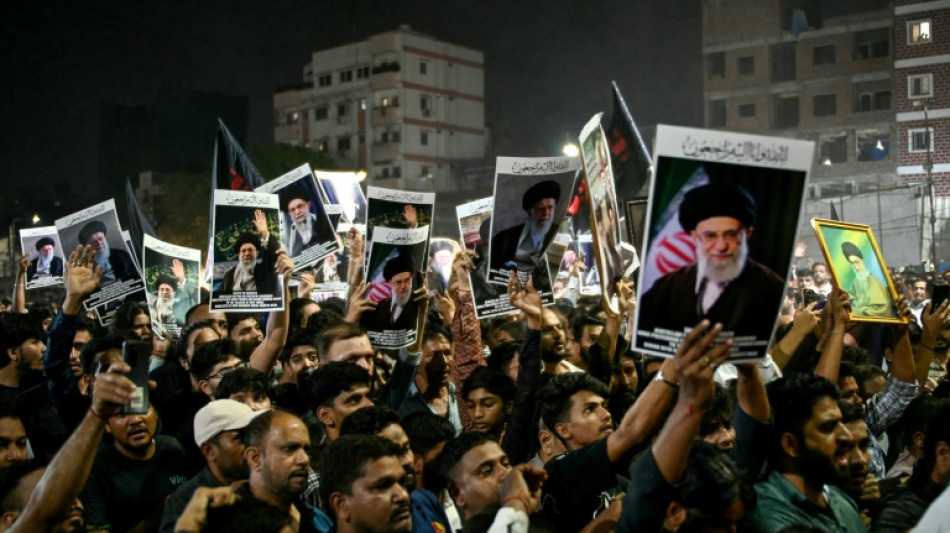
What future for Iranian leadership after Khamenei's death? / Photo: © AFP
The killing of Iran's supreme leader Ayatollah Ali Khamenei and the ongoing US-Israeli bombing campaign have ushered in a period of uncertainty for the country's leadership.
At the beginning of the air campaign, US President Donald Trump urged Iranians to seize power once it was over, having voiced support for mass protests against the clerical leadership that peaked in January before a deadly crackdown.
- Continuity for now -
Today "the country appears 'tightly controlled'," said Pierre Razoux, director of the Mediterranean Foundation for Strategic Studies (FMES), after the authorities in recent days closed universities, deployed security forces in cities and cut the internet.
"Everything is being done to prevent protests. As long as the public is not convinced that the repressive apparatus -- 600,000 Basij (volunteer paramilitary) and 250,000 internal security forces -- has been neutralised, they are unlikely to take to the streets again."
Iran's political system has procedures for the succession of the supreme leader, and his "removal does not mean the end" for a system with many centres of power and redundancies in place, Razoux told AFP.
He expected a scenario of "continuity of the regime with new rules of the game -- perhaps to the detriment of the clerics, but with the same people in charge".
Researcher Theo Nencini of Sciences Po Grenoble said: "The entire direction of the regime will depend on the choice of the new supreme leader."
In Venezuela in January, after US forces snatched president Nicolas Maduro, Vice President Delcy Rodriguez took charge with Trump's endorsement and the regime survived in return for concessions to Washington.
French-Iranian sociologist Azadeh Kian speculated to broadcaster Franceinfo that Trump might be "looking to come to an understanding with a more moderate wing of the regime".
Khamenei's killing "could give rise to significant rivalries within the circles of power between the Revolutionary Guards and the civilian leadership," she said, "But for now, they are all working together to keep the system in place".
- The Guards' moment? -
"The alternative is a takeover by the Pasdaran," the country's ideological army, the Islamic Revolutionary Guard Corps (IRGC), Razoux said.
While its commander Mohammad Pakpour was killed in Saturday's strikes, the IRGC remains an extremely well-organised force, with considerable influence in Iranian society, politics and the economy.
"In reality, the rebalancing of power in favour of the Revolutionary Guards has already happened" in recent years, Nencini said.
"But a transition towards a more militarised regime under their leadership is a possibility -- a more conventional military regime, without the current Shiite religious framework. Still, I find it hard to imagine them doing away with the religious veneer altogether," he added.
- The regular army -
With a force of 350,000 men, according to the specialist publication Military Balance 2026, Iran's army "does not carry political weight today, but it could still play a role in the future if the military decides to take a political direction different from that of the Guards", Nencini said.
Razoux said the Iranian army "may hold one of the keys, and its positioning will be crucial -- in relation to the population, the leadership and the Guards alike".
"There is no indication of its intentions. At the moment it is stretched thin, busy defending the country and trying to limit the damage," he added.
Moreover, in the event of a political shift, the armed forces will "need to demonstrate that they have fulfilled their role and carried out their mission".
The army could also rally behind another figure, but according to Nencini, there is "no credible political figure offering an alternative among the opposition".
- Fractured opposition -
The opposition inside Iran is repressed and imprisoned, illustrated by the case of jailed 2023 Nobel Peace Prize laureate Narges Mohammadi.
Opposition movements in exile have long been divided.
The deposed shah's eldest son, Reza Pahlavi, "is being promoted by Western media" and appears to be gaining in popularity, Nencini said, but his credibility in the eyes of people inside Iran remains unclear.
"There is a spectrum of opponents in Iran who could take action in the future," Kian said, also pointing to the emergence of demands from ethnic minorities such as the Kurds and Baluchis.
But for these groups to carry real weight, they would need to form "a coalition", she said, stressing that these minorities wouldn't accept submission to Pahlavi, who "lacks the structures and institutions necessary to come to power".
M.A.Walters--TNT