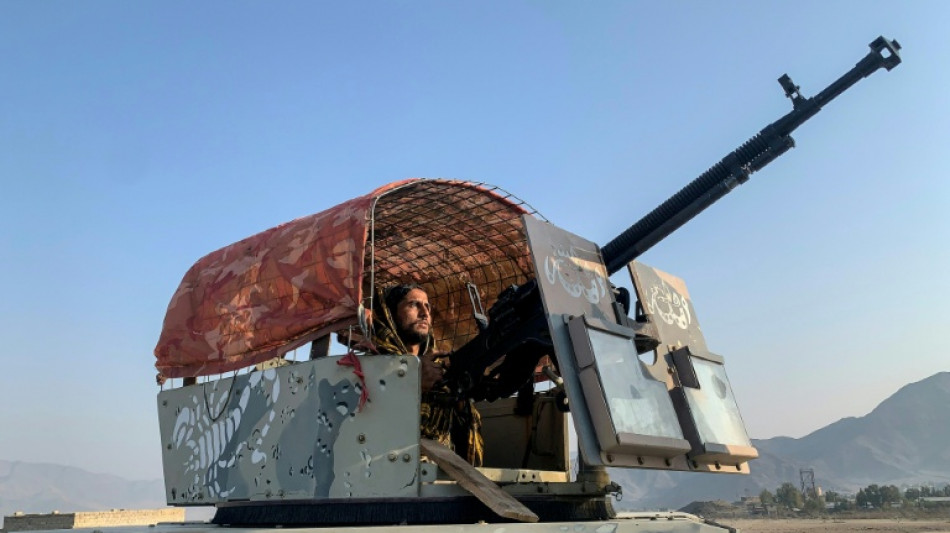
Afghanistan says civilians killed in Pakistan air strikes / Photo: © AFP
Afghanistan accused Pakistan of killing civilians in rural Kandahar on Saturday, as deadly violence flared between the South Asian neighbours.
Months of cross-border clashes escalated Thursday when Afghanistan launched an offensive along the frontier, with Pakistani forces hitting back on the border and from the skies.
On the road between the Afghan capital Kabul and the border, an AFP journalist in Jalalabad heard a jet and two explosions on Saturday. Afghan security forces said they had downed a Pakistani fighter jet and captured its pilot, which Islamabad denied as "totally untrue".
In rural southern Kandahar, construction workers said they were hit by two air strikes, which the manager of the site said killed three people.
"Everything went dark before our eyes," said 20-year-old Enamullah, who only gave one name. "I came from Kabul just to earn a piece of bread."
Pakistan acknowledged bombing key cities a day earlier including Kabul and Kandahar, which is home to Afghanistan's supreme leader. Islamabad has not commented on civilian casualties.
Afghan officials said Thursday's border offensive was a response to earlier air strikes that killed civilians, which Pakistan said targeted militants.
In addition to those killed in Kandahar, the Afghan government's deputy spokesman Hamdullah Fitrat said Pakistani fire has killed 30 civilians across eastern Khost, Kunar and Paktika provinces since Thursday.
Casualty claims from both sides are difficult to verify independently.
- 'Everyone just got out' -
On Saturday, residents in Paktika told AFP exchanges of fire were ongoing, while in Khost some people had fled their homes near the frontier.
"The bombardments started, children, women, everyone just got out," said Mohammad Rasool, 63, who had reached another district.
"Some didn't have shoes, some weren't veiled," he told AFP.
Diplomatic efforts have failed to secure a truce, with Saudi Arabia and Qatar engaged in efforts to halt the fighting. China said it was "working with" both countries and called for calm.
The United States backed "Pakistan's right to defend itself against Taliban attacks", Allison Hooker, the under secretary of state for political affairs, wrote on X after talks with her Pakistani counterpart.
Islamabad accuses Afghanistan of failing to act against militant groups that carry out attacks in Pakistan, which the Taliban government rejects.
Many attacks have been claimed by the Tehreek-e-Taliban Pakistan (TTP), a militant group that has stepped up assaults in Pakistan since 2021, the year the Taliban authorities returned to power in Kabul.
This week's escalation marked the first time that Pakistan has focused its air strikes on Afghan government facilities, analysts noted, a stark change from previous operations that it said targeted militants.
Mosharraf Zaidi, a spokesman for Pakistan's prime minister, told AFP that gunmen he said were associated with the Pakistani Taliban had attacked a checkpoint in the northwest. There was no immediate claim of responsibility for that attack.
"Pakistan's immediate and effective response to aggression continues," Zaidi said Friday, giving a figure of nearly 300 Afghan soldiers and militants killed.
- 'Open war' -
Pakistan's information minister said on Saturday that 37 locations across Afghanistan had been hit by air strikes since its operation began.
Islamabad said earlier 12 of its soldiers had been killed.
Fitrat, Afghanistan's deputy spokesman, said more than 80 Pakistani soldiers were killed and 27 military posts captured.
The Afghan government earlier put the death toll among its troops at 13.
The defence ministry in Kabul has also said it carried out air strikes on Pakistani territory over the past two days, which observers said could have been drones.
Islamabad declared "open war" on Friday against the Taliban authorities, while the Afghan government called for "dialogue" to resolve the conflict.
This month's violence is the worst since October fighting killed more than 70 people on both sides, with land borders between the neighbours largely shut since.
Several rounds of negotiations between Pakistan and Afghanistan last year followed a ceasefire brokered by Qatar and Turkey.
Saudi Arabia intervened this month after repeated breaches of the initial truce, mediating the release of three Pakistani soldiers captured by Afghanistan in October.
burs-pbt/rsc/ami
F.Adams--TNT