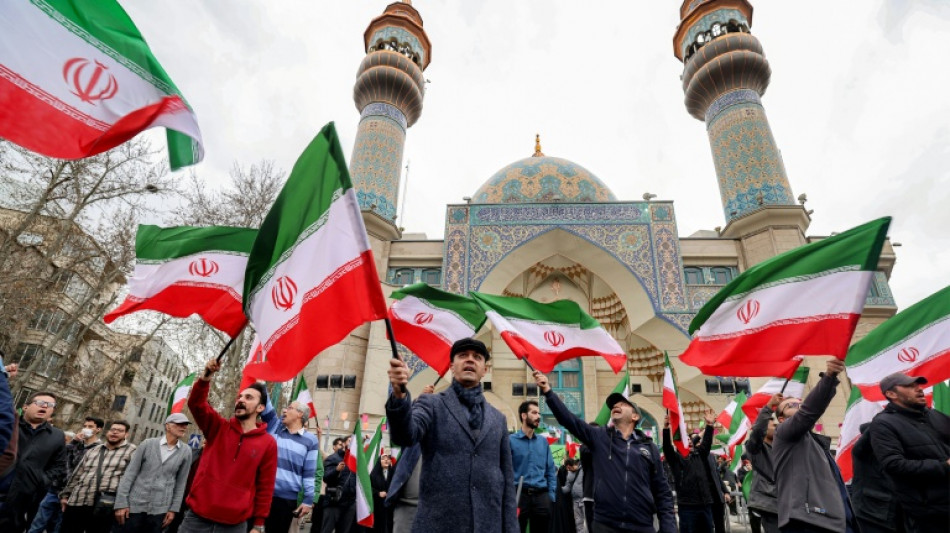
Streets empty and shops close as US strikes confirm Iranian fears / Photo: © AFP
For weeks, Iranians had been nervously anticipating another attack by the United States and Israel, despite Tehran and Washington holding negotiations aimed at averting a violent showdown.
Nevertheless, on Saturday morning just before the strikes, life in Tehran was moving at its usual pace, taxis and buses were inching through mid-morning traffic and people were running errands.
Then the routine was shattered by a series of detonations. Security forces flooded the streets and dark columns of smoke rose near the home of Iran's supreme leader, Ayatollah Ali Khamenei.
"I am hearing explosions and fighter jets overhead," one resident of central Tehran said at around 9:45 am local time, before communications and internet access were cut.
Within minutes of the attack, traffic-choked streets slowed and long queues formed outside bakeries and gas stations. Police and security forces were out in numbers.
Saturday is usually the start of Iran's working week, but many shops pulled down their shutters and few pedestrians risked going out, an AFP journalist saw.
From outside the capital, reports came in that targets had been hit in almost two thirds of Iran's provinces.
Loud screams could be heard in the background of media footage of the soot-covered debris from a school building hit in the southern province of Hormozgan.
As distraught people gathered at the site, the reported death toll rose to reach at least 51 students.
With US President Donald Trump urging Iranians to rise up against their leaders, rumours swirled over the status of Iran's senior military and political figures.
But state media was quick to insist that President Masoud Pezeshkian and Foreign Minister Abbas Araghchi and "all the commanders" of Iran's army were in good health.
One small demonstration took to the streets, covered by state media, with around 300 pro-government marchers convening on Tehran's Palestine square.
Beyond Tehran, explosions were reported in Kermanshah in the west, Isfahan in the centre and as far as Zahedan in the southeast.
In response, the Revolutionary Guards announced missile and drone strikes on Israel as well as on the US Fifth Fleet base in Bahrain.
Explosions were also reported over cities across the region, including in the United Arab Emirates, Saudi Arabia, Qatar, Kuwait, Iraq and Jordan.
Within Iran, the country's top security body, the Supreme National Security Council, said contingency plans were being activated.
Schools were ordered closed until further notice, while banks were to remain open and government offices would operate at half capacity.
Local media quoted officials as saying that food and fuel supplies were covered and that subway and bus services would continue operating as usual.
Saturday's attack came as Tehran and Washington were engaged in negotiations aimed at reaching a deal.
The strikes recalled the 12-day war in June, when Israel launched attacks just days before a planned sixth round of talks between Tehran and Washington.
Iranian authorities have anticipated the possibility of renewed conflict since last June's war, which officials said aimed to bring down the Islamic republic.
For many ordinary Iranians, tension had already been high following mass protests in late December triggered by economic hardship that left thousands dead.
Ahead of the strikes, social media users -- particularly on Instagram -- on Friday shared safety advice on what to do in the event of explosions or air strikes.
Following the attacks, the military's Khatam al-Anbiya Central Headquarters said operations "will continue without pause until the enemy's definitive defeat".
J.Sharp--TNT