Will the fight to succeed 'El Mencho' spark a new wave of Mexico violence? / Photo: © AFP
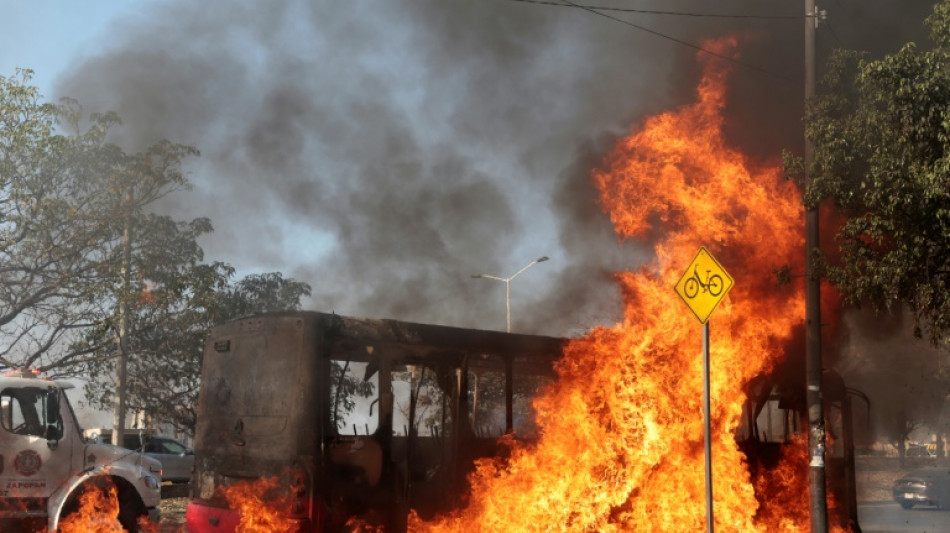
The killing of the head of the Jalisco New Generation Cartel (CJNG) by Mexican authorities on Sunday sparked widespread violence, with gang members opening fire on soldiers and setting up burning roadblocks in various parts of the country.
The killing of Nemesio Oseguera, also known as "El Mencho," constituted a victory for the government of President Claudia Sheinbaum.
Experts now warn that the true challenge is whether she can contain the inevitable fighting as the CJNG enters into a war over control of one of Mexico's largest criminal groups.
Elite Mexican soldiers supported by US intelligence agencies killed Oseguera on Sunday in Tapalpa, in the western state of Jalisco, where he was wounded while trying to flee. He died while en route to the hospital.
Experts say the cartel's response -- gunbattles, highway blockades, and the burning of cars, businesses, and banks in 20 out of Mexico's 32 states -- was not just revenge for the death of their leader.
It was a show of force.
- What can the cartel do? -
The cartel will have to fill the void left by "El Mencho," who managed the organization of more than 30,000 members with a vertical command structure and an iron fist, according to academic experts.
For Raul Benitez Manaut, a national security expert, the question is whether there will be an agreed-upon transition of power between the second-tier hierarchy of the cartel, or whether Sunday's violence will unleash a far larger internal war.
If the criminal organization carries out more choreographed acts like they did on Sunday, they will put the Mexican government and security forces in "far more awkward situations."
- Who will succeed 'El Mencho'? -
Oseguera's power within the CJNG was so established that many believe he could have named his successor to ensure the cohesion of the cartel.
In 2025, the US Treasury Department said that Julio Alberto Castillo Rodriguez, the son-in-law of "El Mencho," was "considered a possible successor to Oseguera."
Working through the industrial Pacific coast port of Manzanillo, Castillo has facilitated the entrance of precursor chemicals the cartel uses to produce fentanyl and other illicit drugs that are trafficked to the United States, the Treasury Department said at the time in a communique.
- Can the government contain the violence? -
The organization's violent response to the killing of its leader provoked widespread terror among the Mexican population.
"It was about sending a message to the Mexican government and rival cartels, saying 'we're still powerful, we're still strong,'" Mike Vigil, a former DEA agent, said.
They are warning that the killing of "El Mencho" will not weaken them, threatening their enemies to keep them from taking over their drug trafficking routes and territories, he added.
The government has been "taking precautions" by deploying thousands of soldiers to Jalisco and other states, according to the ex-DEA agent, who believes the Mexican military has the situation under control.
Manaut, the national security expert, suggested that the military should uproot the gangs from the Pacific coast, much of which is controlled by the CJNG, as well as the country's "central plateau," where they use two strategic highways that are key for both legal and illegal trade in western and northern Mexico.
The operation that ended the life of "El Mencho" was "a triumph for the military and the president, in the short term. But if they don't control the consequences, it can all backfire on them," Manaut warned.
G.Waters--TNT