DR Congo sanctuary resists bloody forest sell-off / Photo: © AFP
The soft singing of workers rings out at daybreak in the Congolese village of Romee, whose wooded haven is threatened by a scramble for forest land that has sparked deadly violence.
In one of the world's biggest and most precious forests, these locals have so far escaped the clutches of investors seizing concessions in the Democratic Republic of Congo's tropical wilderness -- a vital "green lung" in the face of climate change.
Totalling approximately 150 million hectares, DRC's forests are prized by buyers of forest concessions -- some for logging, others for contested carbon-offset programmes.
After four years of bureaucratic wrangling, villages making up the Yainyongo community, which includes Romee, in 2023 obtained two official concession titles, giving them control over 11,000 hectares of forest that they can now preserve in the northeastern Tshopo province.
Machete in hand, Romee resident Jean-Paul Bitilaongi rejoiced at their successful bid to keep the forest out of reach of the "rich people" he says are trying to plunder it.
"When they get here, they pay almost nothing," according to the young man. "They give maybe some soap, some salt, and (then) they take the land."
- Disappearing forests -
Although the Congolese state officially recognises indigenous communities' right to their ancestral territory, they struggle to impose this in the face of corruption when land concessions are granted.
Yet since 2014, the "community forestry" mechanism has allowed them to acquire their own concessions indefinitely -- each potentially stretching to up 50,000 hectares -- provided they are managed sustainably.
In Yainyongo, few residents seem aware of the concept of "sustainable" management, often seen as a harmful Western fancy.
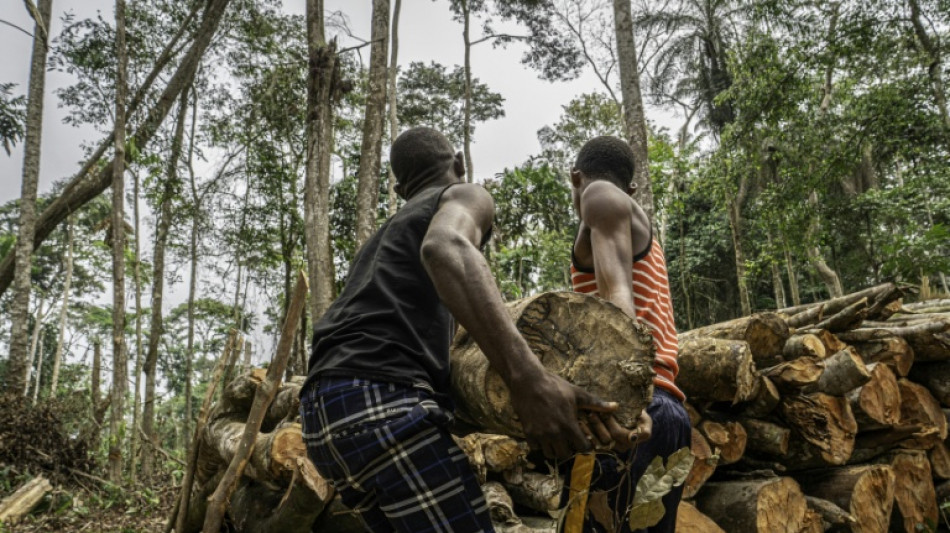
"Now we manage our forest the way we want," said Bitilaongi, standing by huge chopped-down trunks.
In the part of the forest they control, he and other Romee youngsters heave logs to be burned and turned into charcoal, then sent by canoe to the provincial capital Kisangani.
The trade fuels deforestation but is relied on by local communities, who earn 8,000 Congolese francs ($3) per sack.
The DRC lost 36 percent of its tree cover between 2004 and 2022, according to the observatory Global Forest Watch.
In recent years meanwhile, the DRC has seen a proliferation of carbon-offset projects.
- Carbon-offset complaints -
Under these arrangements, companies or brokers buy forest land to preserve it, so that by absorbing carbon from the atmosphere the land redeems or "offsets" the planet-warming emissions produced by firms' other activities.
The integrity and effectiveness of such schemes have been widely called into question in publications by climate researchers and campaigners.
Where local communities are concerned meanwhile, a study by the British NGO Rainforest Foundation UK (RFUK), published in October, revealed "widespread illegalities in project attribution, human rights violations and other impacts".
It indicated "a striking lack of respect" for communities' consent, with local people prevented from exploiting the trees in their forests.
In Yainyongo, by contrast, "the approach is not about stopping activities, but about doing them in a way that causes much less damage," said Paolo Cerruti, a researcher at the Centre for International Forestry Research (CIFOR), a science NGO supporting this community forest.
- Farming improvements -
In the village of Ikongo‑ecole, part of the community, trees have begun growing among the neatly aligned rice plants tended by local farmer Yuma Lokotomba -- a practice known to improve soil fertility and other growing conditions.
These techniques "produce far bigger harvests, and we have started cultivating the same field two or three times over", he said.
This marks a break from the traditional practice of shifting cultivation, which involves clearing a new patch of forest each year -- fuelling conflicts in a region facing rapid population growth.
"As land is not limitless, you will end up encroaching on someone else's," said Cerruti.
Maps pinned to the walls of his office in Kisangani show the relentless advance of farmland into the forest.
Vast polygons mark forest concessions covering 11 million hectares in the DRC, some of which exist only on paper.
- Community violence -
Many companies and even government bodies do not hold proper titles to the land they are exploiting, specialists say. Overlapping plots and jurisdictions trigger intractable land disputes.
Setting up the Yainyongo community forest required years of negotiations between communities and local landowners to define the boundaries of their respective concessions.
In 2025, Yainyongo was hit by a bloody conflict sparked in the neighbouring territory by the award of a logging concession to a Lebanese company on land shared by two local communities, the Mbole and the Lengola.
In this remote region, foreigners are rare and myths persistent.
Local politicians accused the Lengola of selling off their land, sparking a wave of killings.
Local people in Yainyongo were also targeted by the allegations due to their partnership with CIFOR.
"As the white people were always coming to see me, people claimed that I was the one who sold the forest," says Jerome Bitilaongi, the village elder and one of the initiators of the community‑forest project.
One morning, Mbole militiamen, armed with machetes, spears and arrows and laden with amulets, held Bitilaongi captive in his home.
"They took away valuables -- my radio, my phone, and forty head of livestock" from the village, he said, not daring to name those responsible.
Intervention by the governor and community mediation efforts restored a fragile peace to the area, but the instigators of the violence remain at large.
W.Phillips--TNT