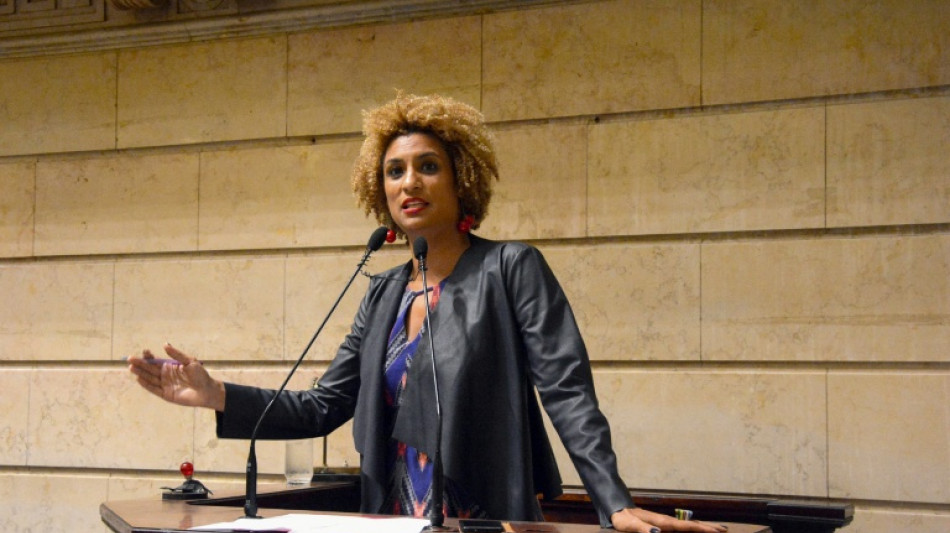
Brazil politicians convicted for ordering murder of black activist councilor / Photo: © Rio de Janeiro Municipal Chamber/AFP/File
Brazil's Supreme Court on Wednesday convicted two former lawmakers of ordering the 2018 assassination of Rio de Janeiro councilwoman Marielle Franco, a popular black activist whose murder exposed deep ties between politics and organized crime.
Franco, a lesbian activist who grew up in a favela and became an outspoken critic of Rio's powerful militia groups, was 38 when she was gunned down in the city center alongside her driver, Anderson Gomes.
The case sent shockwaves through Brazil and drew international condemnation.
The four-justice Supreme Court bench voted unanimously to convict former federal lawmaker Chiquinho Brazao, 62, and his brother Domingos, 60, a former state lawmaker, of ordering the hit on Franco.
They were each sentenced to 76 years and three months in jail for double aggravated homicide, armed criminal organization, and the attempted murder of one of Franco's advisors who survived the attack.
The court found that Franco had been targeted as she was a threat to the interests of the Brazao brothers.
From her position on the city council, Franco worked to prevent the expansion of clandestine housing developments in poor neighborhoods, one of the militias' biggest sources of income.
The Brazao brothers "didn't just have contact with the militia. They were the militia," Judge Alexandre de Moraes said in court.
Franco was murdered to deliver a "message" to Rio's political class, the court heard.
She was, said Moraes, "a black woman who dared to go against the interests of militia members, men, and white people."
Rio's militias emerged around four decades ago when former police officers and security agents created so-called self-defense groups to protect communities from drug gangs.
They quickly evolved into powerful criminal organizations -- controlling large parts of the city, extorting residents and seizing public land -- while benefiting from high-level political support.
- 'Cast the first stone' -
On Tuesday, the defense insisted on the Brazao brothers' innocence, while noting that links between local power and criminals were an open secret.
"Let he who is involved in politics in Rio and has never asked drug traffickers or militia members for votes cast the first stone," said Cleber Lopes, Chiquinho Brazao's lawyer.
Three other defendants were convicted over the masterminding of Franco's murder.
Rivaldo Barbosa, a former police commissioner who first led the investigation, was sentenced to 18 years for obstruction of justice and trying to protect the Brazao brothers.
Former military police officer and militia member Ronald Paulo de Alves was sentenced to 56 years for monitoring Franco's routine and reporting on her whereabouts on the night of her murder.
A former advisor to Domingos Brazao, Robson Calixto Fonseca, got nine years for acting as an intermediary between the defendants and militia members.
Two former military police officers who carried out the murders were given hefty jail terms in 2024.
The investigation into the masterminds was based on the plea testimony of one of them, Ronnie Lessa, who confessed to his role in the murder and was sentenced to 78 years in jail in 2024.
He said during his trial he was "blinded" and "driven crazy" by the prospect of a million-dollar reward for Franco's murder.
"This process has caused me great spiritual and psychological harm," said Justice Carmen Lucia, the only woman on the Supreme Court.
"How many Marielles will Brazil allow to be murdered?" the judge asked.
P.Barry--TNT