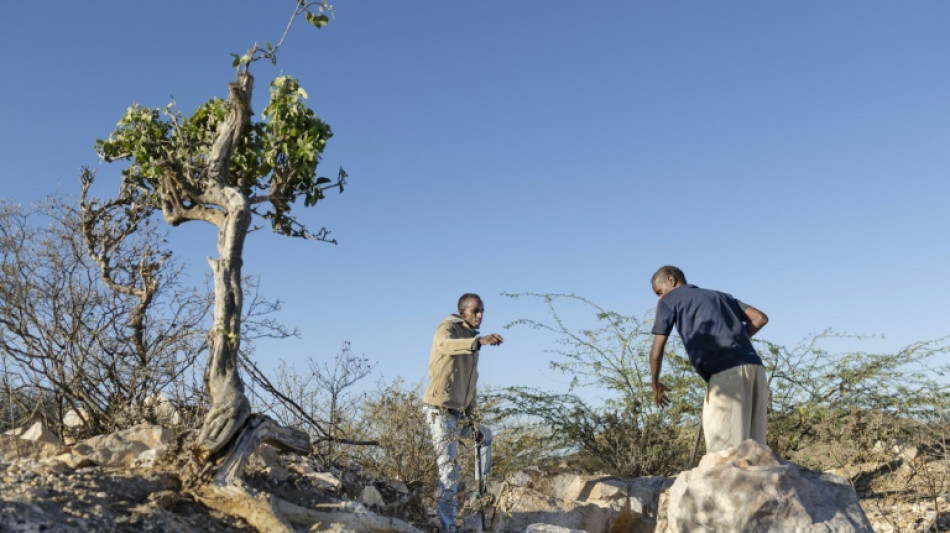
Somaliland pins hopes on critical mineral gold rush / Photo: © AFP
Armed with nothing but a crowbar and shovel in the hills of Somaliland, Ahmed Ibrahim hacks away at rocks where he and fellow miners have already found tonnes of lithium.
Officials in the breakaway territory of northern Somalia say there is an abundance of critical minerals in its ground, and potentially billions of barrels of oil, and they hope that Israel's move to recognise Somaliland's independence in December could unlock an influx of investment.
For now, mining is largely done in ways reminiscent of the United States' gold rush in the 19th century, when so many ended up exhausted in a futile hunt for treasure.
Ibrahim, 52, is a former surveyor in Somaliland's capital Hargeisa, who quit his job in 2015 to try his luck.
His very first day was an incredible success -- he says he found thousands of dollars' worth of diamonds and "completely forgot about the city".
"But ever since, I have been looking for that kind of money and I never found it," he told AFP.
Ibrahim now works at an artisanal mine near Gaeed-Deeble, two or three hours' bumpy drive from Hargeisa, with around 150 other workers.
He lives in a shack without running water and sees his family at best every six months.
An unwavering hope remains, but the abundant lithium ore in the surrounding rocks is not selling as it did a few years ago, despite demand for mobile phones and electric car batteries.
Oversupply has seen global prices fall. Ibrahim and his colleagues were selling the ore for $500 a tonne, but the Chinese traders who bought their past production have not returned since last August, and no one at the mine has been paid for six months.
"We adopted this rough life: no instruments, no electricity, no water. But we need more technology," Ibrahim said.
"We heard of the recognition from Israel. We hope Israel will support the production and supply us with more equipment."
- 'Game-changer' -
In December, Israel became the first to recognise Somaliland's independence since it seceded from Somalia in 1991, drawing angry condemnation from the federal government in Mogadishu, even though it has been self-governing for 35 years.
The recognition could help more companies come to work in the region.
"Previously we had (international) jurisdiction issues. Some companies were restricted by this jurisdiction," Ahmed Jama Barre, Somaliland's minister of energy and minerals, told AFP.
Israel's recognition should "unlock international investors," he said.
In addition to lithium, Somaliland is rich in tantalum and niobium -- critical minerals for electronics -- as well as gold, copper, and emeralds, according to the ministry, though quantities have yet to be verified.
Somaliland's President Abdirahman Mohamed Abdullahi, known as "Irro", has openly considered granting Israel privileged access to its minerals in recent weeks.
Minister to the presidency Khadar Hussein Abdi told AFP on Saturday that Somaliland, seeking further international recognition, was prepared to grant exclusive mining rights to the United States.
Livestock farming currently makes up 60 percent of Somaliland's economy, so minerals are expected to be "a game-changer and become the main pillar of our economy," said Barre, the energy minister.
- 'Like Dubai' -
Oil is another big hope.
Somaliland claims to have similar geology to Yemen and bills itself in a brochure as "one of the few highly prospective yet under-explored petroleum regions in the world".
US firms, including Chevron and Conoco, had begun exploring the region decades ago, but withdrew in 1989 during Somaliland's civil war against the Somali federal government.
Two companies, Britain's Genel and Taiwan's CPC, are scheduled to drill the first exploratory well in the first quarter of 2027, the government says. Neither company responded to AFP's inquiries.
Studies have shown Somaliland could have between one and nine billion barrels of oil.
"If we discover that, we'll be like Dubai," said Barre.
S.Lee--TNT