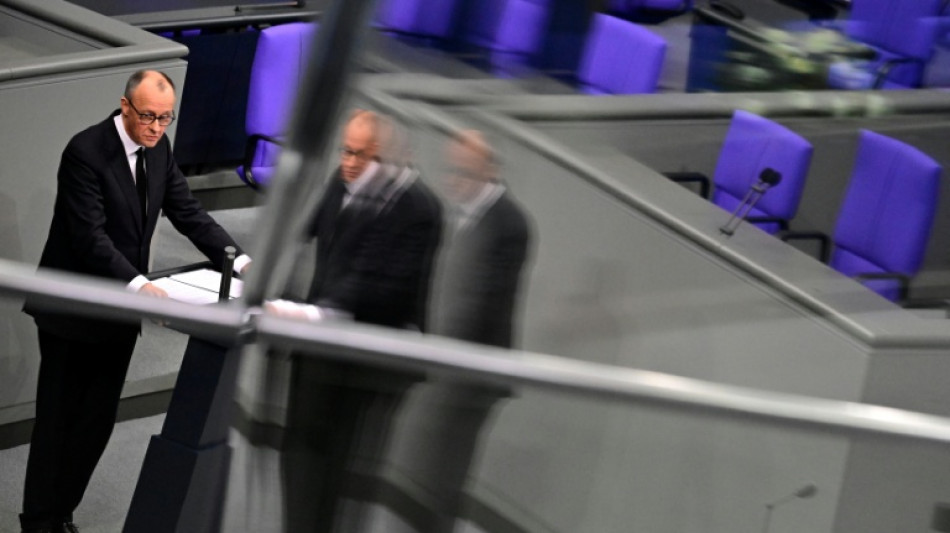
Germany's Merz heads to China for talks centred on trade / Photo: © AFP
German Chancellor Friedrich Merz left Tuesday for his inaugural visit to China, long a huge market for German goods but now a high-tech rival as Europe's biggest economy struggles.
Berlin and Beijing want to build on their decades-old economic ties at a time US President Donald Trump has sparked global chaos with his tariffs blitz and other erratic foreign policy moves.
But Merz is also expected to stress German and European interests in his talks Wednesday with President Xi Jinping, including by urging him to put pressure on its ally Russia to end the war in Ukraine.
Germany considers China, the world's number two economy, as a key trade and investment partner -- but also regards the communist one-party state as a systemic rival to the West.
Many commentators have taken note of the fact that Merz first travelled to India, the world's largest democracy, weeks before he headed to China.
Merz said Friday he was going to Beijing, with a large business delegation in tow, in part because export-dependent Germany needs "economic relations all over the world".
"But we should be under no illusions," he added, pointing out that China as a rival to the United States now "claims the right to define a new multilateral order according to its own rules".
China under Xi has grown far more assertive on the world stage, built up its military, stressed its claim on Taiwan, and pushed back strongly against criticism of its human rights record.
Flexing its muscle at times of tension, Beijing has restricted exports of critical minerals used in products from microchips and wind turbines to electric car batteries and weapons systems.
Last year, Beijing temporarily halted the export of Nexperia chips to Europe following a dispute with the Dutch government.
More broadly, European businesses complain that China, with its low domestic demand, is flooding Europe with goods made cheap through state subsidies and an undervalued currency.
Germany's trade deficit with China hit a record 89 billion euros ($105 billion) last year.
"China has risen to the ranks of the major powers," Merz said just before leaving Berlin Tuesday, stressing that "we want a partnership with China that is balanced, reliable, regulated and fair".
- 'Systemic competition' -
As Trump has unsettled allies and rivals alike, China has nonetheless also sought to present itself as a reliable partner and defender of the multilateral order.
China's top diplomat Wang Yi told Merz at the Munich Security Conference this month that Beijing hoped to bring ties "to a new level" and wanted Germany to be a "stabilising anchor for strategic relations" in the European Union.
As other nations also seek to rebalance their economic relations, the leaders of France, Britain and Canada all recently visited China, where Trump is expected from March 31.
Merz, like his predecessors Angela Merkel and Olaf Scholz, will be joined by business leaders including executives of auto giants Volkswagen, BMW and Mercedes.
In Beijing, Merz will first meet Prime Minister Li Qiang, then have talks and dinner with Xi.
On Thursday, Merz is to visit Beijing's Forbidden City, then a Mercedes plant where autonomously driving vehicles will be presented.
The chancellor then travels to Hangzhou, often called China's "Silicon Valley," to visit the robotics group Unitree and German turbine maker Siemens Energy.
German businesses have given Merz a to-do list on his trip.
"We expect the chancellor to clearly address problems such as overcapacity, distortions of competition, and export controls on critical raw materials," said Wolfgang Niedermark of the Federation of German Industries.
German and European companies in China are not only "competing with highly innovative Chinese firms" but are also players in a "state-driven systemic competition".
Merz should advocate for "structural reforms to strengthen domestic demand and fairer competitive conditions" in China, he said, warning that without change there will be "new trade conflicts with the EU".
E.Cox--TNT