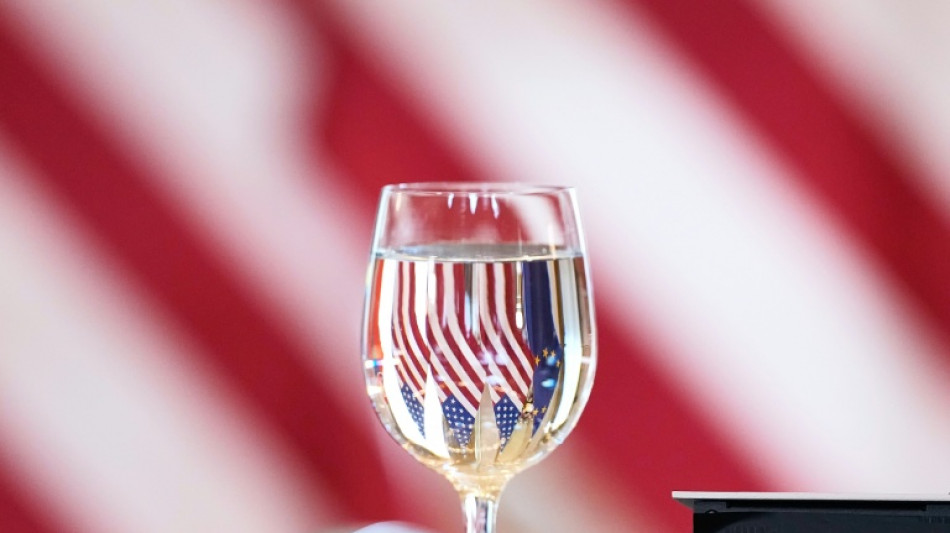
EU puts US trade deal on ice after Supreme Court ruling / Photo: © POOL/AFP/File
European Union lawmakers Monday put a key trade deal with the United States on hold, demanding clarity after a Supreme Court ruling struck down many of President Donald Trump's tariffs.
The move came as Trump warned that countries seeking to "play games" with tariffs risked much higher duties.
Uncertainty has gripped markets since the Supreme Court ruled Friday that Trump does not have the authority to impose tariffs under a 1977 law he has relied on -- to which Trump responded by imposing a new 15 percent global duty on a different legal basis.
That new threat raised worries in Brussels over its implications for the US trade deal struck last July, since European officials and lawmakers say EU goods could face higher duties than under the terms of the agreement.
Parliament negotiators backed putting the deal on ice until it is clearer what the US ruling means, postponing a vote that was due to take place Tuesday.
"We want to have clarity from the United States that they are respecting the deal," the committee head, Bernd Lange, said, adding the negotiators would meet again on March 4.
"In view of the current enormous uncertainty, a vote would not be justifiable," Green lawmaker Anna Cavazzini said.
- New Trump threat -
US Trade Representative Jamieson Greer told US media Sunday that deals with China, the EU and other partners will remain in force.
But European Commission spokesman Olof Gill said Brussels could not take further decisions until it had further clarity from the United States.
"We look forward to our American counterparts explaining to us precisely what is happening," Gill told reporters in Brussels.
After Friday's ruling, Trump responded first with a new 10 percent global duty on imports under a different legal authority, before raising it to 15 percent.
Trump has said the new duties are due to kick in on Tuesday, with exemptions for some products. They will expire in 150 days unless Congress extends them.
China on Monday urged the United States to cancel the unilateral tariffs, while several countries are studying the Supreme Court ruling and Trump's subsequent tariff announcements.
UK Prime Minister Keir Starmer's spokesman said Monday Britain did not expect the ruling to impact the majority of trade under its 2025 deal.
- Better the deal you know? -
Under the EU-US trade agreement, Washington had agreed a blanket 15-percent tariff on most goods from the bloc, but Trump's latest move could in reality see the EU face higher levies.
That is because the new duties would come on top of existing ones of a few percent, known as "most favoured nation" tariffs.
According to Jacob Funk Kirkegaard, senior fellow at the Peterson Institute for International Economics, this could mean most EU manufactured goods would now be subject to, on average, 17 or 18 percent tariffs instead of 15 percent.
"There continues to be potentially significant benefits for the EU to keeping the Turnberry agreement in place," he added, referring to the EU-US deal.
The Supreme Court ruling was a stunning rebuke to Trump from a judicial body that has largely sided with him since his return to office.
It marked a major political setback in striking down his signature economic policy that has roiled the global trade order.
Despite the uncertainty triggered, Kirkegaard said the overall situation for Europe -- and beyond -- was "much better" after the ruling.
"The Supreme Court has reduced Donald Trump's personal capacity to do tariffs by tweet," Kirkegaard told AFP. While tariffs can still be imposed, it would be through a process that would provide more predictability, he said.
burs-mya-raz/ec/rl
C.Stevenson--TNT