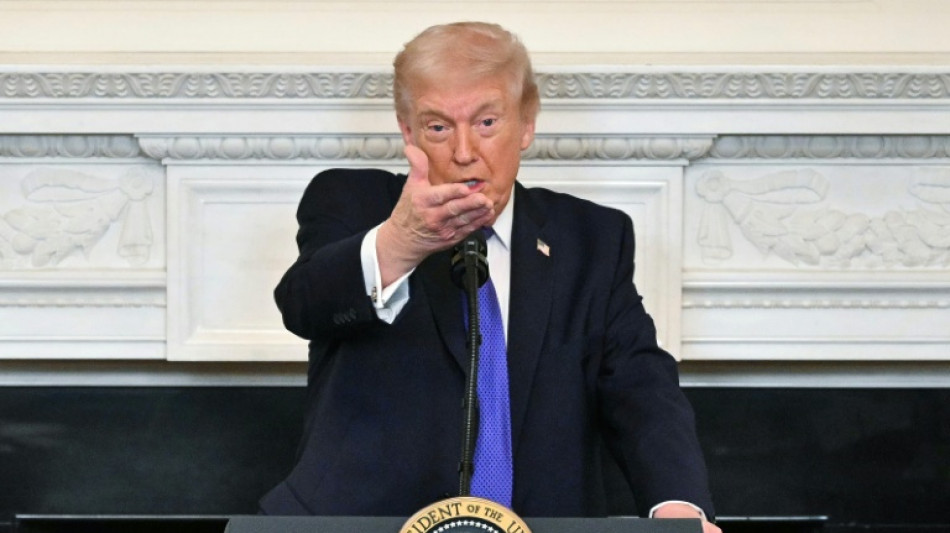
As US pressures Nigeria over Christians, what does Washington want? / Photo: © AFP
US President Donald Trump's decision to put Nigeria on a blacklist for religious freedom violations has sparked high-level talks between Abuja and Washington -- but what they can agree on remains to be seen.
Since Nigeria was labeled last year as a "Country of Particular Concern," a State Department designation that opens the door for sanctions, a "joint working group" has been set up, with talks held in Abuja in January led by Allison Hooker, the number three at the State Department.
A high-ranking Nigerian delegation came to the United States in 2025, and First Lady Remi Tinubu met with lawmakers earlier this month.
"Our two countries have made tremendous strides" in protecting "vulnerable communities here in Nigeria," Hooker said.
But she also said Nigeria "must do more to protect Christians" in a speech that did not mention Muslim victims of violence -- highlighting major gaps that remain between Washington and Abuja.
Trump has claimed the widespread insecurity in Africa's most populous nation amounts to "persecution" of Christians -- a framing rejected not just by Abuja but independent analysts, who point to a broader state failure to contain armed groups, including jihadists.
There are signs though that the governments could find common ground.
Earlier this month, Nigeria charged nine men over a massacre that left upward of 150 people dead in the mostly Christian village of Yelwata -- kickstarting a rare prosecution over mass killings in Nigeria's Middle Belt that often fall across religious and ethnic lines.
A recent statement from the Nigerian presidency struck a conciliatory tone, mentioning the need to protect "vulnerable populations in Nigeria, particularly Christian communities."
Meanwhile, Hooker said ensuring religious freedom would "enhance" opportunities to conduct "trade and economic deals."
- Competing camps -
Nigerian President Bola Tinubu for his part has managed to parlay diplomatic criticism into something palatable for both sides: military cooperation.
In December, with Nigerian support, the US struck militants in the northwest. Since then, the Pentagon has moved to increase intelligence sharing, expedite arms sales and send 200 troops to train their Nigerian counterparts.
Increased arms sales to Abuja could be a tough pill to swallow for separatists from Nigeria's mostly Christian southeast who, along with the US Christian right, have long lobbied the Trump administration over religious freedom concerns.
But Washington is similarly made of overlapping, sometimes competing, camps.
While the Trump administration runs the joint working group, the president also faces pressure from lawmakers in his party. Some, like Senator Ted Cruz, have staked out a hard line, accusing Nigerian officials of "facilitating the mass murder of Christians."
"We want to get them, even if it's reluctantly, to the point where they will protect the Christian communities and non-radical Muslims," Representative Chris Smith, chair of the House Africa subcommittee, told AFP, accusing Abuja of harboring a "culture of denial" toward Nigeria's rampant violence.
He and his House colleagues proposed their own demands for Nigeria's government in a recent bill: increase prosecutions; help internally displaced people, especially "persecuted Christian communities," return home; and repeal blasphemy laws.
Some asks could be contentious, such as the bill's demand that Washington sanction "Fulani-ethnic nomad militias" -- a vague term that could lead to the targeting of a mostly Muslim ethnic group, many of whom also find themselves victims of violence.
- CPC 'off ramp'? -
While some have described ongoing discussions as an "off ramp" to the CPC designation, others are skeptical Trump will ever lift it.
"It is not about facts or foreign relations implications, it is about virtue signaling to their base and showing how 'Christian values' are shaping foreign policy concerns," Matthew Page, a former State Department Africa analyst, told AFP.
And even if both sides are talking more, not everyone is listening.
When Remi Tinubu -- a Christian pastor married to Nigeria's Muslim president -- visited Washington this month, Smith declined to attend a dinner with her.
He was skeptical, the congressman said, that it would be nothing more than a "photo op."
F.Hughes--TNT