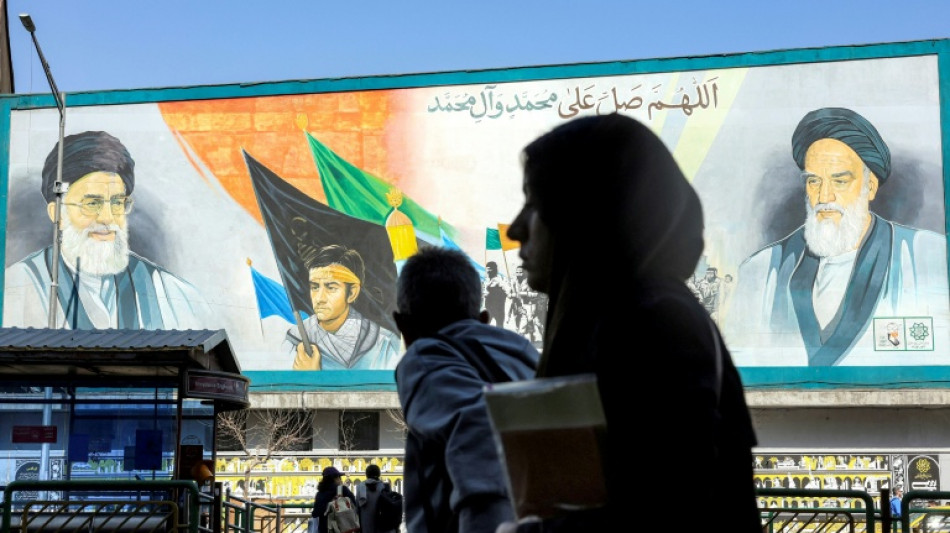
Iranian students chant anti-government slogans, as US threats loom / Photo: © AFP
Iranian students chanted anti-government slogans and scuffled with counter-protesters on Saturday in the latest display of anger at the country's clerical leaders, who also face a US military build-up aimed at pressuring them into a nuclear deal.
The gatherings at universities, which were reported by both local and diaspora media outlets, followed a mass protest movement that was met with a government crackdown last month that left thousands dead.
The crackdown had prompted US President Donald Trump to threaten to intervene militarily, though the focus of his threats eventually shifted to Iran's nuclear programme, which Western governments fear is aimed at producing a bomb.
The US and Iran recently resumed Oman-mediated talks aimed at securing a deal, but Washington has simultaneously increased its military presence in the region, dispatching two aircraft carriers, jets and weaponry to back its warnings.
Videos geolocated by AFP to Tehran's top engineering university showed fights breaking out in a crowd on Saturday as people shouted "bi sharaf", or "disgraceful" in Farsi.
Footage posted by the Persian-language TV channel Iran International, which is based outside the country, also showed a large crowd chanting anti-government slogans at Sharif University of Technology.
Iranians had reprised their protest slogans earlier this week to mark the 40th day since thousands of people were killed as a wave of demonstrations was peaking on January 8 and 9.
They gathered again at several universities in the capital on Saturday, local media reported.
The unrest first broke out in December over prolonged financial strain, but exploded into mass anti-government demonstrations that were suppressed in a violent crackdown by security forces.
The clerical authorities acknowledge more than 3,000 deaths, but say the violence was caused by "terrorist acts" fuelled by Iran's enemies.
The US-based Human Rights Activists News Agency (HRANA), however, has recorded more than 7,000 killings in the crackdown, the vast majority protesters, though the toll may be far higher.
Iranian authorities had initially acknowledged the legitimacy of the protesters' economic demands, but as the movement took on an overtly anti-government tone, they accused archenemies the United States and Israel of whipping up "riots".
Local news outlet Fars said that what was supposed to be a "silent and peaceful sit-in" on Saturday of students commemorating those killed was disrupted by people chanting slogans including "death to the dictator" -- a reference to Iran's supreme leader.
A video posted by Fars showed a group chanting and waving Iranian flags facing off with a crowd wearing masks and being held back by men in suits.
Both groups were holding what appeared to be memorial photographs.
- Talks and threats -
Ever since the initial wave of protests, the United States and Iran have been trading threats of military action.
Trump sent the aircraft carrier USS Abraham Lincoln to the region, accompanied by a flotilla of 12 support ships, while a second carrier group attached to the USS Gerald R Ford is en route to the area via the Mediterranean.
The US has also redeployed dozens of other warplanes to the Middle East -- where it maintains several bases -- while boosting its land-based air defences.
The build-up is aimed at pressuring Iran's authorities to cut a deal on the country's nuclear programme, even as the two sides have pursued talks on the subject.
Iranian Foreign Minister Abbas Araghchi told US media this week that following the latest round of negotiations in Geneva, Iran would be submitting a draft proposal for an agreement, saying "in the next two, three days, that would be ready".
Araghchi also said the "US side has not asked for zero enrichment" of uranium, contradicting statements from American officials.
Trump had suggested on Thursday that "bad things" would happen if Tehran did not strike a deal within 10 days, a period which he subsequently extended to 15.
Iran denies it is trying to produce nuclear weapons and says its programme is peaceful, but insists on its right to enrich uranium for civilian purposes.
The US media outlet Axios reported this week, citing an unnamed senior US official, that the US was prepared to consider a proposed deal that only permitted "small, token enrichment".
A previous round of nuclear diplomacy between the US and Iran last year was interrupted by Israel's surprise bombing campaign against the Islamic republic.
The United States ultimately joined its ally, striking key nuclear facilities before declaring a ceasefire.
burs-sw/smw/dc
V.Allen--TNT