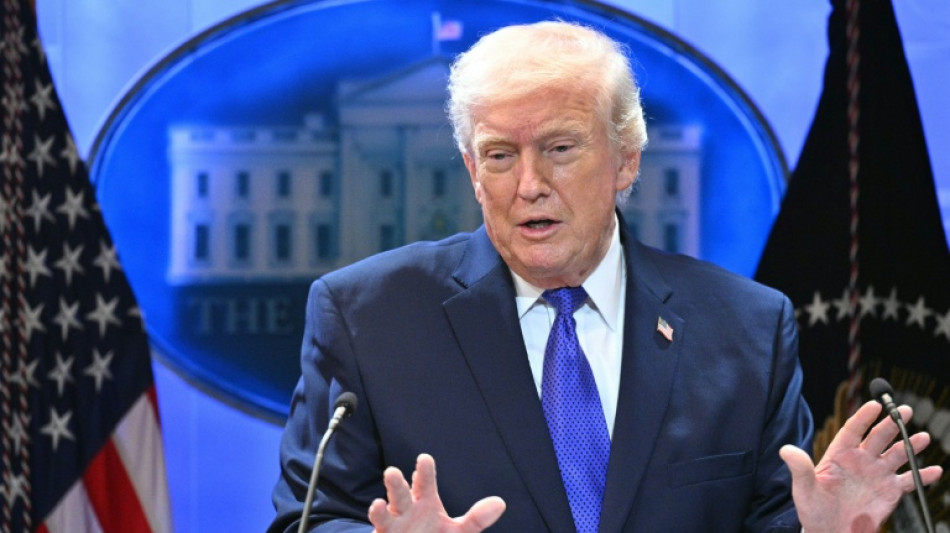
Trump imposes 10% global tariff after stinging court rebuke / Photo: © AFP
President Donald Trump imposed Friday an additional 10 percent tariff on imports into the United States after the Supreme Court struck down many of his sweeping and often arbitrary duties, delivering a stinging rebuke on his signature economic policy.
Trump signed the tariff order in the Oval Office -- saying on social media it was "effective almost immediately" -- after he spent the past year imposing various rates spontaneously to cajole and punish countries, both friend and foe.
The conservative-majority high court ruled six to three Friday that a 1977 law Trump has relied on to slap sudden rates on individual countries, upending global trade, "does not authorize the President to impose tariffs."
Trump, who had nominated two of the justices who repudiated him, responded furiously, alleging without any evidence that the court was influenced by foreign interests.
"I'm ashamed of certain members of the court, absolutely ashamed, for not having the courage to do what's right for our country," Trump told reporters.
"In order to protect our country, a president can actually charge more tariffs than I was charging in the past," Trump said, insisting that the ruling left him "more powerful."
Treasury Secretary Scott Bessent, addressing the Economic Club of Dallas, said the alternative method "will result in virtually unchanged tariff revenue in 2026."
- Major setback -
The ruling did not impact sector-specific duties Trump separately imposed on steel, aluminum and various other goods. Government probes still underway could lead to additional sectoral tariffs.
Still, it marked Trump's biggest defeat at the Supreme Court since returning to the White House 13 months ago.
The court has generally expanded his power. In a controversial decision before the 2024 election it ruled in Trump v. United States that he was immune from prosecution for "official acts" during his first term, when he refused to accept defeat.
The justices ruled Friday that "had Congress intended to convey the distinct and extraordinary power to impose tariffs" through the 1977 law, the International Emergency Economic Powers Act, "it would have done so expressly, as it consistently has in other tariff statutes."
"IEEPA contains no reference to tariffs or duties," Chief Justice John Roberts said in his opinion.
Wall Street saw share prices rise modestly after the decision, which had been expected.
Business groups largely cheered the ruling, with the National Retail Federation saying this "provides much-needed certainty" for companies.
- Doubts on refunds -
The Trump administration in court arguments said companies would receive refunds if the tariffs were deemed unlawful. But the ruling did not address the issue.
Trump said he expected years of litigation on whether to provide refunds. Justice Brett Kavanaugh, the one Trump nominee to side with him, noted the refund process could be a "mess."
The University of Pennsylvania's Penn Wharton Budget Model projected that the court decision on tariffs would generate up to $175 billion in refunds.
California Governor Gavin Newsom, who is widely expected to seek the Democratic presidential nomination in 2028, said Americans deserved refunds from the "illegal cash grab."
"Every dollar unlawfully taken must be refunded immediately — with interest. Cough up!"
But Elizabeth Warren, the top Democrat on the Senate Banking Committee, cautioned there remained "no legal mechanism for consumers and many small businesses to recoup the money they have already paid."
The Budget Lab at Yale University estimates consumers face an average effective tariff rate of 9.1 percent with Friday's decision, down from 16.9 percent.
The rate "remains the highest since 1946," excluding 2025, it said.
Close US trading partners including the European Union and Britain said they were studying the decision.
Trump, in response to a question, suggested trade deals negotiated with individual countries would remain in place, specifically mentioning India.
Canada, which has faced repeated tariff threats as Trump questioned the sovereignty of the northern neighbor, said the Supreme Court showed the levies were "unjustified," but the country braced for more turbulence.
"Canada should prepare for new, blunter mechanisms to be used to reassert trade pressure, potentially with broader and more disruptive effects," said Candace Laing, president of the Canadian Chamber of Commerce.
A.M.James--TNT