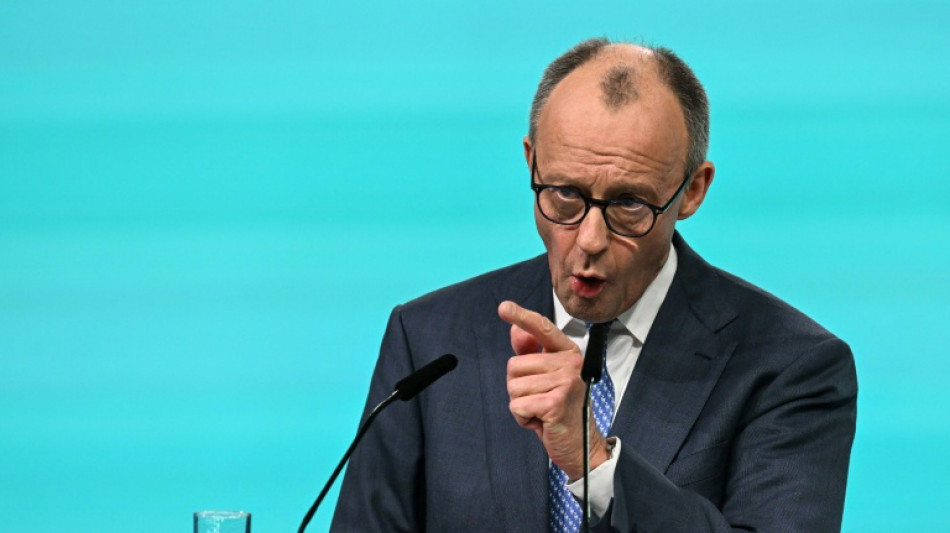
Germany's Merz to visit China next week / Photo: © AFP
German Chancellor Friedrich Merz will visit China next week for talks with President Xi Jinping centred on trade between the top EU economy and the Asian giant, Berlin said.
The visit, the conservative leader's first to China since taking office last May, will be just after Lunar New Year festivities, his spokesman Sebastian Hille pointed out Friday, calling this "a good omen".
China's top diplomat Wang Yi told Merz at the Munich Security Conference last week that Beijing hoped to bring ties "to a new level" and wanted Germany to be a "stabilising anchor for strategic relations".
Merz leaves Berlin Tuesday and is scheduled to be welcomed with military honours on Wednesday in Beijing by Prime Minister Li Qiang before later meeting Xi for talks and a dinner, Hille said.
During the two-day visit, Merz will also visit Beijing's Forbidden City and German car company Mercedes-Benz. He then travels to Hangzhou to visit Chinese robotics firm Unitree and German turbine-maker Siemens Energy.
Hille said Merz would travel with a delegation of business leaders, but without yet naming the companies.
The talks between the leaders of China, the world's number two economy, and Germany, the third-biggest, come at a critical time for Germany, whose car makers and other companies are increasingly reeling from intense Chinese competition.
The countries' traditionally deep economic ties have frayed in recent years over issues ranging from claims of unfair trade practices to protectionism and the supply of critical minerals.
- 'No illusions' -
The visit comes as US President Donald Trump, with his unpredictable foreign- and trade-policy manoeuvres, has upset traditional allies and threatened to upend the international order.
Merz said Friday he was going to China in part because export-dependent Germany needs "economic relations all over the world".
"But we should be under no illusions," he added, pointing out that the one-party state has its own global ambitions and political beliefs.
"China today sees itself in stark contrast to the US and claims the right to define a new multilateral order according to its own rules," Merz told a congress of his CDU party.
He said that when it comes to freedom of opinion, religion and the press, Beijing considers human-rights advocacy "as interference in its internal affairs".
Hille, asked earlier if sensitive rights questions would be up for discussion, said it could be assumed Merz would "of course discuss the whole spectrum of issues".
Another point of contention will be the Ukraine war, where Germany has been a strong backer of Kyiv since the start of Russia's full-scale invasion four years ago next week.
China and Russia are close partners, and while Beijing has said it takes a neutral stance on the Ukraine war, it has never condemned the invasion.
Germany's foreign minister Johann Wadephul visited Beijing in December, pressing Chinese officials including Wang to use their influence to help end Russia's war in Ukraine.
P.Jones--TNT