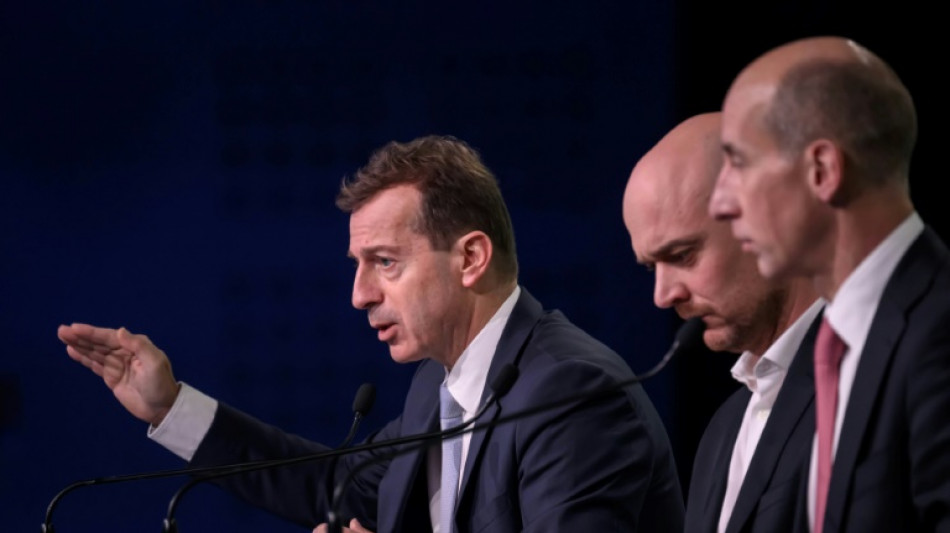
Airbus ready to build two new European fighters if countries want / Photo: © AFP
Airbus, which represents Germany and Spain in the multibillion-euro FCAS warplane program, will support a proposal to instead build two separate jets if the countries participating in the project request it, chief executive Guillaume Faury said Thursday.
"If mandated by our customers, we would support a two-factor solution and are committed to playing a leading role," Faury told a news conference.
"But the deadlock of a single pillar should not jeopardise the entire future of this high-tech European capability which will bolster our collective defence," he said.
This is the first time such a possibility has been publicly raised at the industrial level.
A political decision on the fate of the project, initially due in December, is now anticipated at the end of February.
The Future Combat Air System (FCAS) program was launched in 2017 to replace France's Rafale jet and the Eurofighter planes used by Germany and Spain.
But the scheme, jointly developed by the three countries, has stalled as disagreements persist between Dassault and Airbus.
On Wednesday, German Chancellor Friedrich Merz signalled that Berlin could abandon the project, saying Germany does not need the same type of fighter jets as France.
Failure to get FCAS off the ground would be a blow to broader efforts by European NATO allies to demonstrate tight defence cooperation in the face of threats from Russia and doubts about American security commitments.
German industrial interests and some politicians have bristled at Dassault's alleged efforts to revise agreements and take greater control of the aircraft portion of the project.
In September 2025, the head of Dassault Aviation, Eric Trappier, said his firm could build the future European fighter jet by itself.
"I don't mind if the Germans are complaining. If they want to do it on their own, let them do it on their own," he said at the time.
Faury said Thursday that Airbus believed the program "as a whole makes sense".
"We've spent a lot of time and energy to support this program that has a number of pillars," he said.
However, "on the next-generation fighter, there is a deadlock that is linked to expectations of the governance that differ between partners on what leadership means, what cooperation means."
He said the other aspects of FCAS, such as an interlinked drone swarm and a digital cloud communication system, were "making good progress".
- 'Is there enough money?' -
Faury said that if a two-fighter-jet solution were possible, it could be an opportunity for other partners to join the program.
"But it belongs to our customers to decide with whom they want to join forces," he added.
A German industrial source has floated the possibility of a partnership with Swedish aerospace and defence company Saab, with which Airbus management has a "good relationship."
Analysts estimate it will cost 100 billion euros ($118 billion) to develop the new jet and its cutting-edge technologies.
French President Emmanuel Macron's office said Wednesday that he remained "committed to the success of the FCAS project" and considered it "incomprehensible" that the disagreements have not been overcome at a time when Europe must "show unity and performance".
"Only President Macron still believes in it," a European source told AFP this week.
Spain said Thursday that it remained committed to the development of the European combat aircraft.
In a statement to AFP, Spain's defence ministry said the country "remains fully committed to the program based on the principles established by the countries (Germany, France, Spain)" in the framework agreement signed in 2019.
Jerome Rein, a defence expert at Boston Consulting Group, said the FCAS program "goes beyond" the fighter jet and is based on the interoperability between armed forces.
"But we're talking about billions of dollars in development costs," he told AFP.
"Is there enough money to develop several fighter jets?"
R.T.Gilbert--TNT