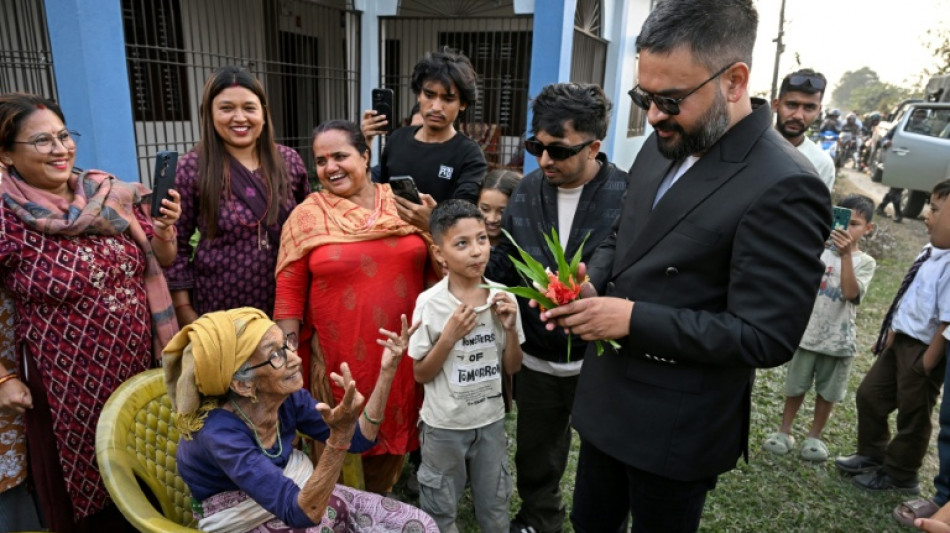
High-stakes showdown in Nepal's post-uprising polls / Photo: © AFP
In Nepal's eastern plains, rival political flags depicting blue bells and red suns flutter over tea farms and brick homes -- symbols of a local election campaign shaping landmark nationwide polls.
Two prime ministerial candidates are going head-to-head in Jhapa-5, turning the sleepy district into a pivotal battleground in the Himalayan nation's March 5 elections -- the first since deadly anti-corruption protests in September toppled the government.
The district is the stronghold of Marxist leader KP Sharma Oli -- the 73-year-old, four-time prime minister ousted by the unrest -- who is confident of a return to power from a seat he has won multiple times.
"There is no need to doubt," tough-talking Oli told reporters, as official campaigning kicked off this week. "There is no need for me to think that this is challenging."
He faces 35-year-old rapper-turned-politician Balendra Shah as his main rival. The former mayor of Kathmandu stepped down to run against Oli in the former leader's constituency, 275 kilometres (170 miles) southeast of the capital.
"Contesting against a major figure signals that I am not taking the easy way out," Shah, who has cast himself as a representation of youth-driven political change, told AFP.
A defeat for either prime ministerial candidate at the local level would most likely end their bid to lead the country.
- Generational divide -
The youth-led protests against Oli's government in September were triggered by a brief social media ban.
The demonstrations began under a Gen Z movement, but fuelled by far wider anger at economic stagnation and an ageing elite seen as out of touch.
Over two days in September, 77 people were killed, scores were injured, and hundreds of buildings set on fire -- including parliament, courts and a Hilton hotel.
Now the reckoning has narrowed to a single constituency.
"It cannot be seen as an election just between the two leaders," said Nepali political journalist Binu Subedi, adding many have "portrayed it as a fight" between old and new.
"There is a change in the mood of the voters," she added.
Jhapa, on the border with India, is a mix of towns and farming settlements with 163,000 registered voters, that have become the testing ground of public trust in the country's fractured political leadership.
Young men take photos and scroll through campaign clips on their phones, convinced that change is the answer after the protests.
"Nepal is lagging behind because of corruption," said 24-year-old resident Bibek Thapa.
"The older party leaders were selfish and only concerned about themselves and their families. I think if the new party wins, it will bring some reforms, and I am hopeful about that."
Oli has denied he gave orders to police to open fire on protesters, and has blamed "infiltrators" or "anarchic forces" for igniting violence -- without giving further details.
Older voters sit in tea shops, weighing loyalty against uncertainty.
"Oli's position on national interest is clear, so I will vote for him," said 62-year-old bus ticket seller Ganga Prasad Bhandari. "I do not know the vision of the new party."
But doubts have been sown.
"I have been casting my vote for KP Sharma Oli since I became eligible," said Gita Subedi, 48, a housewife.
"But my son, who lives in the US, is urging me to vote for Balendra Shah. I have not yet made a decision."
- 'New force' -
Both rivals brim with confidence.
"This place has well-informed people, voters, and party workers," Oli, the leader of the Communist Party of Nepal-Unified Marxist Leninist (CPN-UML), told AFP, scoffing at doubts that he could lose.
"I can say with confidence that, wherever you stand, you will see work done by me, under my leadership and by my party and my government."
Shah, standing for the Rastriya Swatantra Party (RSP), the fourth-largest party in the last parliament, commands a substantial social media following.
He said that taking his campaign to Oli's door was not "an egoistic decision", but was designed to create wider impact.
"The ripple effect would simply be greater if I contest from Jhapa," he told AFP in January.
Oli, who won his first seat in Jhapa in 1991, has been rattled.
"Many believe no one can defeat him," said local journalist Krishna Karki, who has reported on several elections in Jhapa.
"But I have never seen Oli so stressed," he said, noting that this time, unusually, he is going door-to-door to woo voters.
Kathmandu-based Binu Subedi said that traditionally, Oli had a stronghold in Jhapa but that could change.
"If you look at the dissatisfaction among the people, effects of the Gen Z uprising and hope for a new force, voters have for the first time been more open to a different name," she said.
W.Baxter--TNT