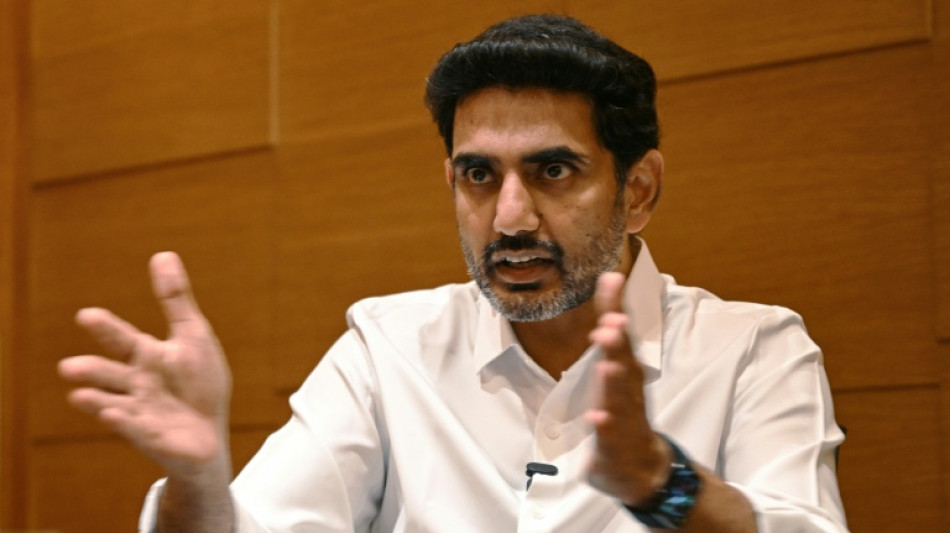
India plans AI 'data city' on staggering scale / Photo: © AFP
As India races to narrow the artificial intelligence gap with the United States and China, it is planning a vast new "data city" to power digital growth on a staggering scale, the man spearheading the project says.
"The AI revolution is here, no second thoughts about it," said Nara Lokesh, information technology minister for Andhra Pradesh state, which is positioning the city of Visakhapatnam as a cornerstone of India's AI push.
"And as a nation... we have taken a stand that we've got to embrace it," he told AFP ahead of an international AI summit next week in New Delhi.
Lokesh boasts the state has secured investment agreements of $175 billion involving 760 projects, including a $15 billion investment by Google for its largest AI infrastructure hub outside the United States.
And a joint venture between India's Reliance Industries, Canada's Brookfield and US firm Digital Realty is investing $11 billion to develop an AI data centre in the same city.
Visakhapatnam -- home to around two million people and popularly known as "Vizag" -- is better known for its cricket ground that hosts international matches than cutting-edge technology.
But the southeastern port city is now being pitched as a landing point for submarine internet cables linking India to Singapore.
"The data city is going to come in one ecosystem... with a 100 kilometre (60 mile) radius," Lokesh said. For comparison, Taiwan is roughly 100 kilometres wide.
- 'Whole nine yards' -
Lokesh said the plan goes far beyond data connectivity, adding that his state had "received close to 25 percent of all foreign direct investments" to India in 2025.
"It's not just about the data centres," he explained while outlining a sweeping vision of change, with Andhra Pradesh offering land at one US cent per acre (three per hectare) for major investors.
"I'm chasing the companies that make those servers that go sit in those data centres, the companies that make the entire air conditioning, the water-cooling system -- the whole nine yards."
The 43-year-old, Stanford-educated minister is the son of Andhra Pradesh Chief Minister N. Chandrababu Naidu, who helped turn Hyderabad into a major technology hub that is dubbed "Cyberabad".
They are allies of Prime Minister Narendra Modi, who will host the AI Impact Summit from Monday.
India is now third in a global AI power ranking -- sitting above South Korea and Japan -- based on more than 40 indicators from patents to private funding calculated by Stanford University's Institute for Human-Centered AI.
With more than a billion internet users, India has seen a surge of investment as generative AI players seek inroads to the world's most populous country.
Microsoft said in December it will invest $17.5 billion to help build the country's artificial intelligence infrastructure, with CEO Satya Nadella calling it the firm's "largest investment ever in Asia".
But critics say India lags in access to high-end computing power or commercial AI deployment, and remains more a consumer than creator of the cutting-edge technology.
Some question whether data centres will create meaningful employment when up and running, but Lokesh rejects that.
"Every industrial revolution has always created more jobs than it has displaced," he said.
"But it has created those jobs in countries that have embraced the industrial revolution."
- 'Learned from China' -
Lokesh argues that the jobs and economic benefits would more than compensate for the giveaway cost of land.
He said the state government had accounted for the vast electricity and water demands for the energy-hungry industry, and would tap "surplus water" that drains into the Bay of Bengal to cool the massive data centres.
"It's a crime that so much water during monsoons goes into our oceans," he said.
He cited China as an inspiration -- admiring how India's rival had "been able to systematically bring people out of poverty" at speed.
The state's plan to create industrial clusters was something he had "learned from China".
With a target of six gigawatts of data centre capacity -- three already signed and another three in the pipeline -- Andhra Pradesh is betting that speed and scale will give it an edge.
New Delhi last year agreed to "in-principle approval" for six 1.2 GW nuclear power plants at Kovvada in Andhra Pradesh.
"We are on a journey," Lokesh said. "We will execute these projects at a pace that the country has never seen".
F.Adams--TNT