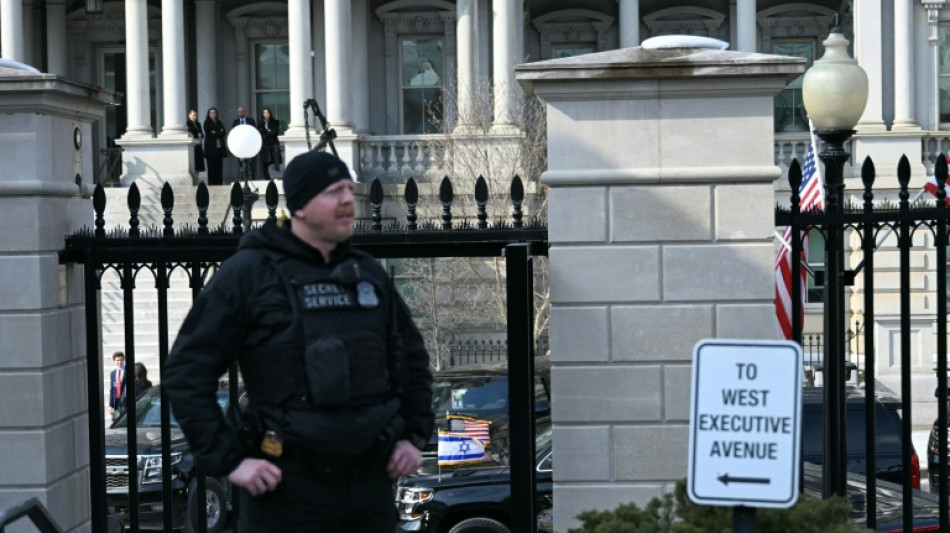
Israel's Netanyahu at White House to push Trump on Iran / Photo: © AFP
Israeli Prime Minister Benjamin Netanyahu met Donald Trump at the White House on Wednesday, after rushing to Washington to push the US president to take a tougher stance in nuclear talks with Iran.
In contrast to previous visits, it was a low-profile arrival, with Netanyahu's black SUV with Israeli and US flags coming in to the White House via a side road with no fanfare.
Trump said on the eve of the hastily arranged meeting that he was weighing sending a second US "armada" to the Middle East to pressure Tehran to reach a nuclear deal.
But Netanyahu, making his sixth visit to the United States since Trump took office, will also be urging the US leader to take a harder line on arch-foe Iran's ballistic missile program.
Iranian President Masoud Pezeshkian said Tehran, which resumed talks with Washington last week in Oman, would "not yield to excessive demands" on its nuclear program.
But he insisted his country was not "not seeking to acquire nuclear weapons."
- What are Netanyahu's goals? -
Netanyahu had been expected to come to Washington for a February 19 meeting of Trump's "Board of Peace" for Gaza, but reportedly brought forward his visit as the US-Iran talks proceeded.
He met Trump's Middle East envoys Steve Witkoff and Jared Kushner on Tuesday night.
Netanyahu said as he left for Washington his talks would "first and foremost" be about the Iran negotiations, while adding that they would also discuss Gaza and other regional issues.
"I will present to the president our views regarding the principles for the negotiations," he said in a video statement. Netanyahu's office said he would highlight Iran's missile arsenal.
Israel's concerns came to a head during their unprecedented war last year, during which Iran launched waves of ballistic missiles and other projectiles at Israeli territory, striking both military and civilian areas.
So far, Iran has rejected expanding the scope of its talks with the United States beyond the issue of its nuclear program, though Washington also wants Tehran's ballistic missile program and its support for regional militant groups on the table.
- What does Trump think? -
While talking up hopes of a nuclear deal, Trump warned in an interview with the Axios news outlet earlier Tuesday that he was "thinking" of sending a second aircraft carrier strike group to the region.
"Either we will make a deal or we will have to do something very tough like last time," Trump said. "We have an armada that is heading there and another one might be going."
Trump, who ordered US strikes on Tehran's nuclear sites during Israel's 12-day war with Iran last June, separately told Fox Business that any deal would have to involve "no nuclear weapons, no missiles."
He added that Iran's leaders "want to make a deal" but "it's got to be a good deal," saying Tehran had been "very dishonest with us over the years."
- What about the West Bank? -
The meeting will also come amid growing international outrage over Israeli measures to tighten control of the occupied West Bank by allowing settlers to buy land directly from Palestinian owners.
Israel's security cabinet approved the move ahead of Netanyahu's Washington visit. It's unclear whether Trump will address it.
A US official said on Monday that Trump "does not support Israel annexing the West Bank" and wants stability, while holding off from directly criticizing the Israeli government's moves.
- How many meetings? -
Wednesday's meeting will be the sixth between the two leaders on US soil since Trump returned to office in January 2025 -- five times at the White House and once at the Republican's Mar-a-Lago resort in Florida.
A seventh meeting took place in Jerusalem in October when Trump announced a ceasefire in Gaza.
burs-dk/des
L.Graham--TNT