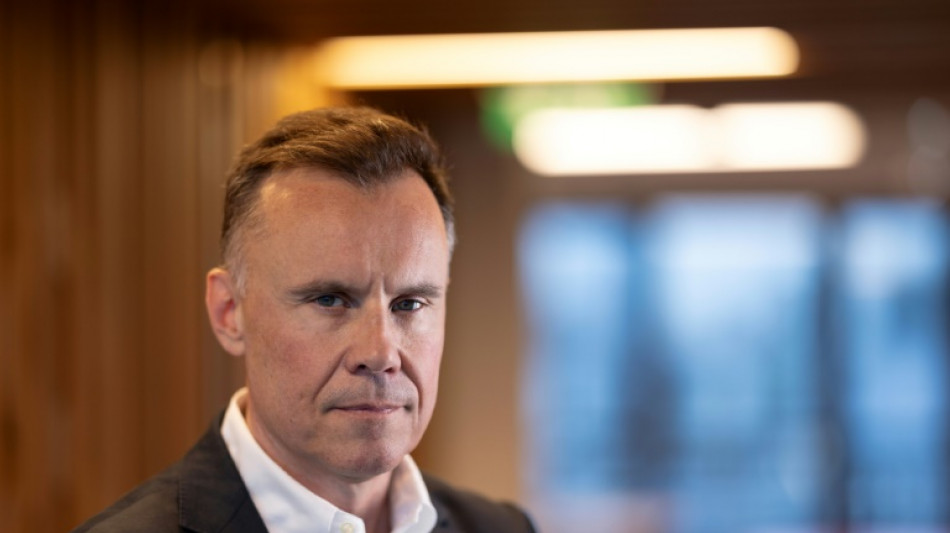
HRW urges pushback against 'aggressive superpowers' / Photo: © AFP
Human Rights Watch has urged nations to push back against "aggressive superpowers" such as Russia, China and the United States under Donald Trump, accusing the countries of undermining human rights and undoing much of the progress of the past decades.
In an interview with AFP, HRW executive director Philippe Bolopion called for an alliance of "middle powers" that could stand up to Washington, Moscow and Beijing.
"With Trump's first year (of his second term) in power, history is accelerating in the wrong direction: all the gains and progress that have been hard-won over the last few decades are now under threat," he said.
He spoke to AFP as the advocacy and research group warned in its annual report that Trump's return to the White House was turning the United States into an authoritarian state.
Bolopion said that -- apart from working on countries such as Venezuela, Iran, Gaza, Darfur, and Ukraine -- the HRW emergencies team was now also working in Minneapolis where two US citizens were killed by federal agents last month during an immigration crackdown.
"We are even deploying it in Minneapolis in the United States, which is completely new for us," he said.
"The human rights movement is under attack from the Trump administration, but also from Russia and China," which -- despite their strategic rivalries -- are "almost allies of convenience undermining, weakening, and eroding a system of rights that constrains their powers," said the former journalist.
What was happening in the United States was especially unusual, said Bolopion.
He said non-governmental organisations have been "very concerned about our ability to continue to operate completely freely in the United States."
"It is completely new to have to worry about retaliatory measures by the US government, but the Trump administration is openly hostile to all critical voices."
He pointed out that the US authorities had levelled accusations against the American grantmaking network of leftwing billionaire George Soros and threatened political opponents.
"Our presence in the United States is no longer safe," he said.
- UN 'on the defensive' -
Bolopion, who was formerly the UN director of Human Rights Watch, pointed to the weakness of the United Nations.
"In this new world of aggressive, anti-human rights superpowers, who will take up the banner?" he said, adding that the United Nations was "completely on the defensive, weakened, unable to respond to the urgency of the moment".
"Crises are becoming more frequent, more intense, and longer lasting," he said.
Civil society organisations have seen their room for manoeuvre shrink considerably in recent years.
The New-York-based organisation has had to close its offices in Hong Kong, Moscow, and Egypt, while its "Israel-Palestine director was expelled from Jerusalem," said Bolopion.
Faced with such challenges and the occasional impossibility of deploying a team on the ground, "we adapt, we use technology—artificial intelligence, drones, satellite imagery" to investigate and document human rights violations, he added.
- 'Strategic alliance' -
The HRW head called for the creation of "a new alliance, a strategic alliance" of "middle powers" united around common values of democracy and respect for international law, such as Canada, the European Union, the United Kingdom, Japan, South Africa, Brazil, South Korea, and Australia.
Bolopion also cited India, which he said had "experienced a very significant democratic setback" under Prime Minister Narendra Modi, but "could be tempted to improve its human rights situation in order to be part of an alliance that would provide it with protection against the Trump administration's tariffs."
Such an alliance "could carry weight and provide a certain degree of security for its members" through preferential trade and defence agreements, or even allow them to "vote as a bloc in UN bodies, particularly the Security Council," he said.
P.Murphy--TNT