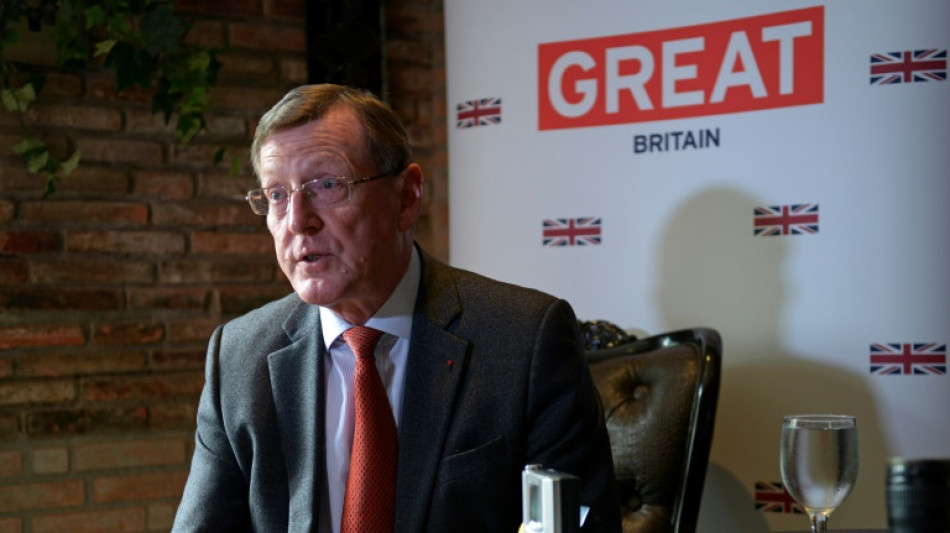
Northern Irish Nobel laureate Trimble dies / Photo: © AFP/File
David Trimble, the Nobel peace prize-winning former first minister of Northern Ireland whose statecraft helped end decades of conflict, died Monday aged 77.
Trimble, a key architect of the landmark 1998 peace deal in the troubled UK province, won the prize along with pro-Irish leader John Hume that year after the pair sealed the historic agreement.
"It is with great sadness that the family of Lord Trimble announce that he passed away peacefully earlier today following a short illness," his Ulster Unionist Party (UUP) said in a statement.
No further details were given about the death of a politician who, despite his staunch pro-UK convictions, worked with Irish nationalists to end the three decades of bloodshed known as the "Troubles".
British Prime Minister Boris Johnson described Trimble as a "giant of British and international politics".
He "will be long remembered for his intellect, personal bravery and fierce determination to change politics for the better", Johnson tweeted.
Irish premier Micheal Martin hailed the Nobel laureate as "someone who played a crucial and courageous role in bringing peace to Northern Ireland".
- Fresh troubles -
Sinn Fein's Michelle O'Neill, in line to be Northern Ireland's next first minister after her nationalist party swept to a historic victory in assembly elections in May, lauded Trimble's "very significant contribution to the peace process".
"His courage in helping achieve the Good Friday Agreement leaves a legacy a quarter-century on for which he and his family should be rightly proud," she added.
Trimble's death comes at a time of renewed tensions in Northern Ireland with the now-dominant pro-UK force, the Democratic Unionist Party (DUP), refusing to serve under O'Neill until London rips up a post-Brexit trading pact with the European Union.
The UK government is pushing through legislation to unilaterally rewrite the so-called Northern Ireland Protocol, sparking legal action by the EU.
But the DUP has still refused to enter the power-sharing government with Sinn Fein.
The UUP also opposes the protocol. But at his final public appearance at the end of June, Trimble said the cornerstone of peace remained in place.
"People are actually not throwing the (Good Friday) agreement to pieces, their complaints are still based on the existence of the agreement," Trimble said at the unveiling of a portrait of him.
"They are not saying 'throw it out', so that's the thing to bear in mind."
UK Foreign Secretary Liz Truss, who drafted the contentious protocol legislation and is running to succeed Johnson as prime minister, praised Trimble as "a great figure".
He was, she tweeted, "instrumental in delivering the Belfast Good Friday Agreement and the optimistic Northern Ireland of today".
At the start of a televised debate with Truss, her Conservative party rival Rishi Sunak also lauded Trimble as "a giant of unionism" and "a deserving winner of the Nobel Peace Prize".
- 'Huge and lasting legacy' -
The 1998 Good Friday accord largely ended 30 years of conflict in Northern Ireland that killed 3,500.
Despite resistance within the unionist community, which steadfastly believes in Northern Ireland's place within the United Kingdom, Trimble brought his party to the table in the fraught peace talks.
As part of the process he became the party's first leader in 30 years to meet with the Irish premier in Dublin, and in 1997 he became the first unionist leader since Ireland's partition to negotiate with Sinn Fein.
The nationalist party's leader at the time, Gerry Adams, acknowledged the challenges that Trimble faced persuading his own side.
"David's contribution to the Good Friday Agreement and to the quarter-century of relative peace that followed cannot be underestimated," he said.
Following the 1998 deal, Trimble served as first minister of Northern Ireland.
However, the UUP's popularity waned amid unionist dislike for elements of the 1998 accord seen as too accommodating to republicans.
The rival DUP eventually supplanted it as the biggest unionist party.
DUP leader Jeffrey Donaldson said Trimble had braved "a considerable threat to his safety" in defending the union with the UK.
Trimble, who led the UUP for a decade from 1995, lost his UK House of Commons seat in 2005.
He sat as a peer in the House of Lords -- the upper chamber of the British parliament -- from 2006.
Q.Marshall--TNT