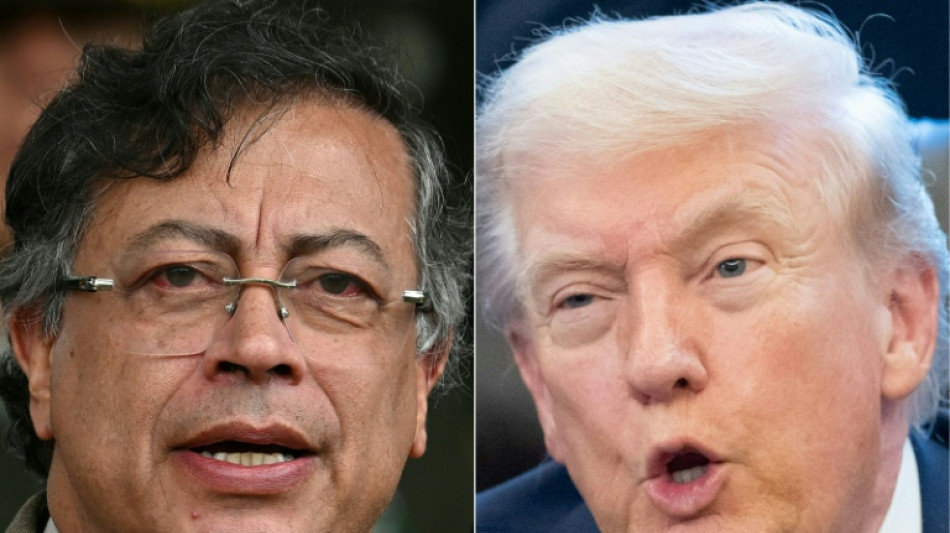
Colombia's Petro meets Trump after months of tensions / Photo: © AFP/File
Colombian President Gustavo Petro and US President Donald Trump held their first face-to-face talks at the White House on Tuesday, aiming to ease months of tensions over Venezuela and drugs.
Less than month after Trump threatened to topple leftist Petro in the same way he had Venezuela's Nicolas Maduro, the pair warmly shook hands in the West Wing colonnade, according to photos released by Bogota.
But the visit was kept low-profile. Petro's car arrived by a side entrance, with none of the flags and fanfare typically accorded to heads of state visiting the White House, AFP correspondents said.
Trump and Petro's meeting in the Oval Office was also being held behind closed doors for now, the White House said.
Pictures released by the Colombian presidency showed the two leaders talking in the Oval Office, accompanied by US Vice President JD Vance and Secretary of State Marco Rubio.
Coming from opposite ends of the political spectrum, Petro and Trump long exchanged online insults, with the Colombian defending Maduro and criticizing deadly US air strikes on alleged drug trafficking boats.
In the wake of the lightning US military raid on Caracas to topple Maduro, Trump warned Petro to "watch his ass" and said a Venezuela-style action against Colombia "sounds good to me."
- 'Fight against drug trafficking' -
But after an apparently warm phone call on January 7 the two agreed on Tuesday's talks.
Petro said on X shortly before the meeting that during the talks he was "determined to continue strengthening the relationship between two nations that share a common goal: the fight against drug trafficking."
In an apparent reference to the strikes on drug boats in the Caribbean and Pacific that have killed more than 100 people, he added that he wanted to do so "from an approach that prioritizes life and peace in our territories."
In an olive branch to Trump hours before their talks, Petro extradited an accused drug lord to the United States after a months-long suspension on such transfers.
Colombia also abruptly agreed on Friday to accept US deportation flights -- reversing the very decision that triggered the falling-out between Trump and Petro last year.
"I mean, he's been very nice over the last month or two," Trump said on Monday. "He was certainly critical before that, but somehow, after the Venezuelan raid, he became very nice. I look forward to seeing him."
Trump said they would also be "talking about drugs, because tremendous amounts of drugs come out of his country."
As with other Latin American nations, he has been pushing Colombia, the world's biggest producer of cocaine, to crack down on the trade.
- 'Off the rails' -
For decades, Colombia was Washington's closest partner in Latin America, with billions of dollars flowing to Bogota to boost the country's military and intelligence services in the drug fight.
But under Petro, coca production and cocaine exports have surged.
Critics blame the end of eradication programs and his policy of negotiating with an alphabet soup of drug-running guerrillas, cartels and paramilitaries who still control swaths of the country.
In Bogota there had been deep nervousness about what might happen in the meeting.
Diplomats joke darkly about Petro being "Zelenskyed" -- receiving an Oval Office dressing down like the Ukrainian president did in February 2025.
"Both Trump and Petro are volatile," said Felipe Botero, a political expert at the University of the Andes. "The meeting could easily go off the rails."
The ex-guerrilla Colombian leader is prone to long, bombastic monologues while former reality TV star Trump rarely likes to share the spotlight.
T.Cunningham--TNT