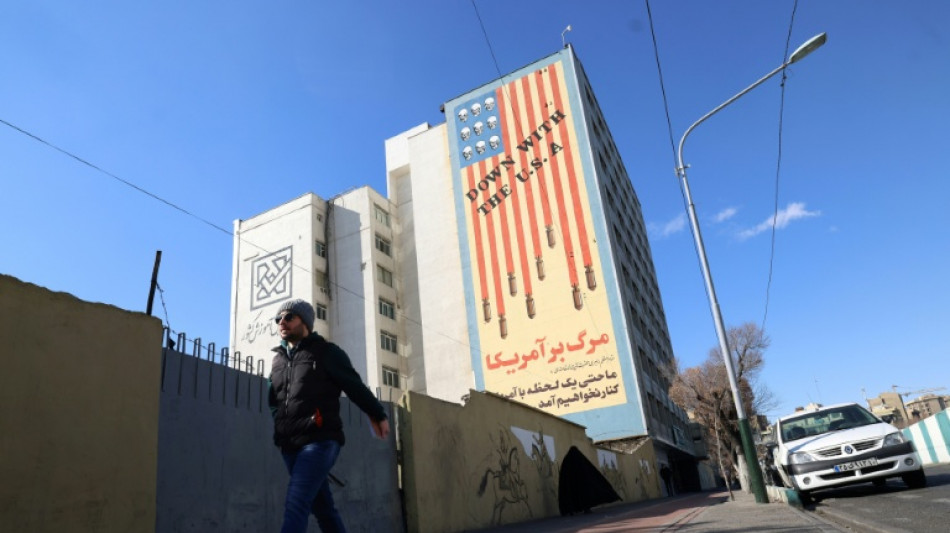
Iran declares European armies 'terrorist groups' after IRGC designation / Photo: © AFP
Iran has declared European countries' armies "terrorist groups", its parliament speaker said Sunday, following the EU's decision to apply the same designation to the Islamic Revolutionary Guard Corps.
Lawmakers wore the green uniform of the Guards in a display of solidarity at the legislative session, where they chanted "Death to America", "Death to Israel" and "Shame on you, Europe", state television footage showed.
Slamming the bloc's "irresponsible action", speaker Mohammad Bagher Ghalibaf said that under "Article 7 of the Law on Countermeasures Against the Declaration of the IRGC as a Terrorist Organisation, the armies of European countries are considered terrorist groups".
It remained unclear what immediate impact the decision would have.
The law was first passed in 2019, when the United States classified the Guards as a terrorist organisation.
Sunday's session was held on the 47th anniversary of the return from exile of the late Ayatollah Ruhollah Khomeini, who founded the Islamic republic in 1979.
The Guards are the ideological arm of Iran's military, tasked with safeguarding the Islamic revolution from external and internal threats.
They have been accused by Western governments of orchestrating a crackdown on a recent protest movement that left thousands dead.
Tehran has attributed the violence to "terrorist acts" fomented by the United States and Israel.
The European Union agreed on Thursday to list the body as a "terrorist organisation" over the response to the protests.
The step matched similar classifications enacted by the United States, Canada and Australia.
Ghalibaf said the decision, "which was carried out in compliance with the orders of the American president and the leaders of the Zionist regime, accelerated Europe's path to becoming irrelevant in the future world order".
The move, he added, had only increased domestic support for the Guards.
- Threats and dialogue -
The legislative session came as Iran and the United States have traded warnings and threats of potential military action.
Tehran's response to the protests prompted US President Donald Trump to threaten to intervene, dispatching an aircraft carrier group to the region.
In recent days, however, both sides have insisted they remain willing to talk.
"Contrary to the hype of the contrived media war, structural arrangements for negotiations are progressing," Ali Larijani, head of Iran's Supreme National Security Council, said on Saturday.
Trump later confirmed that dialogue was taking place, but without withdrawing his earlier threats. He told Fox News that Iran was "talking to us, and we'll see if we can do something, otherwise we'll see what happens... we have a big fleet heading out there".
Trump has previously said he believes Iran will make a deal over its nuclear and missile programmes rather than face US military action.
Tehran, meanwhile, has said it is ready for nuclear talks if its missile and defence capabilities are not on the agenda.
Iranian President Masoud Pezeshkian said Saturday that "a war would be in the interest of neither Iran, nor the United States, nor the region", during a call with his Egyptian counterpart Abdel Fattah al-Sisi, according to Pezeshkian's office.
Qatari premier Sheikh Mohammed bin Abdulrahman Al, who also serves as foreign minister, held talks in Iran Saturday to try to "de-escalate tensions", the kingdom's foreign ministry said.
Firouzeh, a 43-year-old homemaker who declined to give her full name, said the recent tensions have left her "very worried and scared".
"Lately, all I do is watch the news until I fall asleep. Sometimes I wake up in the middle of the night to check the updates."
P.Sinclair--TNT