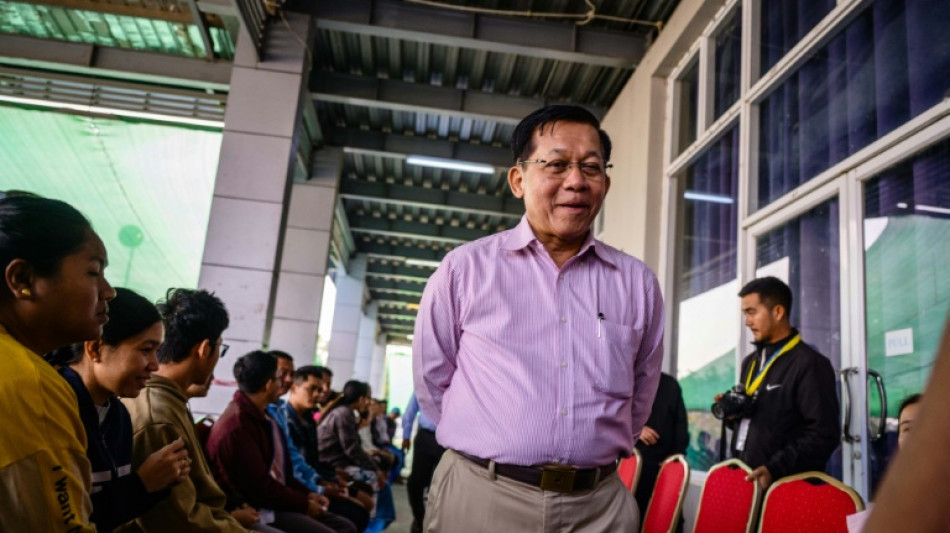
New glove, same fist: Myanmar vote ensures military's grip / Photo: © AFP/File
The colour of the winning party in Myanmar's junta-run election is the same green as a general's uniform, its staff are retired senior officers, and most expect it to march in lockstep with the military.
The Union Solidarity and Development Party (USDP) claimed an overwhelming victory that indicates the country's armed forces, known as the Tatmadaw, intend to preserve their grip on power.
But the decision by the top brass to cloak its command in civilian dress means ceding some of junta chief Min Aung Hlaing's singular authority, analysts say.
It also gives some regional partners cover to engage with and invest in a country that many Western nations consider a pariah, five years after the military seized power in a coup, triggering civil war.
"The Tatmadaw is here to stay, but political and military dynamics will change," said Morgan Michaels, a research fellow at the International Institute for Strategic Studies think tank.
The new quasi-military government could even prove to be more resilient than the junta, which has struggled to quell rebels.
"The Tatmadaw's strategy of responding to dissent and armed opposition since the coup solely with force has led to humiliating defeats and serious damage to the institution," said Michaels.
"This is not a sophisticated way to rule the country."
- 'Change uniforms' -
Official election results have yet to be released after the vote's final phase on Sunday, but the pro-military USDP said it will form a government when parliament convenes in March.
Democracy advocates and citizens complain no other party had a fighting chance in the poll -- widely criticised as a ploy to rebrand military rule.
"I'm not interested in the results at all because I already knew what they would be," said a 48-year-old taxi driver from Mandalay, speaking anonymously for security reasons.
"Even if they form a new government, it's just the same people," he added. "They'll simply change uniforms."
Junta chief Min Aung Hlaing ceding power to a civilian government, even one bound tightly to his will, would seem to dilute his authority.
But sharing power around different elites bound by ties to the military cannily ensures it will maintain a central and unchallenged role, analysts say.
Min Aung Hlaing, meanwhile, will have to carefully manage his climbdown from ultimate authority.
Touring polling stations in civilian dress on Sunday, he again declined to rule out serving as president.
Taking up the civilian role would mean handing control of the armed forces to a successor, and he would want to ensure their loyalty.
But staying on as armed forces chief could leave him exposed to power tussles with the new parliament and president.
The military ousted the government of democratic figurehead Aung San Suu Kyi and claimed voter fraud after her National League for Democracy won 2020 polls in a landslide, detaining the Nobel laureate and dissolving her organisation.
- 'Constitutional facade' -
The junta's installation of a nominally civilian government this year could help its diplomatic positioning, where the armed forces' naked rule has been problematic.
Countries which took a strong stance against the election are likely to remain unmoved by the results.
But those who backed it -- such as key investor China -- did so knowing pro-military politicians were near-certain to win.
There is a third category of countries -- weary after five years of freezing out Myanmar to little effect and perhaps open to re-engaging after a box-ticking election.
The Association of Southeast Asian Nations (ASEAN) 11-country regional bloc has snubbed the military leadership since the coup and did not send election observers.
But its special envoy Maria Theresa Lazaro, from the Philippines, flew to Myanmar during the election and enjoyed a "warm and constructive exchange of views" with Min Aung Hlaing, a statement from her team said.
"The election was less an attempt to win broad international legitimacy than to provide a constitutional facade sufficient for selective engagement," said Naing Min Khant, a programme associate at the Institute for Strategy and Policy Myanmar, a think tank.
That facade, he said, will enable "pragmatic normalisation with regional and non-Western partners, without meaningfully improving Myanmar's standing in the democratic world".
F.Adams--TNT