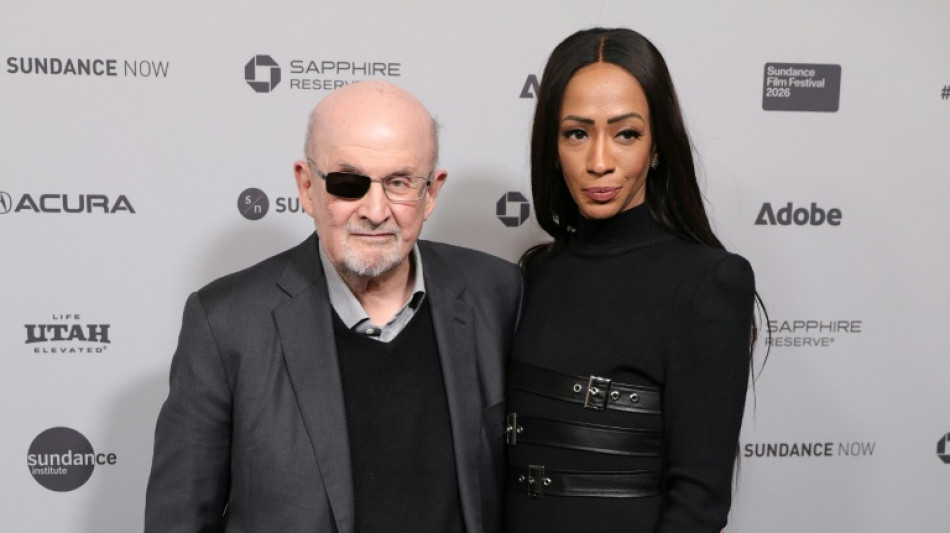
Rushdie warns of political violence as he recounts his attack / Photo: © GETTY IMAGES NORTH AMERICA/AFP
The horrific knife attack that almost killed Salman Rushdie was an example of violence unleashed by unscrupulous political leaders, the author said Sunday, warning that "everybody's in danger now" in the increasingly febrile United States.
Speaking at the premiere of the documentary "Knife: The Attempted Murder of Salman Rushdie," the writer pointed to events unfolding across the country, where a second protester was shot dead by federal agents 24 hours earlier.
"The idea of danger and violence is close to everyone now in this country," he told AFP at the Sundance Film Festival in Park City, Utah.
"I think everybody's in danger now."
The film, directed by documentarian Alex Gibney, is the companion piece to Rushdie's "Knife," a memoir recounting the harrowing 2022 attack and its aftermath.
The British-American author was at an event in Chautauqua, New York when 24-year-old Hadi Matar leapt onto the stage and stabbed him 15 times.
The brutal assault left Rushdie with life-changing injuries, including the loss of his right eye.
The comments on political violence come as President Donald Trump has surged militarized immigration raids into American cities, notably Minneapolis where federal agents have shot dead two US citizens this month.
A man was arrested at Sundance on Saturday after allegedly punching Congressman Maxwell Frost in the face and screaming that Trump was going to deport him, the Florida lawmaker said on X.
- Fatwa -
Gibney's film uses graphic video of the assault on Rushdie, shot by event organizers and attendees, as well as intimate footage filmed by his wife, Rachel Eliza Griffiths, over six weeks as the author lay in hospital grievously wounded.
It also mixes in archival news reports and interviews with Rushdie detailing the furor in the Islamic world that greeted the publication of his 1988 novel "The Satanic Verses."
The following year, Iran's supreme leader Ayatollah Ruhollah Khomeini issued a fatwa, telling Muslims worldwide it was their religious duty to kill Rushdie.
For over a decade the author lived in hiding, protected by the British government, until a deal was reached in which the fatwa was officially rescinded in exchange for Britain's granting diplomatic recognition to Tehran.
As the immediate risk appeared to recede, Rushdie re-emerged, becoming something of a celebrity and continuing to create successful literary fiction.
But the threat against him never vanished, and the animosity some bore him remained.
- 'Authoritarian' -
Hadi, who was sentenced last year to 25 years for attempted murder and assault, told a reporter before his trial that he believed Rushdie had "attacked Islam."
He admitted he had only read two pages of "The Satanic Verses."
Rushdie said the brutal attack on him was an example of a "larger thing."
"Violence is that thing, violence unleashed by the unscrupulous using the ignorant to attack... culture.
"For the authoritarian, culture is the enemy. Whether that's journalism or universities or music or writing... the uncultured and ignorant, and the radical don't like it, and they take steps against it, which we see every day."
Rushdie's comments come in the wake of a crackdown Trump has launched on higher education, in an effort to stamp out what he claims is a "liberal bias" in university teaching.
Trump also routinely derides journalism and journalists, blasting any report he disagrees with as "fake news," while conservative US states increasingly ban books from school libraries.
The Booker-Prize winning author said the film as conceived was not intended as a commentary on the here and now.
"When you're making the film, you're making the film, and then the world does what it does, and sometimes the two things run into each other," he said.
"I'm now beginning to think that maybe the film is here at a kind of apposite moment, that maybe all of us now are feeling the risk of violence."
The Sundance Film Festival runs until February 1.
A.Parker--TNT