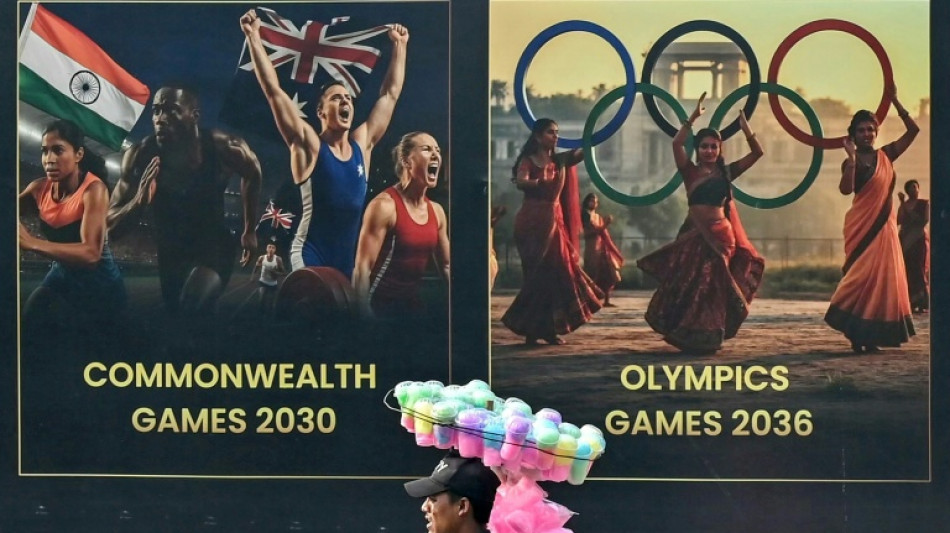
T20 cricket World Cup row overshadows India's Olympic ambitions / Photo: © AFP
India hopes next month's T20 World Cup will bolster its credentials as a global sports host -- and the country's Olympic ambitions -- but preparations have been rocked by a diplomatic row with Bangladesh and accusations of political interference.
With barely two weeks until the tournament, Bangladesh have effectively been forced out after the International Cricket Council (ICC) rejected a request to move their matches from India to co-hosts Sri Lanka, citing security concerns.
"Our only demand is to play the World Cup -- but not in India," Bangladesh Cricket Board President Aminul Islam Bulbul told reporters on Thursday, adding that without a change of venue, the team would not participate.
India is preparing to host the 2030 Commonwealth Games in Ahmedabad, seen as a stepping stone to the 2036 Olympics.
But the chaotic build-up to the T20 World Cup has cast a shadow over those ambitions, especially with cricket returning to the Olympic Games at Los Angeles 2028.
The T20 World Cup schedule was delayed and not released until December and now it appears Scotland could have to be drafted to replace Bangladesh just days before the opening match on February 7.
- 'No one to challenge' -
"Bangladesh is a cricket-loving nation. If a country of nearly 200 million people misses the World Cup, the ICC will lose a huge audience," Bulbul added.
"Cricket is entering the Olympics in 2028, Brisbane in 2032, India is bidding for 2036. Excluding a major cricket-loving country like Bangladesh would be a failure."
The ICC said it had found "no credible or verifiable threat" to move Bangladesh's games, and was committed to "safeguarding the collective interests of the global game".
But that global game is dominated by India, where cricket is woven deep into culture, the economy and politics.
South Asia accounts for about 90 percent of cricket's billion-plus fans, with India generating roughly three-quarters of the sport's global income.
India's supremacy stems from the outsized revenues of its BCCI cricket board, flush with cash from its role as custodian of the most popular sport in the world's most populous country.
Sports journalist Pradeep Magazine wrote in the Tribune, an Indian daily, that the BCCI's "staggering revenues... gives it unimaginable control over decision-making in cricketing affairs of the world".
"There is no one to challenge India's hegemony."
ICC chairman Jay Shah is the son of Amit Shah, India's powerful interior minister, and right-hand man of Prime Minister Narendra Modi.
- 'A political issue' -
"Cricket has been captured completely by politics in a way that it never has been before," Indian sports journalist Sharda Ugra told AFP.
"The Bangladesh issue has reached where it has because it's a political issue."
Political relations between India and Bangladesh have soured since a mass uprising in Dhaka in 2024 toppled Sheikh Hasina, now a convicted fugitive hosted by old ally New Delhi.
But matters escalated after the India Premier League (IPL) team Kolkata Knight Riders were ordered by India's BCCI board to drop Bangladeshi fast bowler Mustafizur Rahman, triggering fury in Dhaka.
Mustafizur's removal followed online outrage by right-wing Indian Hindus who invoked alleged attacks on a fellow community in Muslim-majority Bangladesh.
Dhaka maintains that Indian media had exaggerated the scale of the violence.
Bangladesh's interim government sports adviser Asif Nazrul said that "no one should have a monopoly" over cricket.
"If the ICC truly wants to be a global organisation, and if the ICC does not rise and sit at India's command, then we must be given the opportunity to play in the T20 World Cup in Sri Lanka," Nazrul said.
Bangladesh wanted to follow the example of Pakistan, who will play all their matches in Sri Lanka under a deal hatched after India refused to travel to Islamabad for the 2025 Champions Trophy and all their games were moved in Dubai.
Nuclear-armed neighbours India and Pakistan have fought multiple conflicts since they were divided at the end of British rule in 1947 and are bitter rivals on the pitch, refusing to shake hands in their recent matches.
"There is no one in the ICC who can stand up to anything that the BCCI says or does," said Ugra.
"The BCCI and the ICC are the same thing at the moment."
C.Stevenson--TNT