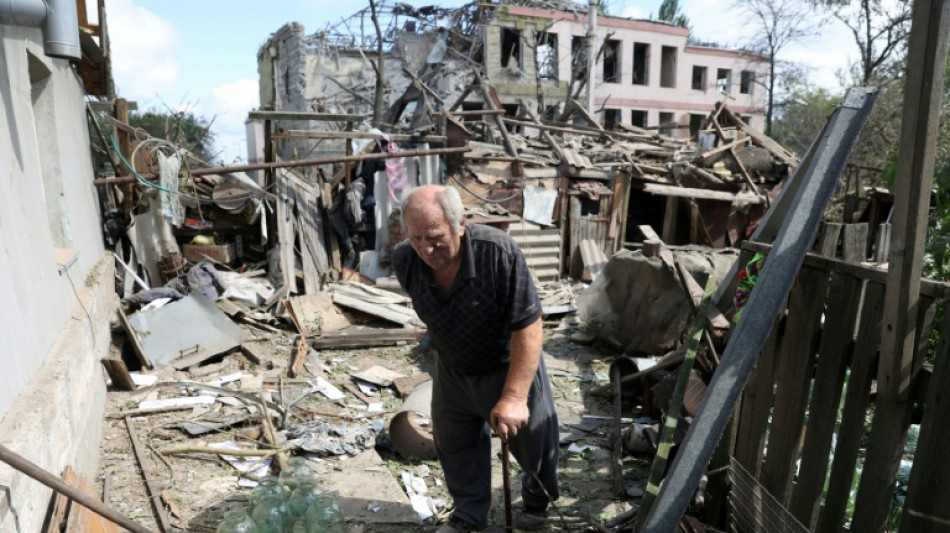
Five months on, anger and despair prevail in Donbas / Photo: © AFP
Fatigue, despair and anger are prevalent in eastern Ukraine after five months of what volunteer humanitarian aid worker Oleksiy Yukov calls "a war without mercy that has gone crazy".
There has been fighting in the vast industrial area of Donbas -- made up of the Donetsk and Lugansk regions -- ever since 2014 when Russia-backed separatists took over part of the area.
But Moscow's invasion on February 24 took the suffering to another level in a working-class area where there can be as much resentment against Ukrainian troops as against Russian ones.
Towns and villages along the frontline are hit by shelling and lives are cut short every day.
In the best cases, it is only homes that are destroyed -- one-storey bungalows with well-tended gardens and vegetable plots turned into ruins.
Even further from the frontline in Kramatorsk, the main administrative centre for the Donetsk region, there is a constant threat of strikes.
Regional governor Pavlo Kyrylenko said over 600 civilians have been killed since the start of the invasion and more than 1,600 have been injured.
Russian forces, which have gradually captured almost the whole of the Lugansk region, are now trying to do the same in Donetsk.
And even though the frontline has not moved much in recent weeks, the ongoing war of attrition is inflicting havoc on local residents.
- 'Bad omens' -
In the mining town of Toretsk, an exhausted soldier covered in grey dust after a bombing that killed six people -- most likely brothers in arms, although he refuses to say -- raises his fist in a victory sign but there is hopelessness in his eyes.
In Sloviansk, 54-year-old Andriy shows an enormous crater left by a shell in his mother-in-law's garden and suddenly breaks down in tears.
A woman in Bakhmut on the frontline points at journalists, her face tense with anger, calling them "harbingers of misfortune" in the ruins of her pharmacy, destroyed by a missile she thinks was Ukrainian.
In a region where Soviet nostalgia is strong, there is sometimes fierce opposition to the government in Kyiv, accused of ignoring local needs for years.
Some locals are looking forward to the arrival of Russian troops while others are firmly opposed.
All of them have had enough.
- 'Nobody answers' -
Many inhabitants say they feel despair and incomprehension and feel abandoned.
In Chasiv Yar, which was hit by a strike on July 10 in which more than 45 people were killed, a 64-year-old woman gathered apricots in a scene of devastation in front of the destroyed building.
"There are still children under there. Their parents call them but nobody answers," cried Lyudmila, a mother of six and grandmother of 12.
"Nobody needs us here. There is nothing anymore. The officials have left. We have to fend for ourselves to stay alive," said Lyudmila, who like most people refused to give her full name.
Local officials are often absent in the aftermath of strikes while the military stay silent.
"The mayor of one village will be the first to flee, the mayor of another will be the first to collaborate with the Russians," one local said.
- 'I used to love my life' -
The authorities have called for people to evacuate many times. But many have nowhere to go.
"I used to love my life. I had my work in a factory nearby. I had a house. Nothing special but we lived well," sighed Tatyana.
The woman in her 50s spoke from the town of Pokrovsk in the aftermath of a strike that damaged a dozen homes in a single street.
Many civilians also complain, more or less openly, about Ukrainian soldiers setting up bases inside residential areas -- in abandoned schools or homes.
In response to a question from AFP, a representative from the Ukrainian army in Donbas refused to comment on the allegations.
The issue is very sensitive since it is often a claim made by Moscow that strikes on those areas are necessary because of a military presence.
"I should not be talking to you. I could have problems," said one woman in Toretsk, hours after a strike on a residential building.
"But I would like the military to leave, to go and fight elsewhere. There are children here and normal people," she said.
E.Reid--TNT