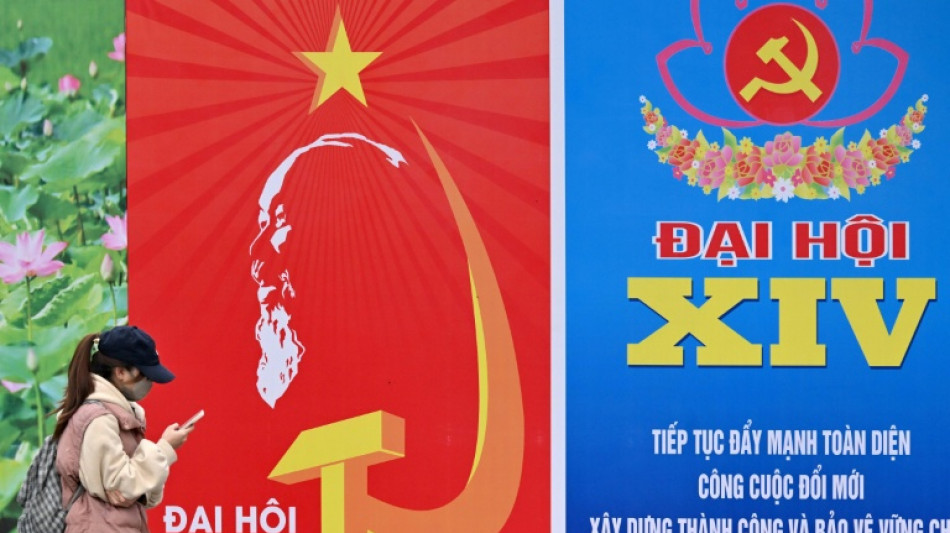
Vietnam leader seeks more power at party congress / Photo: © AFP
Vietnam's leaders convene next week for a once-every-five-years congress, where General Secretary To Lam is looking to cement control over the Communist Party ruling one of Asia's fastest-growing economies.
The nation of 100 million people is both a repressive one-party state and a regional economic bright spot, with the party seeking to deliver rapid expansion to underpin its claim to legitimacy.
But its leaders face challenges from tensions between its main trading partners the United States and China, along with mounting environmental and social pressures domestically.
Since he ascended to the top role just 17 months ago, Lam has enthusiastically pursued an anti-corruption drive, thinned and streamlined bureaucracy, and accelerated infrastructure investment in reforms officials describe as a "revolution".
Lam will remain the party's top leader, according to sources briefed on key internal deliberations.
But he is seeking the presidency as well -- a dual role similar to Xi Jinping in neighbouring China -- and experts say clinching it will signal the supremacy of his security-dominated faction.
"If he manages to claim both positions, Vietnam's leadership model will shift from consensus decision-making or collective leadership towards more authoritarian rule," said Le Hong Hiep, a senior fellow at the ISEAS-Yusof Ishak Institute in Singapore.
Lam's reach will depend on who else secures top posts and politburo positions during the January 19-25 conclave, particularly from the more conservative military faction that opposes Lam and his changes.
One source briefed on last month's party deliberations told AFP Lam's bid for expanded powers was provisionally approved.
But some reports suggest he had to shelve his presidential ambitions to secure support for his reform agenda.
- Ministries abolished -
Lam rose rapidly to the pinnacle of Vietnamese power after a long career with the secretive public security ministry.
He was named president -- considered the second-most important job in Vietnamese politics -- in May 2024, after his predecessor was sacked for corruption.
Less than two months later the incumbent general secretary Nguyen Phu Trong died and Lam succeeded him in turn -- later relinquishing the post of president.
In his short tenure as party chief, he has eliminated whole layers of government -- abolishing eight ministries or agencies and cutting nearly 150,000 jobs from the state payroll, while pushing ambitious rail and power projects.
Experts say he will focus on spurring private sector, digital and technological growth as the manufacturing hub seeks to break into the club of upper middle-income countries by the end of the decade.
That would mean raising GDP per capita by 70 percent from today's $5,000.
Vietnam has proved surprisingly resilient in the face of new 20 percent tariffs imposed by Donald Trump, clocking eight-percent growth last year.
But the balancing act between the United States and China has grown tougher, while the expectations of millions of young people are rising.
Housing affordability has become a major issue, as has pollution that blankets major cities in toxic smog.
"Buying a house has never really been part of my plan because I never thought it was something I could afford," said Kim, 23, a researcher in Ho Chi Minh City who still lives with her parents.
She hoped the leadership "will pay more attention to inequality", asking to be identified only by her first name for fear of retribution.
- 'More like China' -
The ruling party tolerates little dissent and regularly jails its critics, more than 160 of whom are behind bars, according to Human Rights Watch.
But unlike in present-day China or the Kim dynasty's North Korea, political power in Vietnam has not traditionally been concentrated in one paramount leader.
Its collective system of government rests on four pillars: the party chief, president, prime minister and the chairman of the National Assembly. An internal Communist party position was added as a fifth pillar last year.
Lam would be the first person to be named to both the top two jobs simultaneously by a party congress, rather than stepping in following a holder's death.
If he is, said Derek Grossman of the University of Southern California, "Vietnam will become more like China and North Korea rather than maintaining a separation of powers".
R.Campbell--TNT