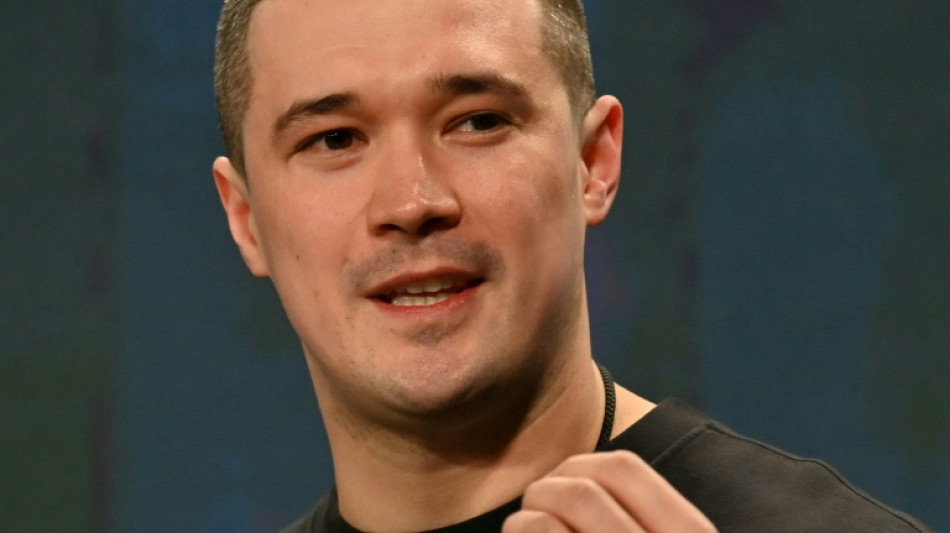
Five problems facing Ukraine's new defence chief / Photo: © AFP
Ukraine's former head of digital transformation Mykhailo Fedorov takes the role of defence minister Wednesday with several crises in his in-tray.
The fresh-faced 34-year-old has no formal military background.
But having led efforts to make Ukraine's government more efficient through digitisation and artificial intelligence over the past six years, Ukrainian President Volodymyr Zelensky hopes he is in pole position to modernise Kyiv's overstretched and underfunded army.
Here are just five of the key challenges facing Fedorov in the new role:
- Manpower -
The Ukrainian army has always been smaller than Russia's, which has a population four times bigger than its neighbour.
But the issue of manpower has become more acute as the war has progressed.
Tens of thousands of Ukrainian soldiers have been killed or wounded since Russia launched its full-scale invasion in February 2022, according to independent estimates.
At least two million Ukrainian men are meanwhile wanted by draft authorities, while 200,000 have gone AWOL, Fedorov told parliament on Wednesday.
In the face of these shortages, Fedorov has proposed Ukraine double down on its strengths -- unconventional warfare and drones.
"More robots means fewer losses, more technology means fewer deaths. The lives of Ukrainian heroes are of the highest value," he told lawmakers on Wednesday.
- Tech war -
Ukraine prides itself on drone warfare.
It has pioneered AI-controlled systems that fly autonomously towards a target, even when the operator loses connection.
It has also developed maritime drones such as the "Sea Baby", which have damaged vastly bigger Russian warships in the Black Sea; and a ground-launched cruise missile, "Flamingo", that has a purported range of 3,000 kilometres (around 1,900 miles).
But Russia is also innovating. Since 2024, Russia has twice launched its hypersonic "Oreshnik" ballistic missile at Ukraine, which Kyiv is not able to intercept with conventional air defences.
In comments to lawmakers on Wednesday, Fedorov said Ukraine needed to beat Russia in every technological cycle and be "one, two or 10 steps ahead".
He pledged to "strengthen asymmetric and cyber strikes on the enemy and its economy".
- Financing -
Ukraine's defence budget faces a 300-billion-hryvnia ($7- billion) hole this year, Fedorov said.
His first act as defence chief will be to conduct an audit of his ministry and tackle the shortages head on.
Ukraine has received more than $350 billion in military, financial and humanitarian aid from its allies since the war began, according to the German-based Kiel Institute.
But much of this aid was delivered in the first years of the war. With US President Donald Trump now in charge in Washington, Ukraine's biggest single military backer, support is uncertain.
The EU said Wednesday that two-thirds of a vital 90-billion-euro loan ($105 billion) would go to Ukraine's military.
Fedorov will also need to root out any possible corruption, a problem that has repeatedly sapped Ukraine's defence coffers since the invasion.
- Air defences -
As Russian bombing of Ukraine's critical infrastructure intensifies, causing regular blackouts, Zelensky named strengthening air defences a top priority in a meeting with Fedorov on Wednesday.
The new defence chief will need to fulfil the president's oft-stated priority of making more interceptor drones, inexpensive devices that can neutralise swarms of their Russian counterparts.
Ukraine will also need to find a way of intercepting Oreshnik, which Russian President Vladimir Putin says can fly 10 times the speed of sound.
"The president has set a clear task: to build a system that is capable of stopping the enemy in the sky," Fedorov said Wednesday.
- Convincing allies -
As defence minister, Fedorov will play a big role in persuading allies that money sent to Ukraine is spent effectively.
With US President Donald Trump alternating between support for Kyiv and sympathising with Moscow, aid from Washington is no longer as certain as it was in the early years of the conflict.
Fedorov, Ukraine's youngest defence minister, has little diplomatic experience but is savvy on social media, having managed the digital side of Zelensky's successful election campaign in 2019.
In 2022, he appealed directly to US technology magnate Elon Musk on social media platform X for Ukrainian access to satellite internet provider Starlink. Musk announced it was live the same day.
D.Kelly--TNT