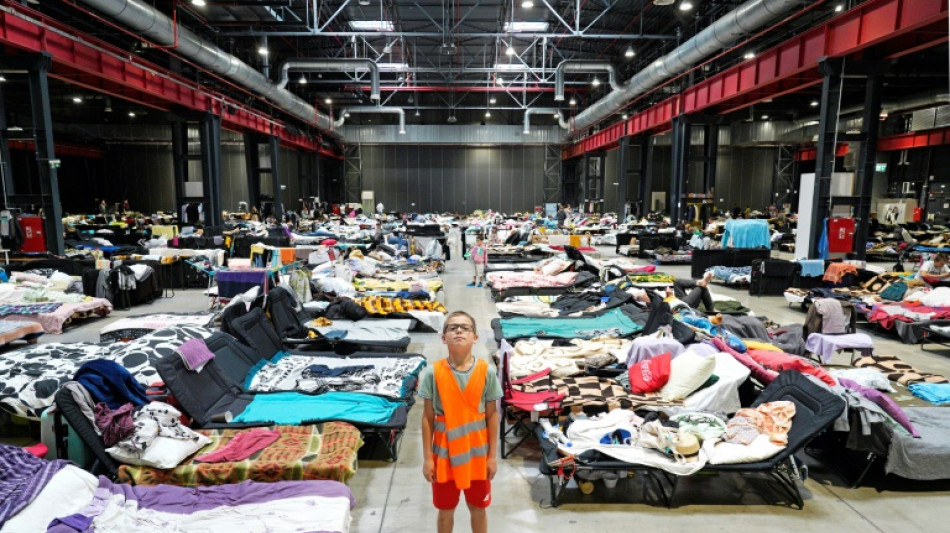
Ukrainians in limbo at Polish refugee centre / Photo: © AFP
Kyrill is killing time. Sitting on his cot at the Global Expo refugee reception centre in Warsaw, the 11-year-old busies himself by trying to take apart a scooter.
For four months now, he and his family -- mother Olena Polonitska and aunt Oksana -- have called the former exhibition centre home.
They fled Ukraine soon after Russia invaded in February, crossing the western border into Poland along with hundreds of thousands of others.
The makeshift refugee centre was meant to be a temporary solution but as the war drags on, their lives are still on hold.
"All I hope for now is to return home... or else to be relocated somewhere in Poland," Polonitska told AFP.
Of the 1.2 million Ukrainians registered for temporary protection in Poland, most are renting or being hosted by others, according to the UN's refugee agency.
But around 20 percent are still living in transit centres or collective sites like Global Expo.
Not wanting to stray too far from Ukraine and their loved ones, and without better prospects in Poland, thousands are biding their time in limbo.
- The struggle to settle -
Many at Global Expo are waiting on housing offers from Polish families.
There are fewer now compared to the deluge at the start of the invasion, according to volunteers at the centre.
"We still get housing offers from Polish individuals, but they no longer come from the big cities," said Angelika, coordinator of a relocation programme.
"But the Ukrainians want to remain in the big cities as they think they're more likely to find jobs there," she told AFP.
On Tuesday, the Polish government announced a programme to encourage refugees to move to rural areas lacking workers.
All Polish households with refugees already receive a daily stipend of 40 zlotys (nearly nine dollars) per person hosted.
They receive the stipend for 120 days, or longer in certain cases.
The belief is that four months is enough time for the refugees to settle in and become self-sufficient, with a job and their own place.
That timeline is not always realistic. Many remain without work or struggle to rent an apartment, as demand exceeds supply in the big cities.
"There are refugees who arrive at the centre after having lived with Polish families who no longer have the means or the will to host them," volunteer Marcin Kulicki told AFP.
- Stay or go -
At a welcome desk at Global Expo, a Japanese flag hangs over a sign announcing accommodation options.
Refugees there say they regularly receive housing offers abroad, sometimes even with jobs thrown into the mix.
"We set up a partnership with the Japanese administration for 2,000 refugees to go there to work," said volunteer Maksym Demidov, who heads a Polish-Ukrainian charity.
He told AFP that some 50 people are ready to take the plunge. Most of the refugees however prefer to stay put, no matter the country on offer.
According to the UN's refugee agency, 79 percent of those hosted by Poland plan to remain in the EU country for the near future.
"Participants in focus group discussions noted that they had decided to seek refuge in a country near Ukraine so they could be closer to home," the agency said in a report this month.
But some, like those from areas now occupied by Russia, see their future far from Ukraine.
"I'm from Mariupol, my apartment has been levelled. There's nothing to go back to," Daniel Lupanov told AFP while playing cards at the Warsaw centre.
Ultimately he hopes to put an ocean between him and the war -- by obtaining a visa to Canada.
Voicing his plans, he struck a note of bitter irony: "It's worked out well. I'm young and had been wanting to travel."
D.Cook--TNT