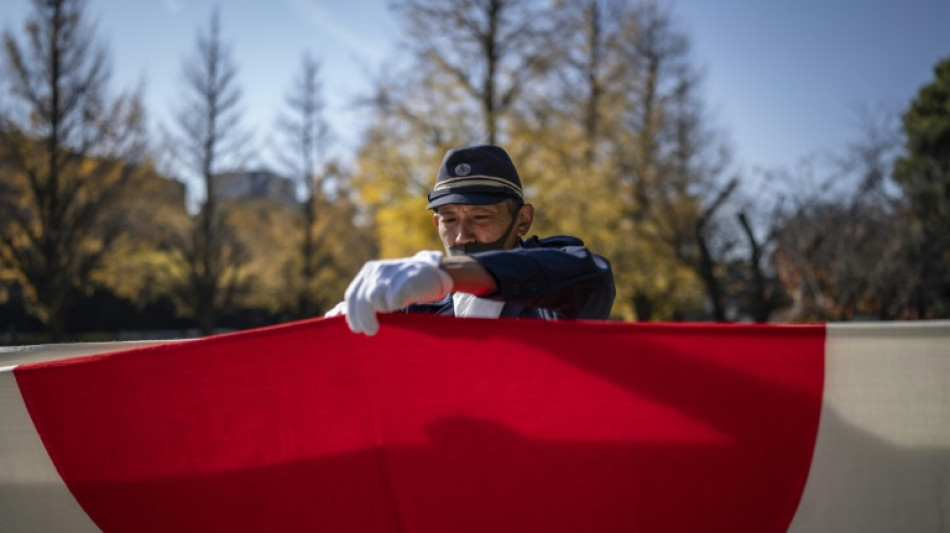
'Samurai Spirit': Ultra-nationalists see Japan tilting their way / Photo: © AFP
Driving around Tokyo blaring slogans on the 84th anniversary of the Japanese attack on Pearl Harbor, ultra-nationalist outfit Taikosha only has around 100 mostly male, middle-aged members.
But the recent rightwards lurch of mainstream politics under Prime Minister Sanae Takaichi means that suddenly some parts of their patriotic messaging no longer seem quite so fringe.
Since being elected in October, the conservative Takaichi has picked a fight with China, is preparing tough new rules on foreigners, and wants to outlaw desecration of the Japanese flag.
The anti-immigration Sanseito party has also done well in elections with its "Japanese first" slogan and admiration for Donald Trump's "Make America Great Again" campaign and other populist movements.
Taikosha members, marching somewhat out-of-step in military-style uniforms on Monday at the Yasukuni shrine honouring Japan's war dead, say that politicians are stealing their ideas.
"We're a bunch with the courage of our convictions. We're not at all like these people jumping on the populist bandwagon," campaign chief Naoto Ozawa told AFP.
"I'd say times finally caught up with us. We've been saying this for 40, 50 years now," Ozawa, 52, told AFP in reference to the "Japanese first" platform.
Not that they like Takaichi, a regular Yasukuni visitor before becoming premier.
She has expressed some revisionist views in the past, but has no links to Taikosha.
"We just accept her," said chairman Hitoshi Marukawa, 63.
She represents "the politics of a defeated nation -- which we are not committed to", Marukawa told AFP.
A "Japan centred on the emperor" is his ideal.
- Day jobs -
Founded 101 years ago, Taikosha claims to be one of Japan's biggest right-wing organisations.
Its activities are financed by fees collected from members who have different day jobs. Ozawa owns a pub.
On Monday, around 30 of them assembled at Yasukuni shrine.
With one member holding a large Japanese flag that fluttered in the autumn sun, they bowed deeply towards the imperial palace
Then they filed into vans emblazoned with slogans like "Samurai Spirit".
Blasting messages about "breaking free" from being a "defeated nation", excitement surged near the Russian embassy.
Japan's territorial dispute with Russia over some northern islands has prevented them from signing a postwar peace treaty.
"Get the hell out!" the protesters shouted at the top of their lungs through loudspeakers.
Although Taikosha is nowhere near as bellicose as it was before, "we sometimes have to remind society that we're a scary bunch not to be messed with", Ogawa said.
- Biker ties -
But even with recent developments in Japan, Taikosha is struggling to find new recruits.
Gone are the days when the subculture of "bosozoku" -- motorcycle gangs of rebellious teens -- provided a reliable supply of rookies always ready for a punch-up with riot police.
Office worker Gasho Murata, 56, Taikosha's general manager, is a former bosozoku biker himself.
"Back then, it was either become a right-winger or a yakuza (gangster) for guys like me," shades-wearing Murata recalled at the group's headquarters, adorned with pictures of the imperial family.
But bosozoku gangs have driven into the sunset and anonymous online platforms feeding nationalist views have proliferated, eroding interest in real-life activism.
While recognising them as "political societies", authorities, too, see right-wing organisations as hand-in-glove with the criminal underworld.
Many "maintain close relationships with organised crime forces", with "yakuza organisations sometimes merely posing as right-wing groups", the National Police Agency said in a 2020 report.
Taikosha head Marukawa frankly admits that "we of course do have relationships" with yakuza, although denying any of its own members currently belong.
Calling yakuza the paragon of the "way of man", Murata said: "Their path and that of right-wingers are ultimately the same -- it's the samurai spirit."
"When I first saw Taikosha vans as a child, these men looked like heroes to me," said a 33-year-old delivery driver surnamed Sato, one of the youngest members.
"I love Japan so much I've never gone abroad."
L.Johnson--TNT