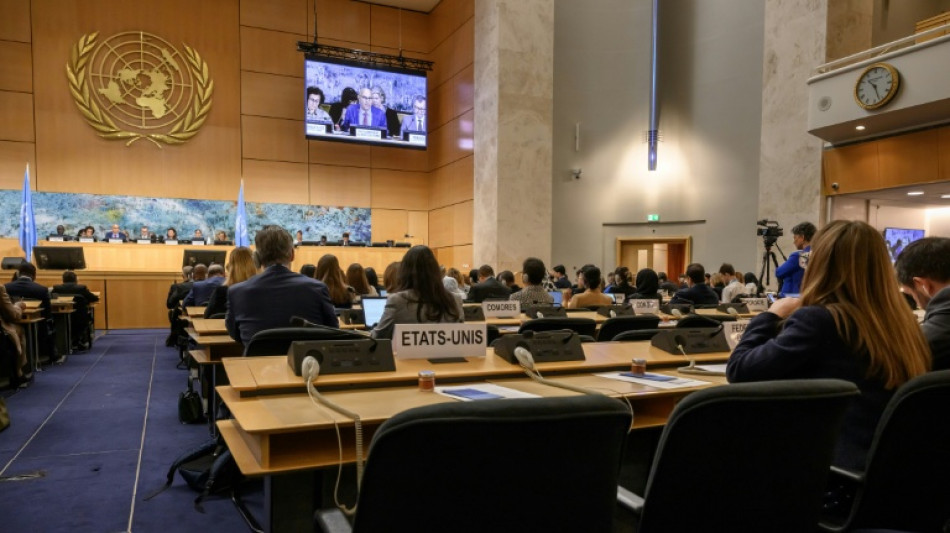
US officials, NGOs cry foul as Washington snubs UN rights review / Photo: © AFP
US officials and rights defenders gathered at the United Nations in Geneva on Friday to voice concerns over human rights under President Donald Trump's administration, and denounce Washington's decision to snub a review of its record.
The US mission in Geneva confirmed this week that the country would skip its so-called Universal Periodic Review (UPR), after first announcing the decision in August, becoming only the second country to ever boycott the process.
All 193 United Nations member states are required to undergo the standard review of their rights situation every four to five years.
The decision "is deeply disappointing," Uzra Zeya, head of Human Rights First, said in an email.
"It sends the wrong message and weakens a process that has helped drive progress on human rights worldwide -- including in the United States."
Zeya was to host one of several events at the UN in Geneva featuring activists and elected US officials voicing concerns around rights in the United States, in particular since Trump returned to power in January.
The US decision to snub its review was linked to Trump's order in February withdrawing the country from a number of UN bodies, including participation in the Human Rights Council.
But dropping the UPR was not a given. Trump also withdrew from the council during his first term, but his administration still opted to take part in its 2020 review.
The US under Trump especially has repeatedly slammed the council for being biased against Israel, and has cited that alleged bias as prompting its withdrawal from the review.
- 'Tragic' -
The move "really, really undermines ... the notion that international human rights law is inalienable and applies equally to all," warned Phil Lynch, head of the International Service for Human Rights.
He was speaking at an event in a room of the UN's European headquarters where former US first lady Eleanor Roosevelt helped draft the Universal Declaration of Human Rights before its adoption in 1948.
"It's tragic and deeply ironic that we helped to create the norms as well as this (UPR) process that we are now backing out of," a former senior US official told AFP, asking not to be named.
Another former US official who worked on the country's previous UPR engagements warned the move was a "dangerous" signal.
"We're losing our legitimacy globally on human rights leadership... It's a hard pill to swallow."
The US absence sparked outrage among civil society, which typically participates in reviews, providing analysis and recommendations.
Denied the UPR platform, numerous groups, academics and local US officials were nonetheless intent on making their concerns known.
They listed a string of alarming developments, including repression of dissent, militarised immigration crackdowns, national guards sent into US cities, crackdowns on universities and art institutions, and lethal strikes on alleged drug boats in the Caribbean and Pacific.
- Need for 'sunlight' -
Many urged the international community to speak out and support their work to hold the US government in check.
"It's the Human Rights Council, the United Nations system and a community of nations committed to human rights and democracy who can bring necessary sunlight to these abuses," said Chandra Bhatnagar, head of the American Civil Liberties Union (ACLU)'s southern California branch.
Robert Saleem Holbrook, head of the Abolitionist Law Center agreed, insisting that as "we see our civil liberties being decimated, these forums are going to take on increasing importance in the future".
The United States is set to become one of the only two countries to fail to show up for their own review since the inception of the UPR system in 2008.
While some countries have requested postponements, only Israel has previously been a no-show, in early 2013, although it eventually underwent a postponed review 10 months later.
Observers warned the US absence could serve as a bad example.
"We hope this doesn't risk normalising withdrawal from the council," Sanjay Sethi, co-head of the Artistic Freedom Initiative, told AFP.
R.T.Gilbert--TNT