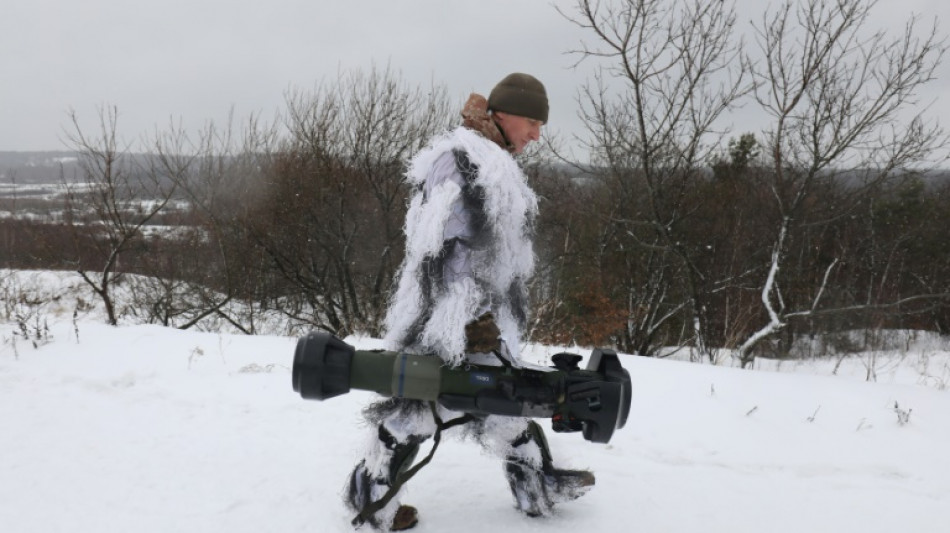
After eight years of war, Ukraine's army a tougher prospect
When he arrived at the front line as a volunteer to fight Russian-backed separatists in 2014, Pavlo Dolynskiy found Ukraine's army in a desperate state.
Kyiv had just lost the Crimean peninsula to Moscow without a shot being fired and its regular forces -- eaten away by years of neglect and corruption -- couldn't cope with the spiralling conflict in the east of the country.
"The army had reached the point where it couldn't stand up to the enemy," Dolynskiy, who now works at a veterans association, told AFP.
Soldiers struggled to get uniforms and boots, they had antiquated Soviet-era weapons, equipment often malfunctioned and the army relied on a ragtag mix of volunteers to plug the gaps.
"It really was in a lamentable condition," he said.
But now, as tensions soar over a massive Russian military buildup on its border, Ukraine's armed forces present a far tougher prospect.
Battle-hardened by nearly eight years of a simmering war that has claimed over 13,000 lives, the military has undergone reforms and been bolstered by Western arms and training.
"Eight years ago, the Ukrainian army did not exist. It was only on paper, and did not have the potential to fight," said Mykola Beleskov, a defence analyst at the National Institute for Strategic Studies in Kyiv.
"Now they are the best armed forces that Ukraine has had in thirty years of independence. The best prepared and the best trained."
- Drones, anti-tank missiles -
The conflict has forced Ukraine's pro-Western leadership to try to turn their depleted Soviet legacy forces into a more modern military aligned closer to NATO standards.
Ukraine's defence budget has tripled over the past decade in US dollar terms to around $4.2 billion in 2021 and reforms have looked to tackle rampant corruption and improve command and control.
The US has provided some $2.5 billion in military aid since 2014 and training from NATO allies -- including also Canada and Britain -- has helped bolster battle readiness.
As part of the modernisation drive, Ukraine's President Volodymyr Zelensky this week signed a decree to add an extra 100,000 personnel to the armed forces over the next three years -- taking its total to some 360,000.
The authorities have pledged to ramp up wages for those serving and professionalise the army by ending conscription by 2024.
A crucial addition has also been the influx of foreign weaponry that has bolstered the military's Soviet-era stockpile.
Ukraine has purchased Turkish Bayraktar TB2 combat drones -- which proved pivotal in the 2020 Karabakh conflict between Azerbaijan and Armenia -- and received shipments of anti-tank missiles from the US and Britain.
"Its forces probably are stronger than they have been for a long time," said Sam Cranny-Evans, a research analyst at the RUSI think tank in London.
"Nonetheless, there are key deficiencies in Ukraine that have not been addressed."
He pointed to its limited air defence systems, lack of assets able to carry out long-range strikes and doubts over its reconnaissance capabilities.
Ukraine's airforce and navy also remain weak points.
Kyiv lost an estimated 70 percent of its vessels when Russia seized the strategic Crimean peninsula in the Black Sea, a recent report from the US Congressional Research Service said.
British minesweepers are on their way but more ambitious plans to rebuild are hampered by severe budget constraints as the economy struggles.
And graft remains a problem draining those tight resources.
"It is widely recognised that Ukraine's path forward regarding reforms and building appropriate military capabilities is predicated upon eliminating corruption in its defence sector," said an analysis from defence intelligence agency Janes.
Oleksandr Syrskyi, commander of Ukraine's ground forces, insisted to journalists Thursday that the military "have taken a big step forward since 2014 -- we increased our combat capacity and ability to repel an invasion".
But he still listed a raft of hardware his troops require: anti-sniper gear, anti-tank weapons, air defence systems, anti-drone systems, reconnaissance systems.
"We are working on this and we have agreements in place to try to improve all this," he said.
- Outgunned, outmanned -
After years of conflict, Ukraine's forces are combat-experienced and highly motivated.
There are also hundreds of thousands of people in the reserves and volunteer fighters have been brought under government control.
Civilians too are preparing, with survival courses becoming increasingly popular among Ukrainians worried about a possible Russian attack.
Despite the improvements, Ukraine understands that its military remains massively outgunned and outmanned by Moscow's vastly superior armed forces.
Russian President Vladimir Putin has pumped vast sums into turning his own creaking military into a well-equiped modern outfit able to impose the Kremlin's goals in global hotspots like Syria.
Analysts said Ukraine would struggle if Moscow unleashed its missiles and aircraft in a major bombardment of critical infrastructure.
"It is no secret that the Russian army is bigger and stronger," said analyst Beleskov.
But, he insisted, if there was a major invasion and Russia tried to hold territory then Ukraine's forces could still turn it into a costly "war of attrition" -- especially if Western arms kept flowing in.
A.M.James--TNT