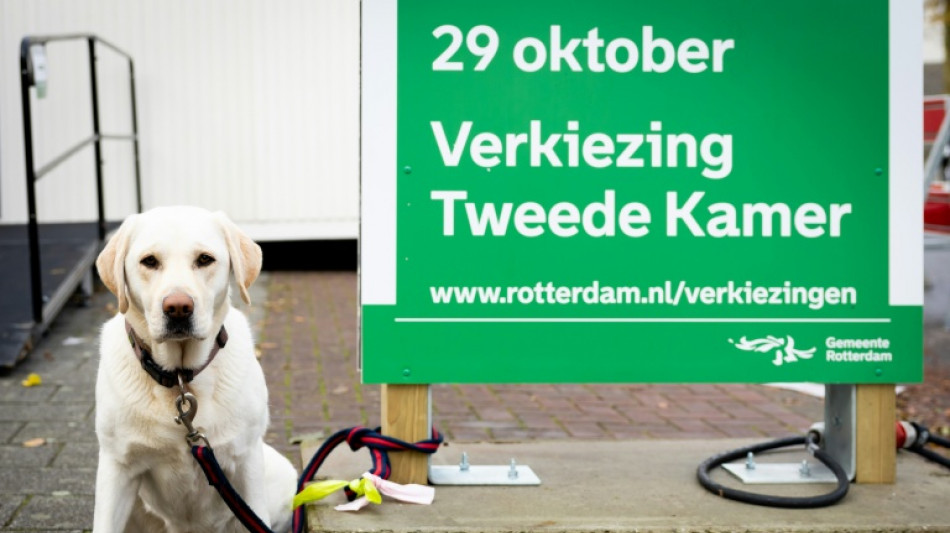
Dutch vote in snap election seen as test for Europe's far-right / Photo: © ANP/AFP
The Dutch headed to the polls Wednesday for a knife-edge election, with all eyes on the performance of the far-right, which is riding high in many top European countries.
Polls suggest anti-immigration and anti-Islam firebrand Geert Wilders could repeat his stunning election success from two years ago with his far-right Freedom Party (PVV).
But with half the electorate still undecided, the result is too close to call, and a pack of three other parties has closed the gap in recent days.
"It is impossible to tell right now who might win the elections because there are four parties tied for first place," Sarah de Lange, professor of Dutch politics at Leiden University, told AFP.
"And on top of that, over 50 percent of Dutch voters are still undecided," she added.
One thing is virtually certain: Wilders will not be prime minister whatever the result.
He sparked the election by collapsing the previous government in a row over immigration, pulling the PVV out of a fractious four-way coalition.
All mainstream parties have ruled out governing with him again, finding him unreliable or his views too unpalatable.
The fragmented Dutch political system means no party can reach the 76 seats needed to govern alone, so consensus and coalition-building are essential.
"The future of our nation is at stake," Wilders told AFP in a pre-election interview.
"Like all over Europe, people are fed up with mass immigration and the change of culture and the influx of people who really do not culturally belong here," said Wilders, sometimes known as the "Dutch Trump".
His score in the Netherlands, the European Union's fifth-largest economy, will be seen as a bellwether of far-right power with similar parties topping polls in France, Germany, and Britain.
Bart Paalman, a 53-year-old baker, cast his vote at the Anne Frank House, converted into a polling station for election day.
"I think society should be more positive and less negative. And so I'm voting for a party who's not that aggressive," he told AFP.
- 'Democracy will be dead' -
The main issues have been immigration and a housing crisis that especially affects young people in the densely populated country.
As other parties have already excluded Wilders, the leader who polls second will likely become the next prime minister.
That is currently Frans Timmermans, an experienced former European Commission vice-president who touts himself as a safe pair of hands after months of chaos.
"This is one of the richest countries on the planet, and still, self-confidence is very low," Timmermans, who heads the Green/Labour left-wing alliance, told AFP in an interview.
"We need to bring that back because there's no issue that we can't solve," said Timmermans, 64, a former foreign minister who speaks six languages.
Momentum is with Rob Jetten and his centrist D66 party, which has shot up the polls thanks to the strong media performances of the fresh-faced 38-year-old.
"I want to bring the Netherlands back to the heart of Europe because without European cooperation, we are nowhere," he told AFP after casting his vote in The Hague.
Also running on a stability ticket is centre-right rising star Henri Bontenbal, head of the Christian Democrats (CDA) party.
The 42-year-old, who has not flown privately since 2006 for climate reasons, told AFP: "I really believe that the Dutch people are not extreme on either side."
The campaign has been marred by violence and disinformation.
Demonstrators against shelters for asylum-seekers have clashed with police in several cities, and violence erupted at an anti-immigration protest in The Hague last month.
Wilders was forced to apologise to Timmermans after two party members created AI-generated images to discredit the leftist leader.
While the outcome is uncertain, what is clear is that coalition horse-trading will take months -- the last government required 223 days.
Until then, outgoing Prime Minister Dick Schoof will run the country -- reluctantly. "I wouldn't wish it on you," he told one MP in parliament.
"If you accept this job, you know that it will end someday," Schoof told AFP after casting his vote.
Wilders has warned "democracy will be dead" if he wins again but cannot be prime minister.
"You can't ignore two and a half to three million votes."
T.Allen--TNT