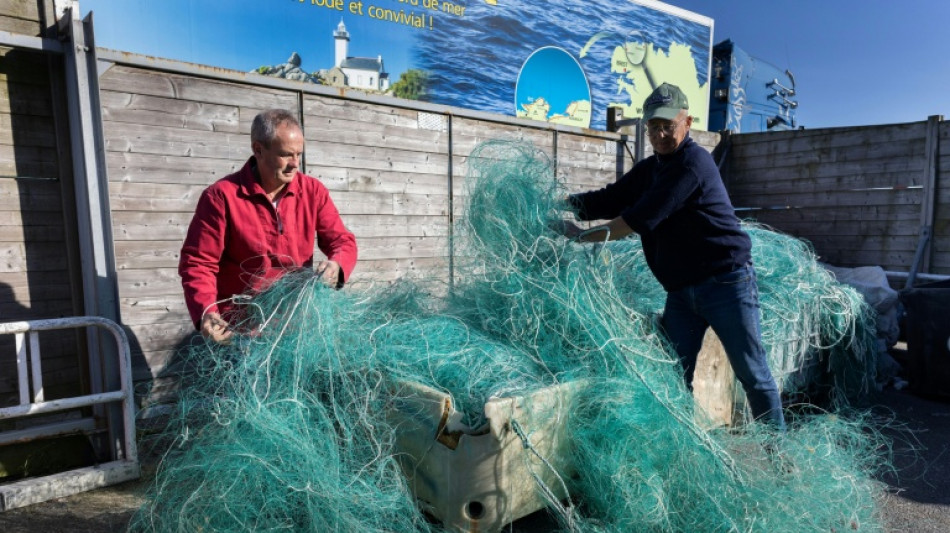
French fishing nets find new purpose on Ukraine's front lines / Photo: © AFP
Once used to scoop fish from the sea off the coast of France, recycled fishing nets are finding new life in Ukraine to protect the country's roads and military infrastructure from Russian drone attacks.
"It smells like rotten fish," joked Christian Abaziou, 70, as he picked up a piece of used netting at Roscoff port in western Brittany's Finistere department.
He and his fellow volunteer Gerard Le Duff, 63, members of the Kernic Solidarites association, were awaiting a delivery of used nets.
Stuffed into giant white bags to be recycled, they loaded the packed piles of thin green netting into a truck to be sent on its way to Ukraine, where they are used to entangle Russian drones.
In early October, the two men had already transported 120 kilometres (75 miles) of nets to Ukraine. And a second truck carrying 160 km of nets left Friday from nearby Treflez.
"When we started humanitarian convoys three years ago, drones weren't part of the picture at all," said Gerard, the association's president.
But the war has evolved, "and now it's a drone war".
- 'Proud' to help -
Russia's drone arsenal used against Ukraine includes small flying devices identical to those sold commercially, but equipped with explosives and capable of striking more than 25 km from the front line.
To defend against them, Ukrainians have been covering roads with nets mounted on poles, stretching for hundreds of kilometres.
As drones approach, they get trapped—like insects in a spider's web.
When Abaziou learned of this new tactic, he quickly got in touch with a retired fisherman.
"Within 48 hours, I had all the fishing nets I needed," he said.
"It's from the heart," said Jean-Jacques Tanguy, 75, former president of the Finistere fisheries committee.
According to him, fishermen "are proud to know that their used equipment... is going to help save lives".
Fishing nets, replaced annually, pile up along the docks of Breton ports.
"The ones we collect are destined for recycling. They might as well serve a good cause," said Marc-Olivier Lerrol, deputy director of Roscoff port, which gathers around 20 to 25 tonnes of nets per year.
"You're always welcome -- come back anytime!" he called out to Gerard and Christian in farewell.
- 'Moved to tears' -
Stored alongside several tonnes of soup, infant formula and medical supplies, the nets are transferred to a Ukrainian truck at the Polish border, more than 2,000 km from Brittany.
The first convoy headed to Zaporizhzhia in the south, where the nets are meant to protect certain neighbourhoods of the city.
The second is expected to go a bit farther south, toward Kherson, a city also facing the daily threat of drones.
A Frenchman living in Ukraine, who wished to remain anonymous, facilitated the exchanges between Kyiv and the volunteers in Brittany.
"There's a huge need for nets here," he told AFP.
"The idea that Breton volunteers would think to send kilometres of fishing nets to save lives in Ukraine... When you tell that to any Ukrainian, they're moved to tears."
Looking ahead, Abaziou hopes Ukrainians will send transporters to collect the nets in Brittany.
"We'll help gather and load them, but we don't have the budget to continue (the convoys) ourselves."
Kernic Solidarites isn't the only group sending nets to the Ukrainian front.
Stephane Pochic, owner of a fleet of trawlers in Finistere's Loctudy, sent some in August via a Hautes-Alpes-based association, Arasfec Paca.
"It's a symbolic gesture to show our support," Pochic told AFP.
And the fishermen's solidarity movement isn't limited to France.
Ukrainian positions are also being protected by nets from Northern Europe, notably Sweden and Denmark.
E.Cox--TNT