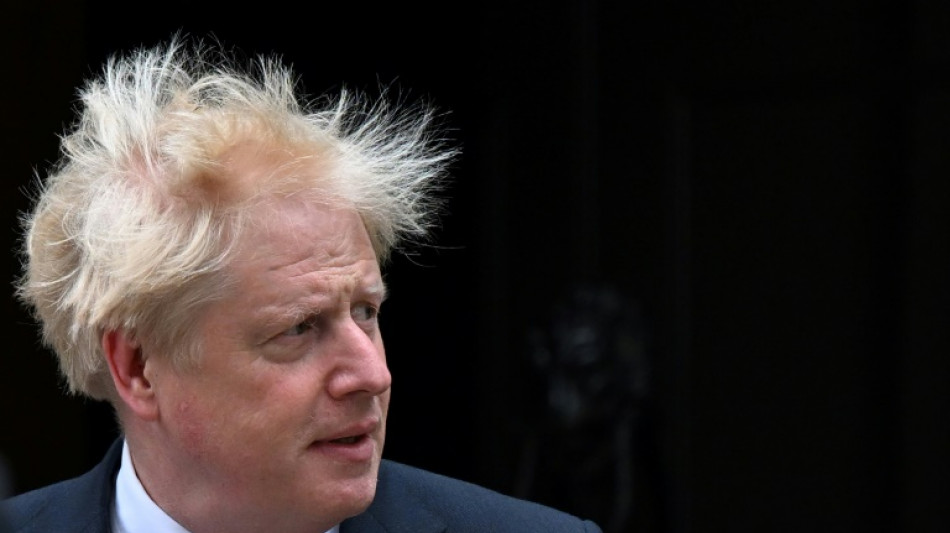
Why is Boris Johnson still prime minister? / Photo: © AFP
Prime Minister Boris Johnson has announced his resignation but is going nowhere for now -- and British voters get no say in his successor. Why?
- The long goodbye -
Bowing to a cabinet insurrection, the scandal-tainted Johnson said Thursday that he was stepping down as Conservative leader.
But he said he would remain in 10 Downing Street until Britain's ruling party elects a successor -- which could take months.
Until then, he continues to wield all the trappings of executive authority.
Britain has no formal designation of a "caretaker" leader in between party elections.
In fact, Britain has no formal constitution at all. Instead it has centuries of convention accrued in royal palaces, parliament and the courts.
- Unpresidential -
The unwritten constitution dictates that Britain is a parliamentary democracy.
The leader of the biggest party gets to be prime minister, with the consent of the monarch.
After a general election, the situation is normally clear-cut -- unless, as in 2010, no single party emerges with an overall majority.
The prime minister needs to prove their majority through a vote of confidence.
If leader of the biggest party, that is guaranteed, if necessary, with the backing of one or more smaller parties (as in 2010).
But parties often change leaders between elections, as now, and as in 2016 when Theresa May succeeded David Cameron following his defeat in Britain's Brexit referendum.
In fact, the last leader to have been voted in and voted out at the ballot box by the public was Tory prime minister Edward Heath way back in 1974.
Labour insists that Johnson cannot hang around a day longer.
It says it will push a no-confidence vote unless the Conservatives agree to install a new leader much more quickly.
- Lacking confidence -
Normally, a ruling party with a working majority of 73 seats would be assured of winning such a vote in the House of Commons.
But several Tories have also expressed their unease at Johnson staying in office for longer.
If -- and it's a big if -- enough of them rebelled and Labour won, Johnson would have to go immediately.
By convention, the Conservatives would have to rapidly anoint another leader, who would have to show they do have majority support in the Commons.
Failing that, Britain would have to hold a general election.
Pressure has grown down the years for a new prime minister, elected internally by their party, to seek a popular mandate.
When Gordon Brown took over as Labour leader and prime minister from Tony Blair in 2007, Brown came close to calling a snap election.
But fatally, he hesitated, the global financial crisis intervened, and Labour lost in 2010.
R.Hawkins--TNT