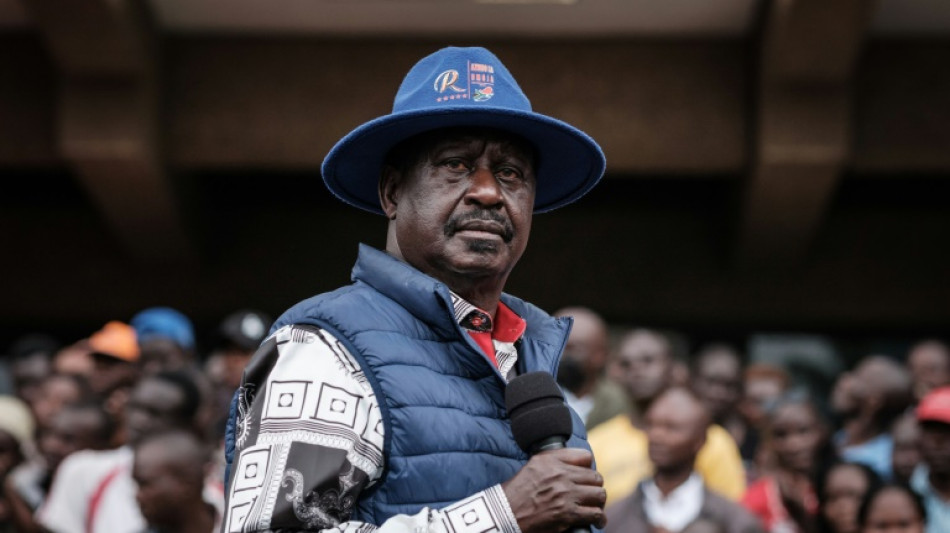
Raila Odinga: Kenya's perennial opposition leader / Photo: © AFP/File
Raila Amolo Odinga, whose death at 80 was announced on Wednesday, spent most of his adult life in politics, including eight years in prison as a pro-democracy campaigner -- but never achieved his goal of becoming Kenya's president, despite five attempts.
Odinga, who died during a trip to an Ayurvedic health clinic in India according to local police, cast himself as an anti-establishment firebrand despite belonging to one of Kenya's top political dynasties.
Born on January 7, 1945, he spent his early years in politics either in jail or in exile, fighting for democracy during the autocratic rule of president Daniel arap Moi.
A member of the Luo tribe, he entered parliament in 1992 and ran unsuccessfully for the presidency in 1997, 2007, 2013, 2017 and 2022, claiming to have been cheated of victory in the last four elections.
The 2007 polls in particular -- which many independent observers also considered deeply flawed -- shocked Kenyan politics, unleashing ethnic violence that pitted the Luo and Kalenjin tribes against the Kikuyu community, costing more than 1,100 lives.
Odinga became prime minister in a power-sharing deal aimed at stopping the violence, a post that was later abolished under a new constitution in 2010.
It was a surprise in 2018 when Odinga shook hands with another long-time rival, Uhuru Kenyatta -- a Kikuyu, drawing a line under decades of vitriol and also effectively leaving Kenya without an opposition.
Similarly, after Odinga lost another bitterly fought election in 2022 to President William Ruto, he followed it two years later with a political alliance that once again left the country without an opposing political force.
- Polarising politician -
While his supporters considered Odinga a much-needed social reformer, detractors saw him as a rabble-rouser unafraid to play the tribal card.
A charismatic speaker, he had a reputation for being stubborn and sometimes short-tempered.
Some observers said his crowd-pleasing skills had diminished in later years, attributed to advancing age and ill health.
With his speech notes in hand, he often stumbled and laboured over his words -- especially in English. Speaking off-the-cuff in his native Swahili, however, he retained the ability to inspire.
Passionate about reggae, Odinga adopted South African star Lucky Dube's song "Nobody Can Stop Reggae" as an unofficial motto for his campaign in later years.
Many observers believed the one-time prime minister would not run for the presidency a sixth time, but he kept his cards close to his chest.
An Arsenal fan, he credited his love of football for helping him develop a philosophical attitude towards the rough-and-tumble world of politics.
"You lose some, you win some. It is painful but that is the way to perfection," he said in an interview with AFP in 2021.
The Odinga family largely played second fiddle to the Kenyattas after Kenya's independence from colonial ruler Britain in 1963.
Raila's father, Jaramogi Oginga Odinga, was the country's first vice president, serving under Jomo Kenyatta.
- 'Promised land' -
Raised an Anglican, Odinga converted to evangelicalism and was baptised in a Nairobi swimming pool by a self-proclaimed prophet in 2009.
The Bible even crept into his 2017 campaign with his repeated promise to lead his followers to Canaan, the mythical "promised land".
He studied engineering in communist former East Germany and named his eldest son Fidel, who died in 2015, after the Cuban revolutionary.
Although not as wealthy as Kenyatta or Ruto, Odinga sat at the head of a business empire with stakes in energy companies.
Married to his wife Ida for around half a century, Odinga is survived by three children and five grandchildren.
C.Blake--TNT