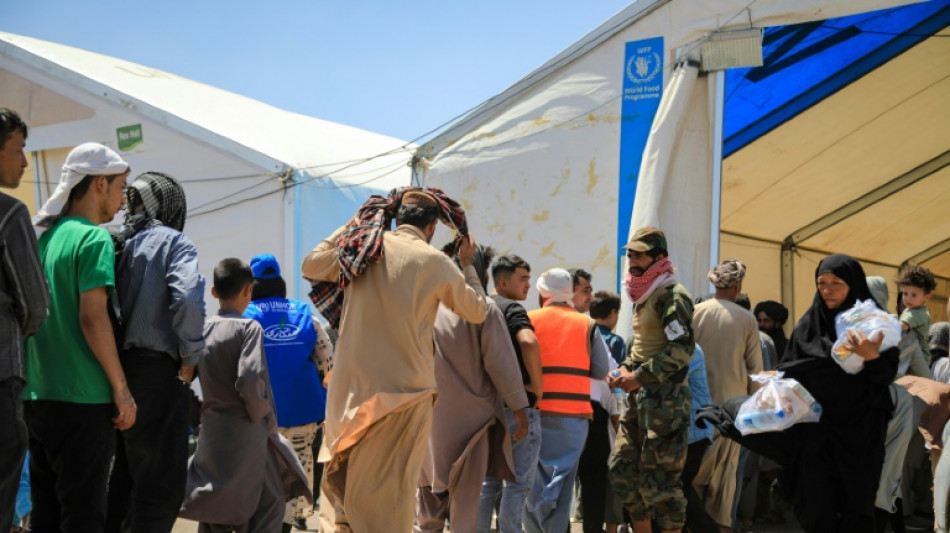
Return of millions of Afghans fuels terror potential / Photo: © AFP
A massive spike in millions of migrants forced back into impoverished Afghanistan by Pakistan and Iran could fuel Islamic State militancy, diplomatic and security sources fear.
Around 2.6 million Afghans have returned since January, including many who have spent decades abroad or who are setting foot in Afghanistan for the first time.
"The risk that Islamic State Khorasan sees these newly arrived Afghans as a potential recruitment pool is high," Hans-Jakob Schindler, a former coordinator of the UN committee monitoring militant groups, told AFP.
Security in Afghanistan has vastly improved since the Taliban won their insurgency against the Nato-backed government and returned to power in 2021.
However, the local branch of Islamic State -- a rival jihadist group with a foothold in eastern Afghanistan -- carries out periodic attacks and remains a threat to Taliban rule and the wider region.
"Since August 2021, the group has continued to recruit disgruntled Taliban as well as Afghans that are not part of the new regime," Schindler said.
The UN warned in July of a "permissive environment for a range of terrorist groups... posing a serious threat to the security of Central Asian and other countries".
It said the most serious threat is from the Islamic State, with 2,000 fighters, who have carried out deadly attacks in Russia, Iran and Pakistan in the past few years.
While the Pakistani Taliban, a separate but closely linked group to the Afghan Taliban, has triple the fighters, it is focused on a campaign against the Pakistan government's security forces.
Islamabad has consistently accused Afghanistan's rulers of giving safe haven to militant groups.
The Taliban government has repeatedly claimed that there are "no longer any terrorist organisations" operating in Afghanistan.
- 'Foreigners' in their own country -
The UN High Commissioner for Refugees (UNHCR) has predicted that up to four million Afghans could return to the country by the end of the year.
Upon arrival, "they face enormous challenges, without jobs, housing, or access to basic services," notes Indrika Ratwatte, the UN's humanitarian coordinator in the country.
"They may become vulnerable to negative coping mechanisms, including exploitation by armed groups."
According to the World Bank, nearly half of Afghanistan's 48 million people live below the poverty line, and nearly a quarter of 15-29 year-olds are unemployed.
"We already know that some Afghans join terrorist groups not out of conviction, but out of 'economic necessity,'" a European diplomatic source told AFP.
Afghans who have spent decades abroad are considered outsiders when they arrive in Afghanistan, said Amina Khan of the Institute for Strategic Studies (ISSI) in Islamabad.
Some will hold resentment towards Pakistan, which took away their businesses and properties.
"They're the perfect fodder for these transnational terrorist groups that are operating within the region," she said.
- 'Ticking time bomb' -
According to Moscow, Afghanistan is home to approximately 23,000 fighters from 20 different organisations.
"The greatest concern is the activity of the Afghan branch of (Islamic State)... which has training camps, mainly in the east, north, and northeast of the country," noted Russian Security Council Secretary Sergei Shoigu at the end of August.
In July, a year after the Islamic State killed 149 people in a mass shooting at a Moscow music venue, Russia became the first -- and only -- country to recognise the Taliban government.
It said the decision would boost regional security and the "fight against the threats of terrorism".
"Many foiled attacks in Europe between 2023 and 2025 have been linked back to the (Islamic State)," Schindler said.
For many European countries, the "risk of a kind of ticking time bomb for Europe is real" the European diplomatic source added.
The only way to stop these recruitments is to "build a dignified future" for migrants, thanks to foreign aid, argues Ratwatte.
But the humanitarian sector has been lacerated by funding cuts since US President Donald Trump took power in January.
S.M.Riley--TNT