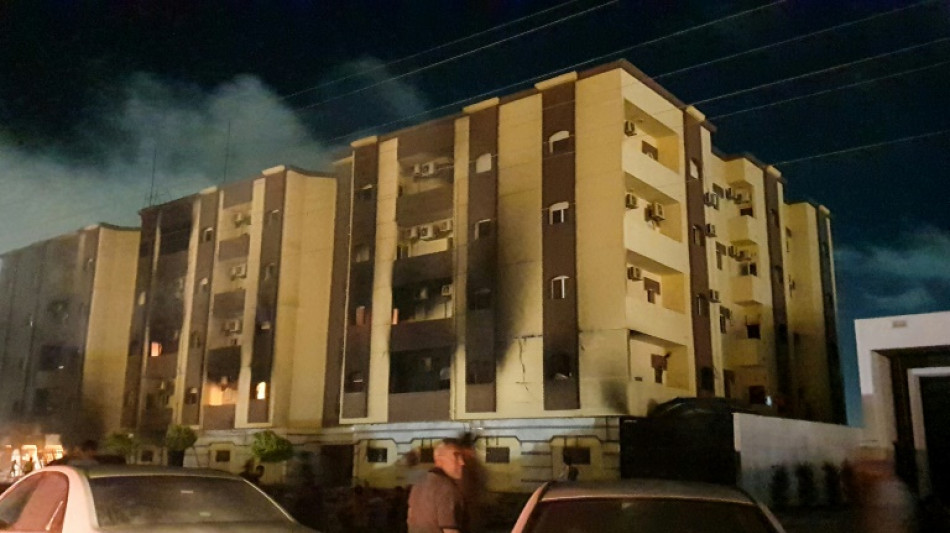
'Fragile situation' as Libya anger boils over living conditions / Photo: © AFP
Libya's rival leaders were under growing street pressure Saturday after protesters stormed parliament as anger exploded over deteriorating living conditions and political deadlock.
Libyans, many impoverished after a decade of turmoil and sweltering in the soaring summer heat, have been enduring power cuts of up to 18 hours a day, fuel shortages, and crumbling services and infrastructure, even as their country sits atop Africa's largest proven oil reserves.
Libya has been mired in chaos and repeated rounds of conflict since a NATO-backed uprising toppled and killed dictator Moamer Kadhafi in 2011.
Protesters stormed the seat of the House of Representatives in the eastern city of Tobruk on Friday night, ransacking its offices and torching part of the building.
In both the main eastern city of Benghazi -- the cradle of the 2011 uprising -- and the capital Tripoli, thousands took to the streets to chants of "We want the lights to work".
Some brandished the green flags of the former Kadhafi regime.
The UN's top Libya envoy Stephanie Williams said Saturday that "riots and acts of vandalism" were "totally unacceptable".
"It is absolutely vital that calm is maintained, responsible Libyan leadership demonstrated and restraint exercised by all," she tweeted.
UN-mediated talks in Geneva this week aimed at breaking the deadlock between rival Libyan institutions failed to resolve key differences.
- 'Extremely painful' year -
Presidential and parliamentary elections, originally set for December last year, were meant to cap a UN-led peace process following the end of the last major round of violence in 2020.
But voting never took place due to several contentious candidacies and deep disagreements over the polls' legal basis between the rival power centres in east and west.
In Tripoli on Friday, hundreds came out to demand elections, fresh political leadership and an end to the chronic power cuts.
The sudden eruption of unrest appeared to be spreading to other areas of the country, with Libyan media showing images of protesters in the oasis city of Sebha, deep in the Sahara desert, torching an official building.
Interim prime minister Abdulhamid Dbeibah leads a Tripoli-based administration while former interior minister Fathi Bashagha draws support from the Tobruk-based House of Representatives and eastern military strongman Khalifa Haftar.
"For more than a year, the overwhelming majority of diplomatic and mediation efforts around Libya have been monopolised by the idea of elections, which won't happen for at least two years, given the failure of the Geneva negotiations," Libya expert Jalel Harchaoui told AFP.
This year "has been extremely painful for Libyans" because the country "imports almost all its food and the Ukraine war has hit consumer prices", Harchaoui said, adding that the economy "should probably have been the real top priority".
- 'Fragile situation' -
Libya's energy sector, which during the Kadhafi era financed a generous welfare state, has also fallen victim to political divisions, with a wave of forced closures of oil facilities since April.
Supporters of the eastern-based administration have shut off the oil taps as leverage in their efforts to secure a transfer of power to Bashagha, whose attempt to take up office in Tripoli in May ended in a swift withdrawal.
Libya's National Oil Corporation has announced losses of more than $3.5 billion from the closures and a drop in gas output, which has a knock-on effect on the power grid.
"There is kleptocracy and systematic corruption in the east as in the west, as the fancy cars and villas of the elite constantly remind the public," Harchaoui said, accusing militias from both camps of carrying out "massive" fuel trafficking.
Recent weeks have seen repeated skirmishes between armed groups in Tripoli, prompting fears of a return to full-scale conflict.
But he urged peaceful protests, adding that "special restraint is necessary given the fragile situation".
J.Sharp--TNT