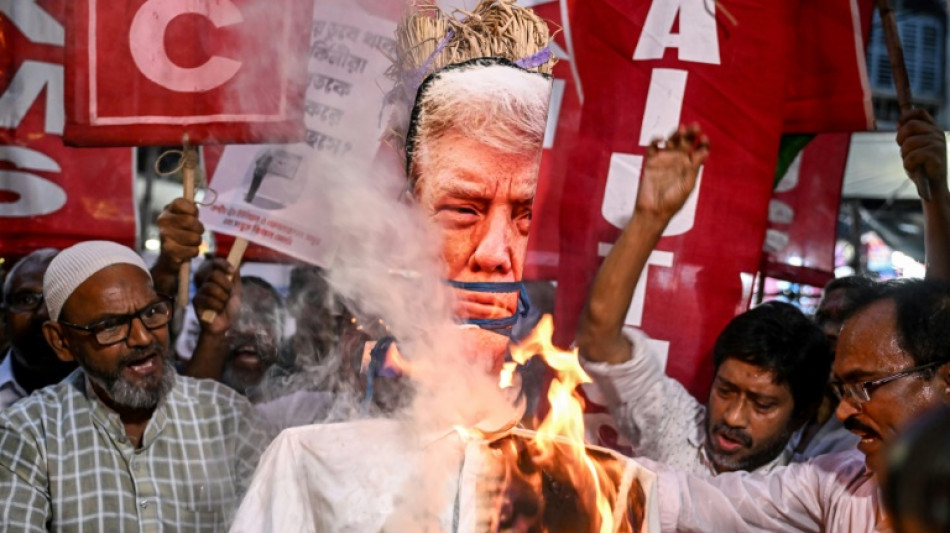
Trump thumbs nose at decades of India courtship / Photo: © AFP/File
India once united US policymakers like few issues. For nearly three decades, US presidents of both parties courted New Delhi as an emerging ally, politely overlooking disagreements for the sake of larger goals.
Donald Trump has abruptly changed that.
The US administration on Wednesday slapped 50 percent tariffs on many Indian products as Trump seeks to punish India for buying oil from Russia.
India was a Cold War partner of Moscow but since the 1990s US leaders have hoped for a joint front with fellow democracy India in the face of the rise of China, seen by Washington as its top long-term adversary.
In striking timing, Indian Prime Minister Narendra Modi heads to China this weekend, the latest meeting between the world's two most populous nations as they explore areas of common ground.
Trump has accused India of fueling Moscow's deadly attacks on Ukraine by purchasing Russian oil. Trump trade advisor Peter Navarro even called Ukraine "Modi's war" in a Bloomberg TV interview Wednesday.
Yet Trump has refrained from tougher US sanctions on Russia itself, saying he still hopes for a negotiated settlement despite wide pessimism.
"This is not just about tariffs, not just about Russia, not just about oil," said Tanvi Madan of the Brookings Institution.
"There seems to be something broader going on here -- personal on Trump's side, piqued as he may be at India," she said.
"And then on the Indian side, for Modi, it becomes a political issue."
- Faltering bromance -
Trump and Modi, both right-wing populists, appeared to forge a strong bond during Trump's first term.
In 2020, Trump rejoiced as Modi invited him to inaugurate the world's largest cricket stadium in front more than 120,000 people.
But Trump has since appeared irritated as he seeks credit for what he said was Nobel Prize-worthy diplomacy between Pakistan and India, which struck its neighbor in May in response to a massacre of Indian civilians in divided Kashmir.
India, which adamantly rejects any third-party mediation on Kashmir, has since given the cold shoulder to Trump as he muses of brokering between New Delhi and Islamabad.
Pakistan by contrast has embraced Trump's attention, with its powerful army chief meeting him at the White House.
US policymakers have long skirted around India's sensitivities on Kashmir and sought to contain fallout from disagreements on other issues.
Jake Sullivan, national security advisor under Trump's predecessor Joe Biden, said that Trump had broken a bipartisan consensus with his "massive trade offensive" against India.
India is now thinking "I guess maybe we have to go show up in Beijing and sit with the Chinese because we've got to hedge against America," Sullivan told news and opinion site The Bulwark.
Madan said that for the Indian establishment, the tariffs contradicted US assurances that unlike China, Washington would not use "economic ties to coerce India."
"If you're India, even if you sort this particular issue out, you're now saying, we used to see this increasing interaction with the US across many domains as an opportunity," she said.
"And now Trump has made us realize that we should also see that integration or dependence as a vulnerability."
- Chance for China -
For China, Modi's trip is an opportunity "to drive a wedge between India and the US," said William Yang, an analyst at the International Crisis Group.
"Beijing won't miss the opportunity to present itself as a 'reliable partner' that is interested in deepening relations with New Delhi," he said.
But he noted that India and China still had fundamental differences, despite recent efforts to resolve a longstanding border dispute.
China is the key partner and military supplier of Pakistan and has sought to ramp up influence in the Indian Ocean.
Kriti Upadhyaya, a visiting fellow at the conservative Heritage Foundation, played down long-term consequences of the tariff rift, noting how much the US-India relationship has developed in recent years.
"When you really like somebody, a friend who's close to you, you're always going to have more grievances with them," she said.
C.Bell--TNT