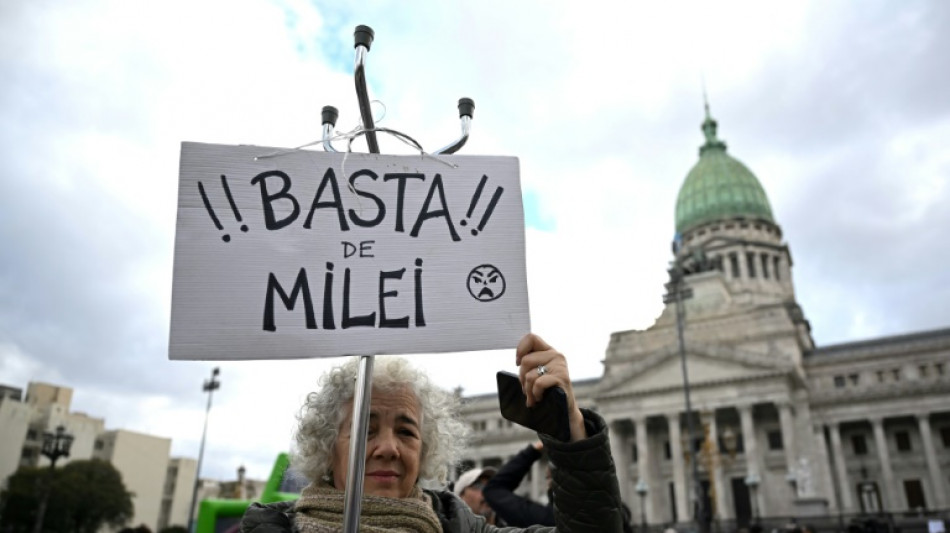
Pensioners on the frontline of Argentina's fiery politics / Photo: © AFP
It has become a tradition Argentina's capital Buenos Aires: each Wednesday, baton-wielding riot police corral or confront a band of protesters brandishing signs, shopping bags and walking frames.
For sure, these veteran "militants" are vocal. Sometimes they are even feisty.
But they are also gray-haired, wrinkled and at times struggle to keep their balance.
"For God's sake!" 87-year-old Ricardo Migliavacca shouted during a recent police advance that nearly toppled him. "How disgraceful!"
He recovered only with the help of his sturdy blue Zimmer frame.
Migliavacca is just one of hundreds of pensioners who have taken part in weekly protests against Argentina's right-wing President Javier Milei.
They want a pension increase to soften the blow of Argentina's seemingly endless price increases.
But Milei -- who at 54 is still at least a decade away from retirement age -- is not convinced.
The economically ultraliberal president has twice vetoed moves by Congress to raise pensions.
This, after all, is the politician who has brought a chainsaw on stage to demonstrate his cost-cutting zeal.
"My task is not to seem good, it is to do good," he said in a recent speech, "even if the cost is being called cruel."
During this last year of protests, his government and the police have been accused of just such cruelty.
They have used tear gas, spray, batons, rubber bullets, and water cannon to disperse the pensioners -- and the assorted groups that join them.
The government does not report figures on injuries or arrests during the protests.
But according to Amnesty International, 1,155 people were injured last year, 33 of them hit by rubber bullets in the head or face.
During one recent scuffle, blows were exchanged on the police line.
In a narrow alley, an elderly man writhed on the floor as helpers tried to pour liquid into his tear-gas-seared eyes.
A young couple in a glass-walled gym nearby ignored the scene and continued lifting weights.
- 'Gangster retiree' -
Beatriz Blanco is about to turn 82.
She arrived at one protest wearing a shirt reading "gangster retiree" -- the nickname the government gave her for allegedly assaulting police officers.
"Watch out, she's dangerous!" jokes a man as he sees her pass.
She smiles and waves her walking stick in greeting.
In March, the octogenarian was pushed by a policeman and hit her head on the pavement, leaving her lying in a pool of blood.
"I thought I was dead," she said. "Then came the anger and pain of being unable to fix anything."
Many of the pensioners have a history of activism that began as students in the 1960s, when Argentina lurched from democracy toward military dictatorship.
"I still maintain that spirit of rebellion," Migliavacca said.
But behind the activism, there is also an acute need.
Nearly half of Argentina's 7.8 million retirees receive the near-minimum US$260 a month.
That is estimated to be less than a third of the cost of basic goods needed by the elderly.
"You can't live like this. Especially not as an elderly person. People need moments of joy," Blanco told AFP.
- 'Constantly' beaten -
Since coming to power in 2023, Milei has sought to straighten out Argentina's finances, cutting red tape, curbing inflation, and winning a new IMF bailout.
But his cuts have been felt acutely across the public sector: in schools, hospitals, research centers and the social safety net.
Milei's remains relatively popular, with an approval rating of around 40 percent, but the pensioners have become one of the most prominent and emotive sources of opposition, according to political scientist Ivan Schuliaquer.
"The retirees are not showing a willingness to physically defend themselves, yet they are constantly being beaten," he told AFP.
There are worries that the harsh security response to such a vulnerable part of the population could be desensitizing Argentines to political violence.
"What this government is doing, no one has done in the democratic era, no one," warned historian Felipe Pigna.
T.Bailey--TNT