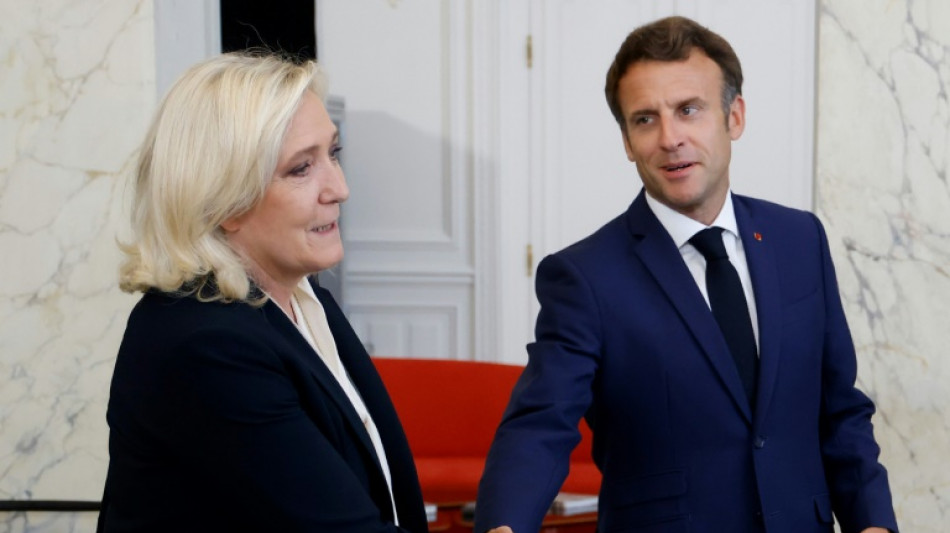
Macron seeks allies as new French parliament opens / Photo: © POOL/AFP/File
France's lower house of parliament reopens Tuesday after an election upset for President Emmanuel Macron whose centrist allies are little closer to building a stable majority, putting Prime Minister Elisabeth Borne's job potentially on the line.
After this month's ballot brought surges for the far right and hard left, opposition forces have made clear that they will not be lured into a lasting arrangement to support Macron's government which is 37 seats short of a majority.
Borne and other senior Macron backers have been trying to win over individual right-wing and moderate left parliamentarians to bolster their ranks, with one MP telling AFP that "the phones are running hot."
But Olivier Marleix, head of the conservative Republicans group seen as most compatible with Macron, said that "we have much better things to do today than selling ourselves piecemeal".
"It's about making progress for the French people," he told Europe 1 radio on Monday.
But he added that his MPs would "do everything we can to reach an agreement with the government" on an upcoming draft law to boost households' purchasing power in the face of food and energy inflation.
"It's not in the interest of parties who have just been elected" to make a long-term deal to support the government, said Marc Lazar, a professor at Paris' Institute of Political Studies (Sciences Po).
- First woman speaker -
The first days of the new National Assembly will be taken up with elections for the speaker and other senior parliamentary officials and committee chiefs.
Pro-Macron candidate Yael Braun-Pivet is expected to be the first woman in French history to claim the speaker's chair in a series of votes Tuesday.
The same day, parties with at least 15 members will be able to form official groups, which enjoy more influence and speaking time.
One key question is whether Thursday's vote to head the Finance Committee -- with its extensive powers to scrutinise government spending -- will be won by an MP from the far-right National Rally (RN).
Led by Macron's defeated presidential opponent Marine Le Pen, the RN would usually have a claim on the post as the largest single opposition party.
It could face a stiff challenge if the NUPES left alliance encompassing Greens, Communists, Socialists and the hard-left France Unbowed (LFI) can agree on a joint candidate.
- Confidence vote? -
Next week could see exchanges heat up in the chamber, as government chief Borne delivers a speech setting out her policy priorities.
It is not yet clear whether Borne will call the traditional vote of confidence following her appearance -- which is not strictly required under France's Fifth Republic constitution.
Macron told AFP at the weekend that he had "decided to confirm (his) confidence in Elisabeth Borne" and asked her to continue talks to find either allies for the government in parliament or at least backing for crucial confidence and budget votes.
Macron has ruled out both tax increases and higher public borrowing in any compromise deals with other parties.
After the president promised a "new government of action... in the first few days of July" once he returns from this week's G7 and NATO meetings in Germany and Belgium, some observers see the compressed calendar as ambitious.
"In all other European countries, when they're in talks to form a government, it can take months" rather than the days Macron has allowed, political scientist Lazar said.
Even as the government projects business almost as usual, hard-left LFI especially has vowed to try to prevent key proposals like a flagship reform to raise the legal retirement age from 62 to 65.
Party deputy chief Adrien Quatennens said Sunday there was "no possible agreement" with Macron, saying cooperation would "make no sense".
"We haven't heard (Macron) move or back down one iota on pension reform" or other controversial policies, he added.
burs-tgb/adp/pvh
R.Evans--TNT